
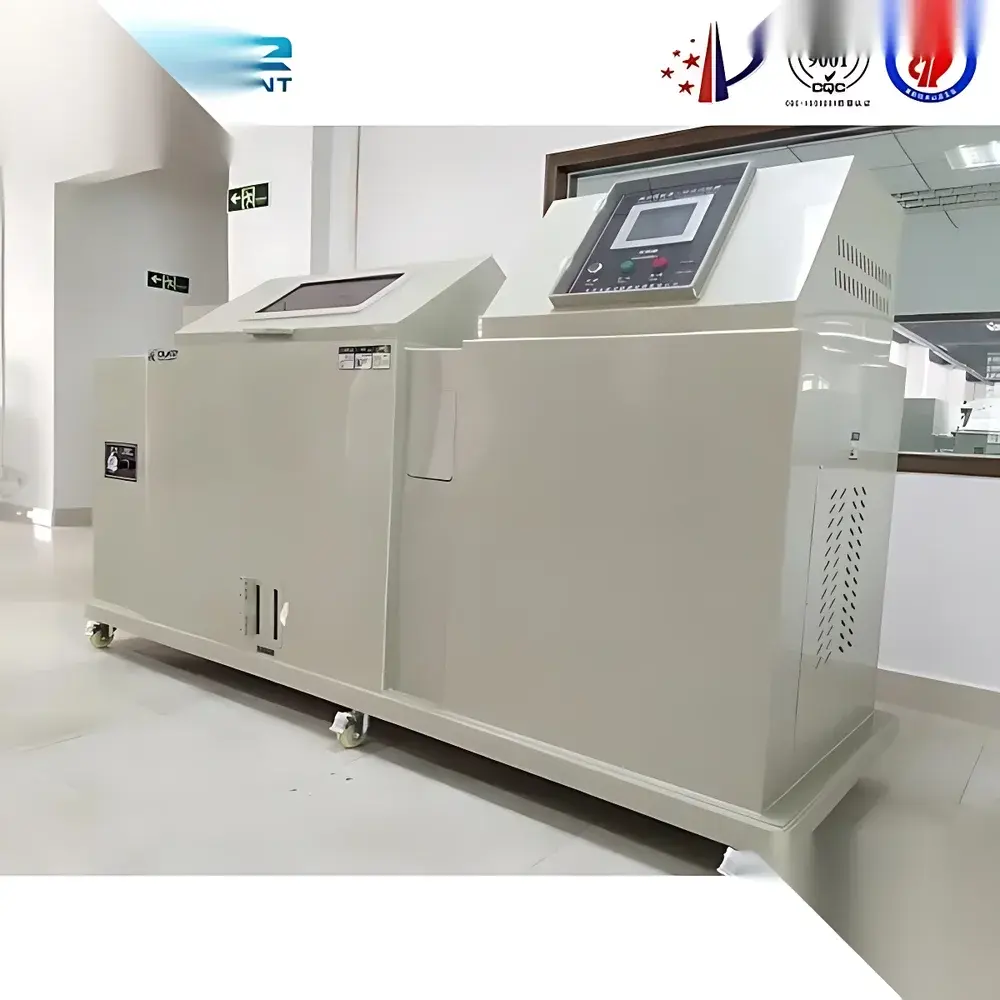
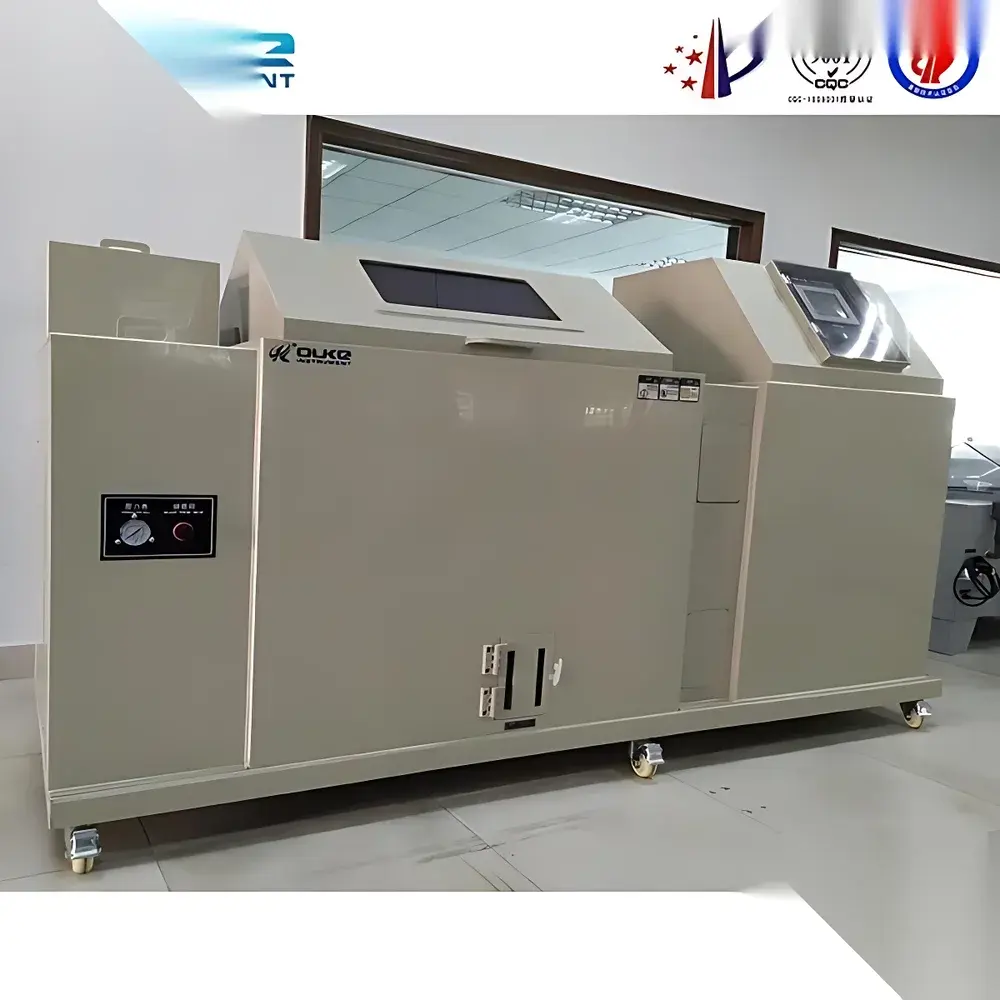
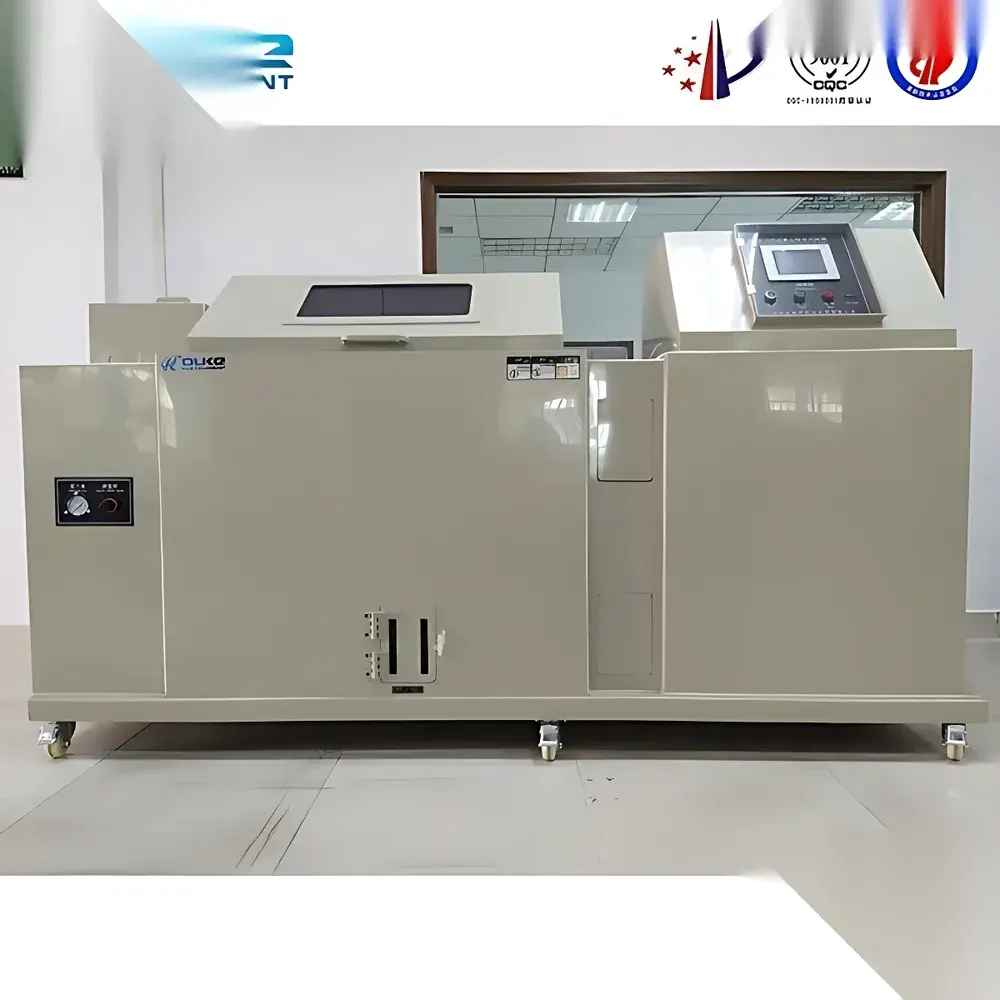
OK-FH-90 Multi-Environmental Corrosion Test Chamber (Temperature, Humidity & Salt Spray Combined)
| Brand | OEM |
|---|---|
| Origin | Imported |
| Manufacturer Type | Authorized Distributor |
| Price | USD 12,500 (FOB) |
| Chamber Internal Dimensions (D×W×H) | 900 × 600 × 500 mm |
| External Dimensions (D×W×H) | 1410 × 880 × 1280 mm |
| Heating Power | 1.3–1.8 kW |
| Temperature Range | +5°C to +55°C |
| Humidity Range | 85–95% RH |
| Temperature Uniformity | ≤ ±2°C |
| Temperature Fluctuation | ≤ ±0.5°C |
| Salt Spray Deposition Rate | 1–2 mL / 80 cm²·h |
| Spray Mode | Continuous or Cyclic Programmable |
| Timer Range | 1 sec to 999 hours, minutes, seconds |
| Heating System | U-shaped titanium alloy high-speed immersion heater |
| Temperature Controller | Intelligent PID microcomputer controller with ±0.1°C control accuracy |
| Sensor | PT100 platinum resistance thermometer |
| Viewing Window | Full-transparent impact-resistant acrylic lid with water-sealed gasket |
| Sealing | Water-trap sealing between lid and chamber body |
| Lid Actuation | Pneumatic support struts |
| Interior Lining | PVC plastic board |
| Exterior Casing | Reinforced rigid PVC sheet (UV-stabilized, corrosion-resistant) |
| Included Accessories | One SO₂ gas cylinder (standard 40L, 15 MPa rated), regulator, and delivery tubing |
Overview
The OK-FH-90 Multi-Environmental Corrosion Test Chamber is an integrated environmental stress testing system engineered for accelerated evaluation of material degradation under combined thermal, humid, and corrosive saline conditions. Unlike standalone salt spray chambers (e.g., ASTM B117-compliant units), this chamber implements synchronized control of temperature, relative humidity, and sodium chloride aerosol generation—enabling simulation of real-world coastal, industrial, or de-icing environments where electrochemical corrosion, hygroscopic swelling, and chloride-induced pitting occur synergistically. The chamber operates on the principle of controlled aerosol dispersion via compressed-air atomization, coupled with precise thermal-hygrometric regulation in a sealed, chemically inert PVC enclosure. Its architecture complies with fundamental design requirements outlined in ISO 9227 (Salt Spray Testing), IEC 60068-2-52 (Cyclic Salt Mist), and supports method development aligned with automotive OEM specifications such as GMW 14872 and Ford CETP 00.00-L-467.
Key Features
- Triple-stress capability: Simultaneous and independently programmable control of temperature (+5°C to +55°C), humidity (85–95% RH), and salt fog concentration (1–2 mL/80 cm²·h).
- Corrosion-resistant construction: Interior lined with seamless, UV-stabilized PVC plastic board; exterior casing fabricated from reinforced rigid PVC with enhanced aging and chemical resistance.
- Optical observation system: Full-transparency, impact-rated acrylic lid with integrated water-seal gasket ensures zero leakage while enabling real-time visual monitoring without interrupting test cycles.
- Pneumatic lid assist mechanism: Smooth, low-effort opening/closing with adjustable damping and fail-safe mechanical locking.
- High-fidelity thermal management: U-shaped titanium alloy immersion heaters immersed directly in the stainless-steel water bath provide rapid heating response and uniform thermal distribution (≤ ±2°C uniformity, ≤ ±0.5°C fluctuation).
- Intelligent process control: PID-based microcomputer controller with PT100 sensor feedback delivers ±0.1°C temperature setpoint accuracy and supports user-defined cyclic profiles (e.g., dry → wet → salt fog → recovery phases).
- SO₂ compatibility: Integrated gas inlet port and pressure-regulated delivery system for supplementary sulfur dioxide exposure—critical for simulating urban/industrial atmospheric corrosion per ISO 11474 and ASTM G91.
Sample Compatibility & Compliance
The OK-FH-90 accommodates test specimens up to 900 × 600 × 500 mm (W × D × H) within its working volume. It supports standardized sample racks (ASTM G85 Annex A5), non-metallic coatings (paints, plastics, elastomers), metallic substrates (steel, aluminum, zinc-coated alloys), and assembled electronic enclosures. All internal surfaces are non-reactive to NaCl, SO₂, and condensate, eliminating cross-contamination risks. The chamber meets structural and operational prerequisites for GLP-compliant laboratories and supports audit-ready documentation when paired with optional data logging modules. While not certified to UL or CE as a complete system (as supplied through authorized distributors), its subsystems—including electrical insulation, gas handling, and thermal cutoffs—conform to IEC 61000-6-2 (EMC immunity) and IEC 60529 (IPX1-level drip protection).
Software & Data Management
The embedded controller provides local parameter configuration, real-time trend display (temperature, humidity, elapsed time), and alarm logging (over-temperature, low solution level, seal failure). Optional RS485/Modbus RTU interface enables integration into centralized lab management systems (LIMS) or SCADA platforms. When connected to compliant third-party software (e.g., LabVIEW or custom Python-based DAQ), full traceability—including timestamped setpoints, measured values, and operator ID—is achievable. For regulated environments, optional 21 CFR Part 11-compliant add-ons include electronic signatures, audit trails, and role-based access control—facilitating FDA, ISO 17025, or IATF 16949 audits.
Applications
- Qualification testing of automotive exterior trim, brake calipers, and under-hood electronics per SAE J2334 and VW PV1210.
- Evaluation of marine-grade fasteners, shipboard coatings, and offshore platform components per NORSOK M-501.
- Comparative assessment of anti-corrosion pretreatments (phosphating, chromating, e-coat) in Tier-1 supplier QC labs.
- Development validation of conformal coatings for PCBs exposed to tropical maritime climates (IEC 60068-2-30, Db test).
- Accelerated aging studies for architectural cladding systems, including aluminum composite panels and stainless steel façades.
FAQ
What standards does the OK-FH-90 support out-of-the-box?
It natively satisfies the equipment requirements of ISO 9227, ASTM B117, and IEC 60068-2-52 for salt spray and cyclic corrosion testing. Custom profiles can be programmed to emulate GMW 14872, Ford CETP 00.00-L-467, and VDA 621-415.
Is the SO₂ gas delivery system calibrated and certified?
The included 40L SO₂ cylinder and regulator meet ISO 8573-1 Class 2 purity requirements. Calibration certificates for flow control are available upon request; users must perform periodic verification using traceable mass flow meters.
Can the chamber operate unattended for extended durations?
Yes—the timer supports up to 999 hours, and safety interlocks (dry-run protection, overheat cutoff, lid-open shutdown) ensure safe autonomous operation. Remote monitoring requires optional communication hardware.
What maintenance is required for long-term reliability?
Daily: Check salt solution level and nozzle cleanliness. Weekly: Inspect water seal integrity and purge air lines. Quarterly: Replace pH-adjusted salt solution, verify PT100 calibration against reference thermometer, and inspect titanium heater surface for scale buildup.
Does the chamber support humidity control during salt spray phase?
Yes—unlike basic salt fog cabinets, the OK-FH-90 maintains active humidity regulation (85–95% RH) concurrently with spray generation, replicating high-humidity coastal fog environments where corrosion kinetics accelerate significantly.



