




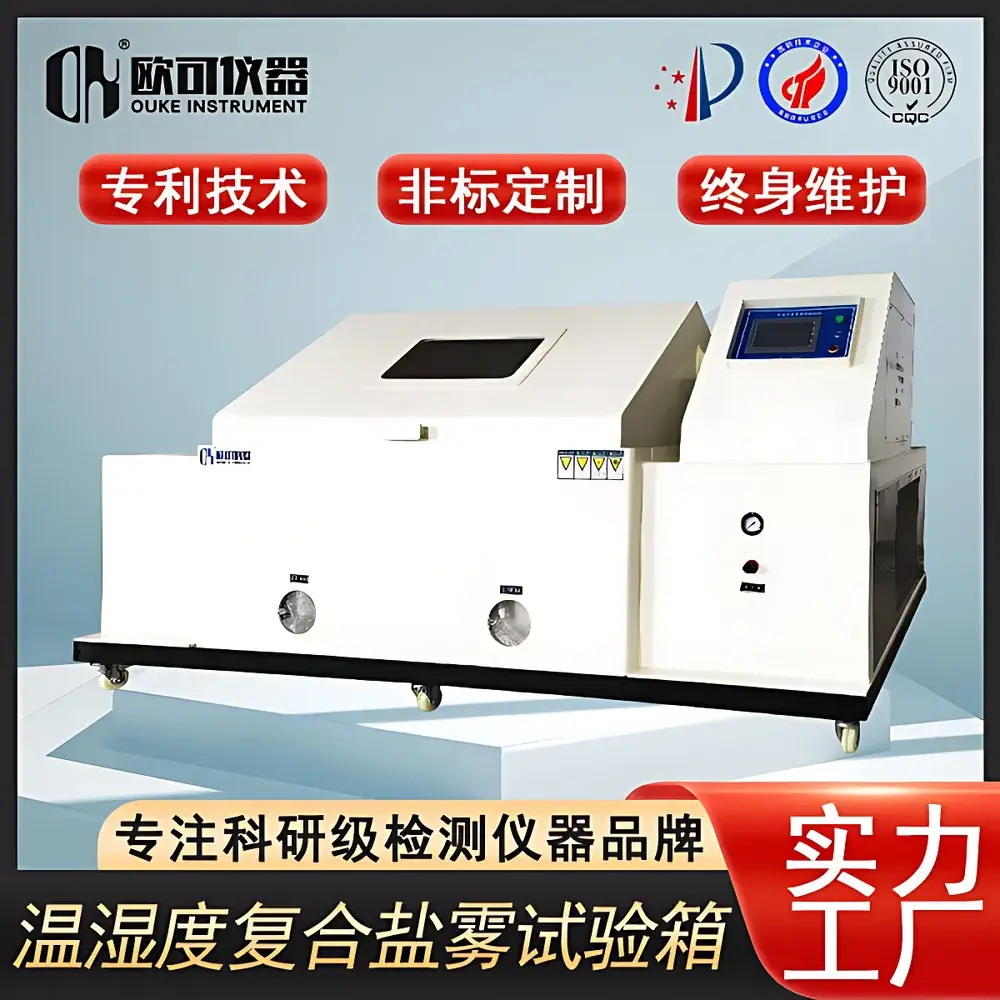
OK-FH-91 Tri-Environmental Corrosion Test Chamber (Temperature, Humidity & Salt Spray)
| Brand | OK Instruments |
|---|---|
| Origin | Guangdong, China |
| Manufacturer Type | Direct Manufacturer |
| Model | OK-FH-91 |
| Spray Mode | Continuous Atomization |
| Spray Rate | 1–2 mL / 80 cm²·hr |
| Nozzle Pressure | 0.7–1.0 kg/cm² |
| Fog Removal Method | Air-Pressure Exhaust |
| Salt Fog Deposition Rate | ~1.0–2.0 mL/80 cm²·hr (ASTM B117-compliant range) |
| Temperature Range | Configurable Options — A: 0°C to +80°C |
| B | −20°C to +80°C |
| C | −40°C to +80°C |
| Humidity Range | 20–98% RH (at applicable temperature bands) |
| Compliance | ASTM B117, ASTM G85 Annex A5 (CCT-I), ISO 9227, IEC 60068-2-11 & -52, GMW 14872, SAE J2334 |
Overview
The OK-FH-91 Tri-Environmental Corrosion Test Chamber is an integrated, programmable environmental stress screening system engineered to simultaneously or sequentially apply three critical stress domains—controlled temperature, regulated humidity, and neutral salt fog—within a single test enclosure. Unlike conventional salt spray cabinets or standalone climate chambers, the OK-FH-91 implements true multi-stress coupling based on the principles of cyclic corrosion testing (CCT), enabling accelerated simulation of real-world coastal, industrial, and de-icing salt exposure environments. Its operational foundation lies in precise thermodynamic control (via dual-stage refrigeration, PID-controlled heating, and steam/humidification/dehumidification subsystems), coupled with a corrosion-resistant atomization system that delivers uniform, metrologically traceable NaCl aerosol deposition. The chamber is designed for high-fidelity replication of standardized CCT profiles—including salt fog → drying → high-humidity storage → low-temperature conditioning cycles—where inter-phase transition integrity, residue mitigation, and cross-contamination prevention are rigorously maintained.
Key Features
- Triple-stress integration architecture supporting concurrent or sequential application of temperature (−40°C to +80°C), relative humidity (20–98% RH), and neutral salt fog (pH 6.5–7.2, 5 wt% NaCl).
- Corrosion-resilient construction: inner chamber fabricated from PP (polypropylene) and titanium-reinforced stainless steel (SUS316L); gaskets and seals rated for continuous salt fog exposure and thermal cycling.
- High-precision salt fog generation system featuring calibrated ceramic nozzles, compressed air filtration (≤0.01 µm particulate removal), and automatic salt solution replenishment with conductivity monitoring.
- Active fog removal mechanism using positive-pressure air purge and dedicated exhaust condensation traps—ensuring complete residual salt aerosol clearance prior to humidity or temperature transitions.
- Intelligent controller with ≥100-step programmable sequence capability, real-time logging, and cycle synchronization logic to prevent phase overlap or uncontrolled environmental carryover.
- Integrated safety interlocks including over-temperature cutoff, low-level salt solution alarm, chamber door open detection, and corrosion sensor diagnostics.
Sample Compatibility & Compliance
The OK-FH-91 accommodates test specimens up to 900 mm × 600 mm × 600 mm (W×D×H), with adjustable sample racks and non-metallic support fixtures to avoid galvanic interference. It supports standardized specimen orientation per ASTM B117 and ISO 9227 requirements. The chamber meets functional equivalence to key international standards for cyclic corrosion testing—including ASTM G85 Annex A5 (CCT-I), GMW 14872 (General Motors), SAE J2334, Volvo VCS 1027,149, and Ford CETP 00.00-L-467—when operated within validated parameter envelopes. All internal sensors (Pt100 temperature, capacitive RH, fog deposition collectors) are traceably calibrated and compliant with ISO/IEC 17025 laboratory practice guidelines. System validation documentation (IQ/OQ/PQ templates) and audit-ready data logs support GLP/GMP and IATF 16949-aligned quality systems.
Software & Data Management
The embedded Windows-based control interface provides intuitive graphical programming of multi-phase CCT sequences, with drag-and-drop step definition, conditional branching (e.g., “if RH > 95%, hold for 4 hr”), and real-time environmental overlay visualization. All operational parameters—including chamber setpoints, actual readings, spray status, and fault codes—are timestamped and stored locally (≥12 months retention) with optional Ethernet/IP or Modbus TCP export. Data export formats include CSV, PDF test reports, and XML-compatible structured logs. Optional software modules enable FDA 21 CFR Part 11 compliance via electronic signatures, audit trail logging, and user role-based access control (RBAC). Remote monitoring and alarm notification (email/SMS) are supported via configurable network protocols.
Applications
The OK-FH-91 is deployed across industries requiring rigorous electrochemical durability assessment: automotive OEMs and Tier-1 suppliers use it for evaluating chassis components, battery enclosures, connectors, and painted body panels per GMW 14872; aerospace manufacturers assess fasteners, avionics housings, and composite surface treatments under simulated maritime deployment conditions; marine equipment producers validate corrosion resistance of navigation hardware, winch mechanisms, and underwater sensor assemblies; and electronics manufacturers apply it to outdoor-rated power supplies, photovoltaic junction boxes, and 5G base station enclosures per IEC 60068-2-52. It is also employed in R&D labs for comparative coating evaluation (e.g., zinc-nickel vs. trivalent chromium passivation), failure mode analysis of solder joints under chloride-induced electrochemical migration, and qualification of conformal coatings for harsh-environment PCBs.
FAQ
What distinguishes the OK-FH-91 from a standard salt spray cabinet?
Unlike single-stress salt fog chambers (e.g., ASTM B117-only units), the OK-FH-91 integrates full temperature-humidity control with precisely timed salt fog phases, enabling true cyclic corrosion testing (CCT) with automated transitions between salt, dry, and humid conditions.
Can the OK-FH-91 perform GMW 14872 testing?
Yes—when configured with the −40°C to +80°C temperature option (Model C) and operated with validated spray deposition rates, dwell times, and transition protocols, the OK-FH-91 meets all functional requirements of GMW 14872 Cycle D.
How is cross-contamination between salt fog and humidity phases prevented?
Through a multi-stage purge protocol: post-spray air pressure evacuation, heated chamber wall drying (>60°C), and condensate trap isolation—verified by in-situ conductivity monitoring of exhaust effluent.
Are calibration certificates and validation support provided?
Yes—factory calibration certificates for all primary sensors are included; IQ/OQ documentation packages and third-party PQ support services are available upon request.
What maintenance intervals are recommended for long-term reliability?
Salt solution tank cleaning every 72 operating hours; nozzle inspection and ultrasonic cleaning weekly; full refrigeration system service and humidity sensor recalibration every 6 months—per manufacturer’s Maintenance Protocol MP-OKFH91 Rev. 3.



