
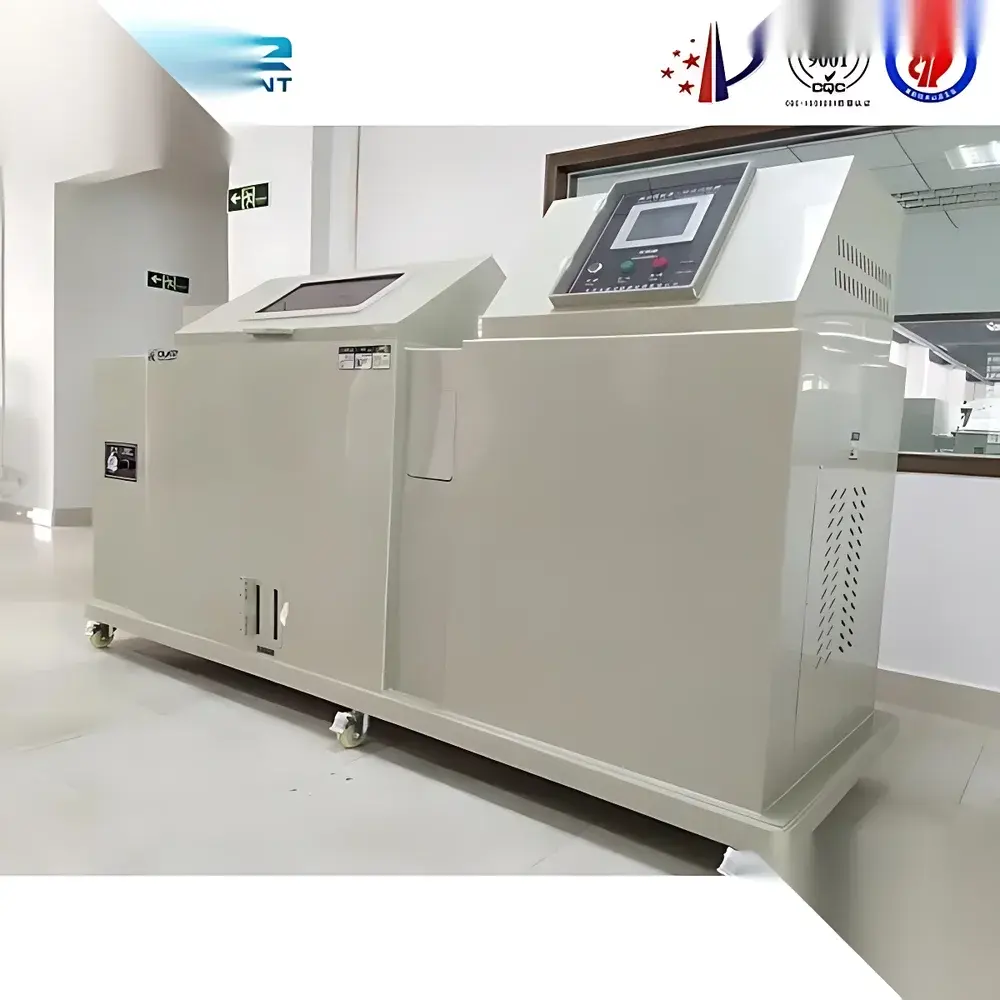
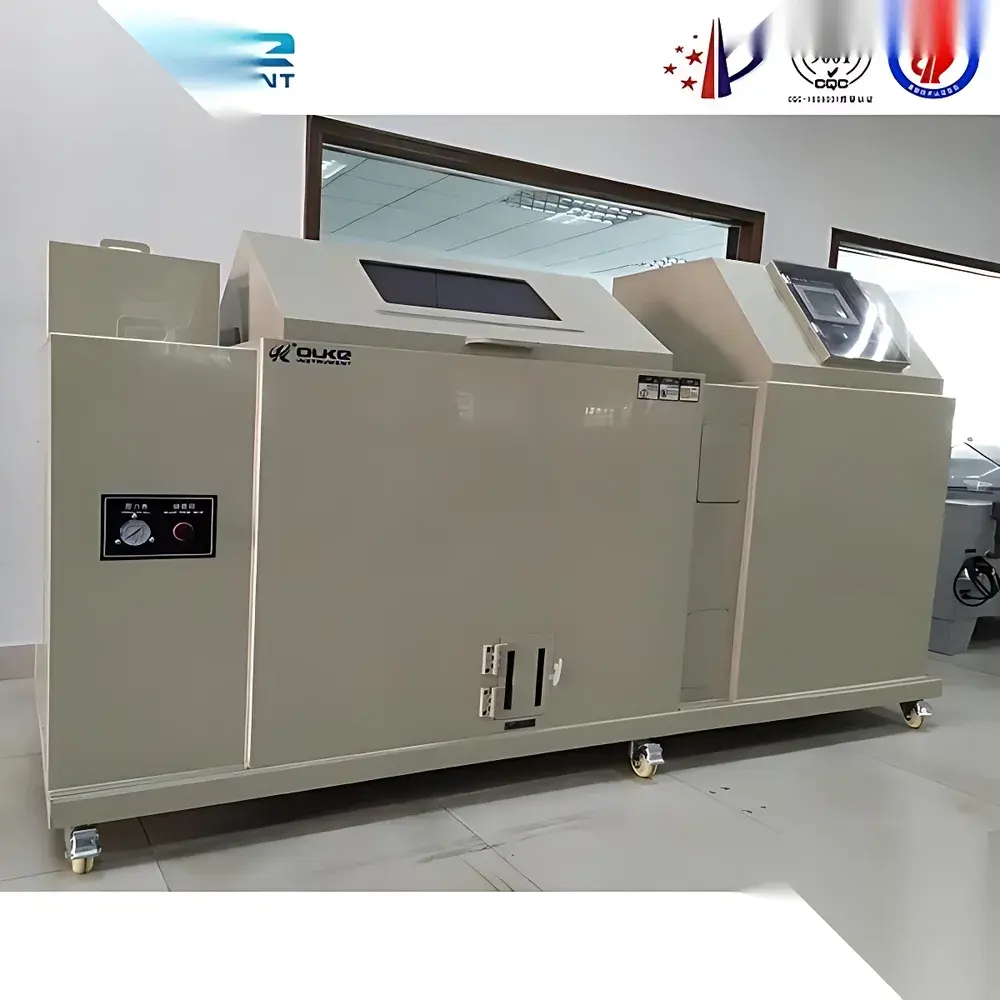
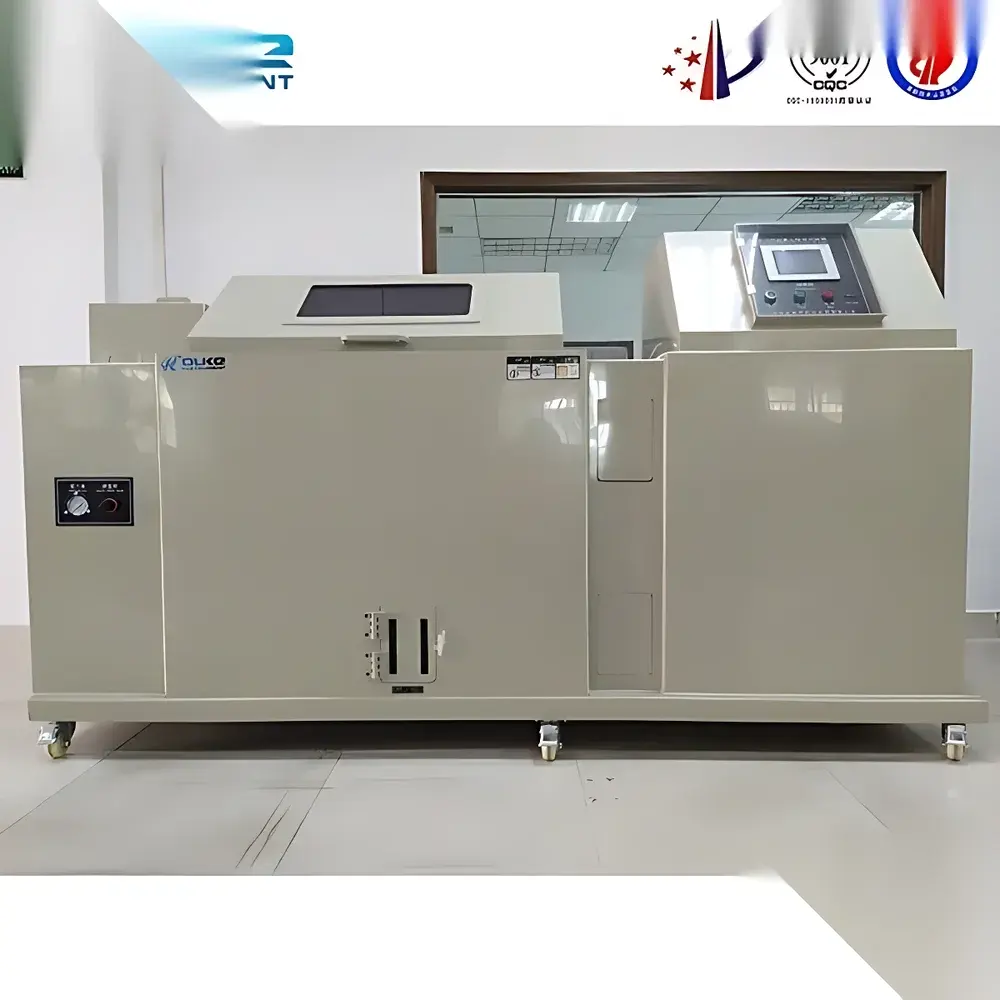
OK-FH Series Combined Salt Fog, Dry, and Humid Environmental Test Chamber
| Brand | Other Brands |
|---|---|
| Origin | Imported |
| Manufacturer Type | Authorized Distributor |
| Temperature Range | RT+10°C to 60°C ±1°C |
| Temperature Uniformity | ±1.0°C |
| Temperature Fluctuation | ±1.0°C |
| Salt Spray Deposition Rate | 1–2 mL/80 cm²·h |
| Salt Solution Temperature | RT+10°C to 60°C ±1°C |
| Salt Concentration | 5.0 ±0.5% (w/w) NaCl |
| Humidity Range | 30–98% RH (adjustable) |
| Chamber Internal Dimensions (W×D×H) | 2000 × 1000 × 500 mm |
| Chamber External Dimensions (W×D×H) | 2400 × 1400 × 1000 mm |
| Test Specimen Tilt Angles | 15° and 30° (standard), ≥50 specimens accommodated at 30° |
| Construction Materials | 8 mm HCPVC inner chamber & lid |
| Air Supply | External compressed air source required (not included) |
| Operation Mode | Continuous or cyclic |
Overview
The OK-FH Series Combined Salt Fog, Dry, and Humid Environmental Test Chamber is an engineered platform for accelerated corrosion testing under dynamically controlled multi-stress conditions—specifically simulating synergistic exposure to salt aerosol, elevated temperature, and variable relative humidity. Designed in accordance with ISO 9227, ASTM B117, ASTM G85 Annex A5 (Prohesion), and JIS Z2371, this chamber enables standardized evaluation of coating integrity, metallic substrate resistance, and electrochemical degradation mechanisms across automotive, aerospace, marine, and electronics industries. Its tri-modal environmental control architecture allows precise sequencing of salt fog (via free-fall deposition), dry-off, and high-humidity conditioning phases—mimicking real-world coastal, industrial, or cyclic atmospheric service environments. The chamber operates without internal air compression; external oil-free compressed air (4–6 bar, filtered to ≤5 µm) is supplied via dedicated inlet ports to generate stable, reproducible salt mist.
Key Features
- Triple-environment simulation capability: independent programmable control of salt fog generation, thermal dry cycles, and humidification phases within a single test cycle.
- Corrosion-resistant construction: 8 mm high-temperature HCPVC inner chamber and lid ensure long-term chemical inertness against acidic NaCl solutions and chloride-laden vapors.
- Structurally reinforced enclosure: PVC-clad outer shell with internal SUS#304 stainless steel framework provides mechanical stability, load-bearing capacity, and thermal insulation integrity.
- Precision saturation system: 3 mm SUS#304 saturated air chamber equipped with integrated water level sensor and auto-refill interface to maintain consistent air preheating and humidity saturation.
- Titanium-sheathed heating elements: chemically inert, non-leaching, and highly durable for uniform chamber temperature distribution without metal ion contamination.
- High-efficiency airflow management: Japan Oriental Motor multi-wing centrifugal blower delivers laminar, low-turbulence air circulation—critical for uniform salt deposition and thermal homogeneity (±1.0°C).
- Modular specimen mounting: adjustable-angle racks support 15° and 30° inclination; 30° configuration accommodates ≥50 standard 100 × 70 mm test panels per cycle.
- External air supply interface: compatible with ISO 8573-1 Class 2 compressed air systems (oil-free, particle-filtered, dew point controlled).
Sample Compatibility & Compliance
The OK-FH chamber accepts flat or moderately contoured metallic, coated, or plated specimens up to 2000 mm in length. It supports standard test coupons (e.g., ASTM G101 reference panels), electronic housings, fasteners, weld joints, and automotive trim components. All operational parameters—including salt concentration (5.0 ±0.5% NaCl), deposition rate (1–2 mL/80 cm²·h), and humidity ramp profiles—are traceable to NIST-traceable calibration standards. The system complies with GLP documentation requirements and supports audit-ready operation logs when integrated with optional data acquisition modules. It meets essential safety provisions of IEC 61000-6-2 (EMC immunity) and IEC 61000-6-4 (EMC emissions), and its material selection conforms to RoHS Directive 2011/65/EU.
Software & Data Management
While the base model features analog/manual control, optional digital controllers provide programmable cycle sequencing, real-time parameter logging (temperature, humidity, elapsed time), and USB/RS-485 export of timestamped datasets. Controller firmware supports user-defined multi-step profiles (e.g., 2 h salt fog → 1 h dry → 4 h humid → repeat), with password-protected parameter locking for QA/QC environments. Data files comply with ASTM E2915 and ISO/IEC 17025 reporting conventions and are compatible with LIMS integration. Optional audit trail modules record operator ID, parameter changes, and alarm events—fully compliant with FDA 21 CFR Part 11 requirements for electronic records and signatures when validated.
Applications
This chamber is routinely deployed for: accelerated corrosion screening of zinc-nickel plating on chassis components; validation of anti-corrosion pretreatments for aluminum die-cast housings; comparative lifetime assessment of powder-coated vs. e-coated steel brackets; qualification testing of printed circuit board conformal coatings under mixed-flowing-salt/humidity stress; and verification of sealant adhesion performance on marine-grade stainless assemblies. It serves as a core tool in supplier qualification programs aligned with Ford WERS, GM GMW14872, and Volkswagen PV1210 specifications.
FAQ
Does the chamber include an integrated air compressor?
No. An external oil-free compressed air source meeting ISO 8573-1 Class 2 specifications (≤5 µm particles, dew point ≤−40°C) must be provided.
What calibration documentation is supplied?
Factory calibration certificates for temperature sensors (traceable to NIST) and salt solution conductivity meters are included. Third-party ISO/IEC 17025 calibration services are available upon request.
Can humidity be maintained during salt fog application?
Yes. The chamber’s dual-control architecture permits simultaneous regulation of RH and salt deposition—enabling Prohesion-type cyclic testing per ASTM G85 Annex A5.
Is the chamber suitable for testing non-metallic materials?
Yes. HCPVC construction and titanium heaters prevent cross-contamination; it is widely used for evaluating polymer gaskets, elastomeric seals, and fiber-reinforced composites under chloride-rich humid conditions.
What maintenance intervals are recommended?
Daily: rinse spray nozzles and inspect water levels. Weekly: clean HCPVC chamber walls with deionized water. Quarterly: verify saturation chamber seal integrity and calibrate temperature/humidity sensors.



