
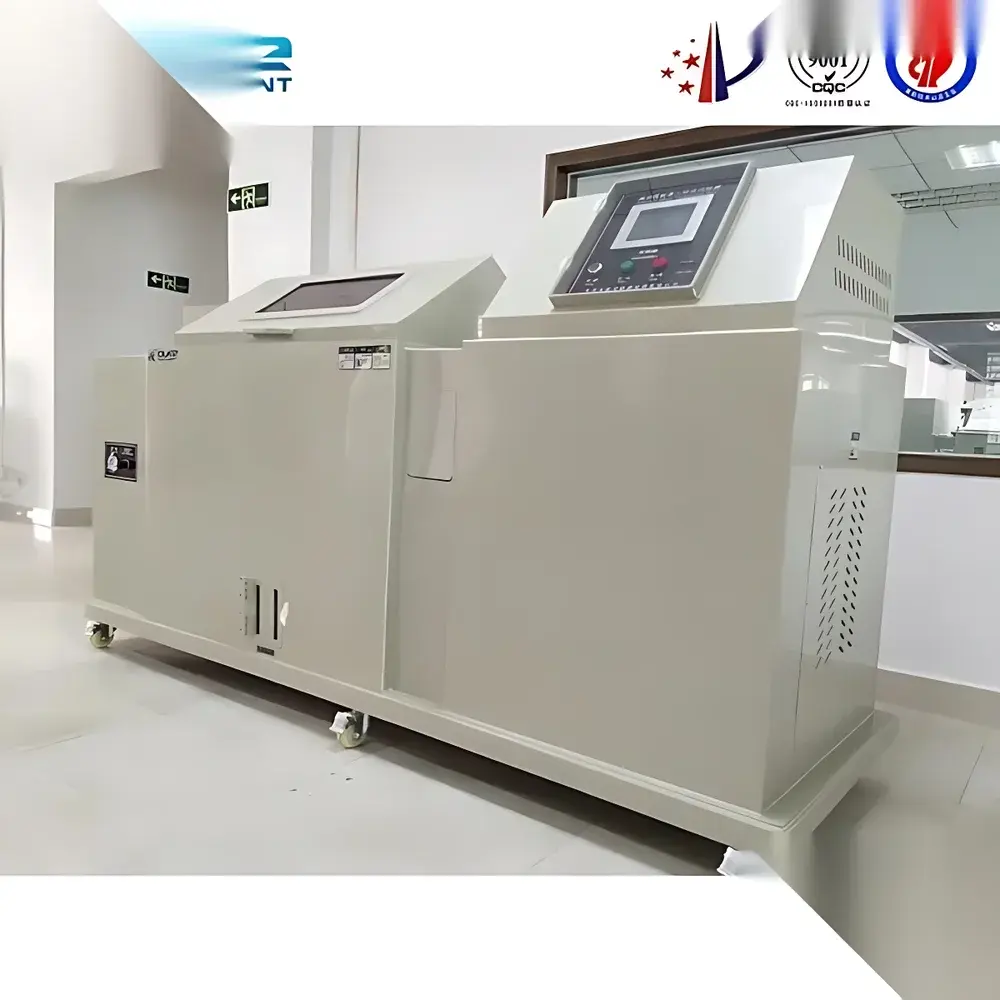
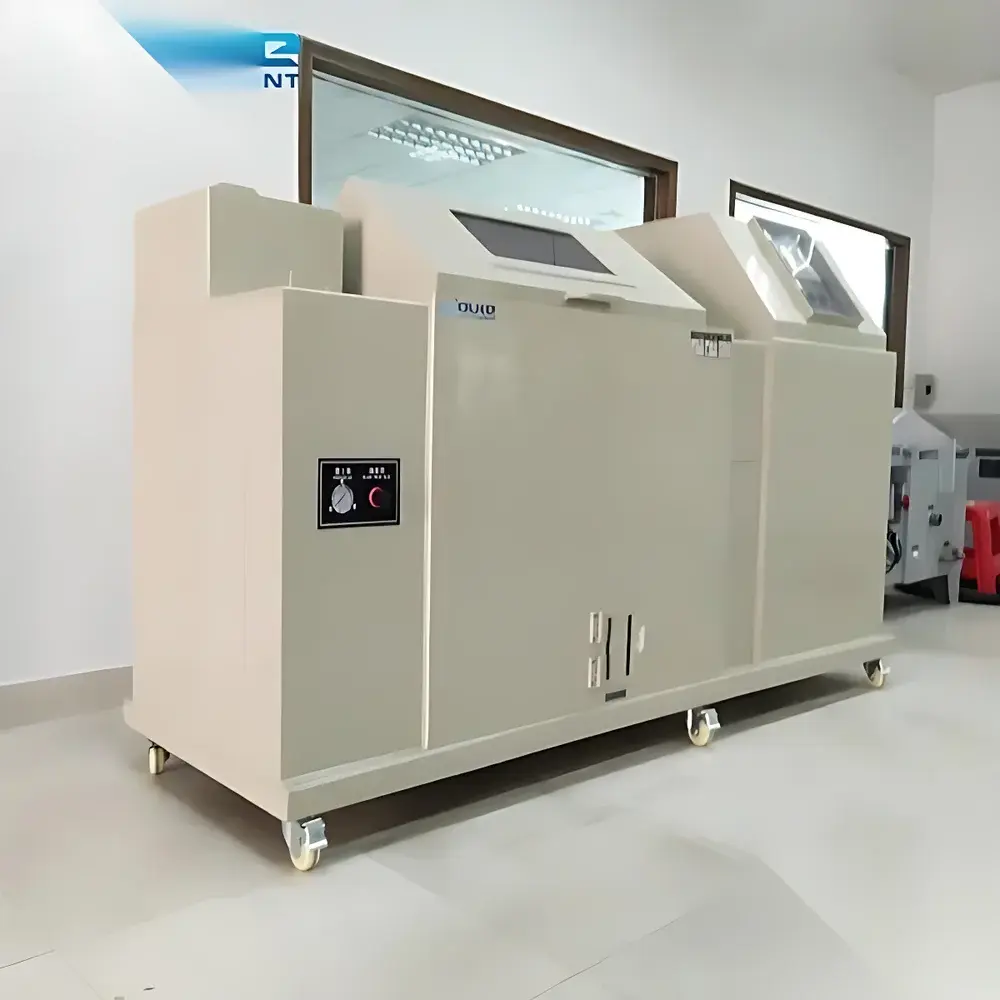
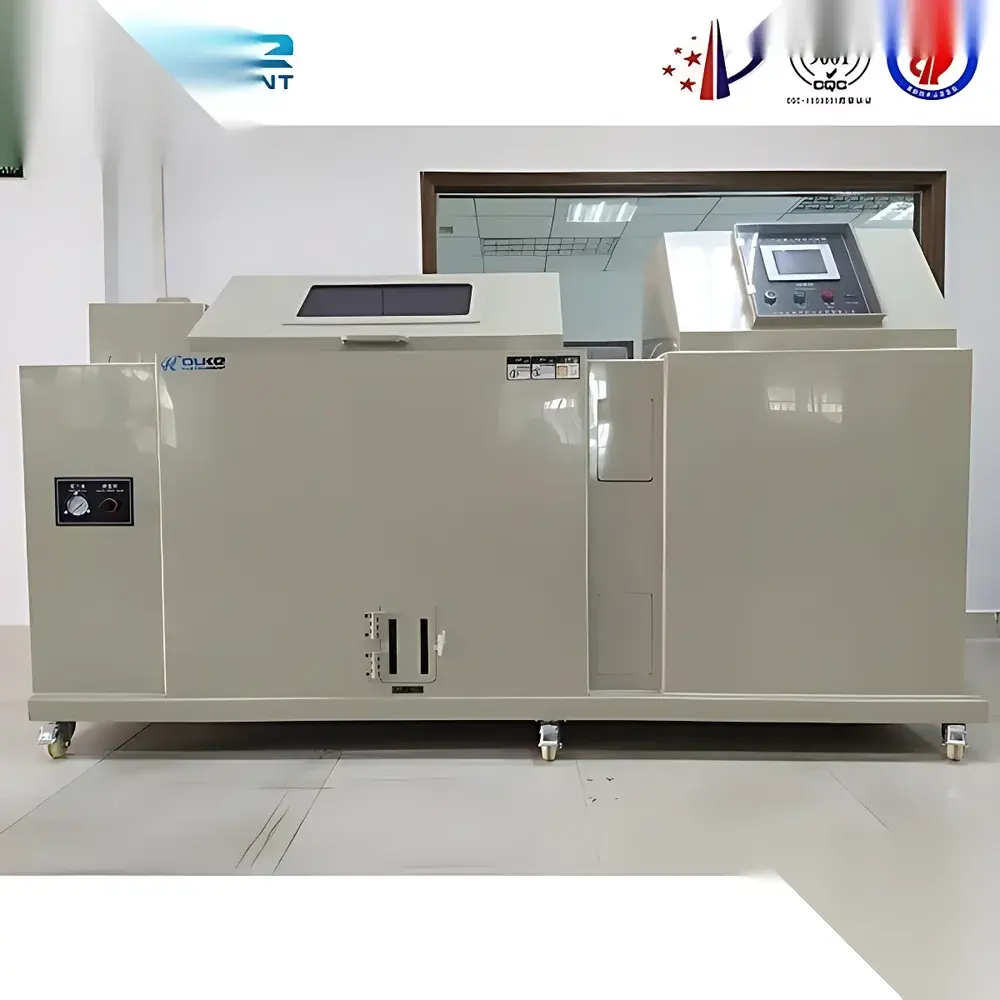
OK-FH Series Multi-Function Composite Salt Spray Test Chamber
| Brand | OEM / Custom Brand |
|---|---|
| Origin | Imported |
| Manufacturer Type | Authorized Distributor |
| Price | USD 12,500 (FOB) |
| Compliance Standards | ASTM B117, ISO 9227, IEC 60068-2-11, JIS Z 2371, GB/T 2423.17 |
| Chamber Capacities (L) | 108 |
| Internal Dimensions (W×D×H, cm) | 60×45×40 |
| External Dimensions (W×H×D, cm) | 110×60×118 |
| Temperature Range | 35°C ± 1°C (salt fog), 15–60°C (dry/humidity cycles) |
| Humidity Control | 30–98% RH (optional) |
| Spray Nozzle Pressure | 0.8–1.2 bar (dual-stage pressure regulation) |
| Salt Solution Concentration | 5.0 ± 0.1% NaCl (by weight) |
| Saturation Tank Material | 3 mm SUS#304 stainless steel |
| Chamber Lining | 8 mm heat-resistant HC-PVC |
| Heating Element | Titanium alloy immersion heater |
| Circulation Fan | Oriental Motor multi-wing centrifugal blower |
| Corrosion-Resistant Pump | Ebara or ITT series |
| Control Interface | LCD with RS232 communication |
| Safety Protections | Low water level, overtemperature, motor overload, spray blockage detection |
Overview
The OK-FH Series Multi-Function Composite Salt Spray Test Chamber is an engineered environmental simulation system designed to replicate aggressive corrosive conditions found in marine, industrial, and coastal atmospheres. It operates on the principle of continuous or cyclic salt fog exposure—based on standardized electrochemical corrosion acceleration—enabling quantitative assessment of protective coating integrity, surface treatment efficacy, and base material resistance across metallic, coated, and composite substrates. Unlike basic static salt spray chambers, the OK-FH platform integrates programmable dry, humidity, and salt fog phases in accordance with ASTM B117, ISO 9227, and IEC 60068-2-11 protocols, supporting both neutral salt spray (NSS), acetic acid salt spray (AASS), and copper-accelerated acetic acid salt spray (CASS) test modes. Its robust architecture ensures long-term operational stability under sustained chloride-laden environments, making it suitable for QC laboratories, R&D centers, and third-party testing facilities requiring GLP-compliant reproducibility.
Key Features
- Integrated dual-phase environmental control: independent heating, humidification, and forced-air drying circuits ensure precise transition between salt fog, wet, and dry cycles without cross-contamination.
- Saturated air conditioning system: compressed air passes through a SUS#304 stainless steel saturation tower maintained at 47°C ± 1°C, minimizing nozzle clogging and guaranteeing uniform droplet size distribution (median diameter ≈ 1–2 µm) and consistent deposition rate (1.0–2.0 mL/80 cm²/h).
- Titanium alloy heating elements and HC-PVC chamber lining (8 mm thickness) provide exceptional resistance to chloride-induced pitting and stress corrosion cracking—even during extended 1,000-hour tests.
- Programmable logic controller with LCD interface supports up to 99 segments per cycle, user-defined ramp rates, start-time scheduling, and real-time parameter logging (temperature, humidity, elapsed time, fault status).
- Dual-stage air pressure regulation (SMC solenoid valves) maintains stable spray pressure (0.8–1.2 bar) regardless of inlet fluctuations, ensuring repeatable test severity across batches.
- Conical spray disperser with adjustable orientation directs mist flow to minimize wall impingement and enhance spatial uniformity—validated per ISO 9227 Annex B for ±15% deposition variance across test zone.
Sample Compatibility & Compliance
The chamber accommodates flat panels, fasteners, electronic enclosures, automotive components, and coated metal specimens up to 160 × 100 × 50 cm (OK-FH-160 model). Adjustable 15° and 30° sample racks support ≥50 standard 75 × 150 mm test coupons per cycle while maintaining prescribed orientation per ASTM B117 Section 7. All internal wetted surfaces comply with ISO 14644-1 Class 8 cleanroom compatibility requirements for low particulate shedding. The system meets CE marking directives (2014/30/EU EMC, 2014/35/EU LVD), and its firmware architecture supports audit-ready data traceability for FDA 21 CFR Part 11–aligned validation when paired with optional Ethernet-enabled data acquisition modules.
Software & Data Management
Standard configuration includes RS232 serial interface for direct connection to laboratory PCs running Windows-based monitoring software (provided). This software enables remote parameter setting, real-time graphing of chamber temperature/humidity profiles, automatic CSV export of timestamped event logs (e.g., “spray start”, “dry phase initiated”, “low-water alarm”), and PDF report generation compliant with ISO/IEC 17025 documentation requirements. Optional upgrade paths include MODBUS TCP integration for SCADA systems and cloud-based fleet monitoring via secure TLS 1.2–encrypted MQTT protocol.
Applications
- Validation of electrophoretic, powder-coated, and galvanized finishes on structural steel and aluminum alloys.
- Accelerated corrosion screening of printed circuit board conformal coatings (e.g., acrylic, silicone, urethane) per IPC-CC-830B.
- Qualification of aerospace fasteners per SAE AMS 2700 and MIL-STD-810H Method 509.6.
- Comparative evaluation of anti-corrosion inhibitors in lubricants and greases under cyclic condensation conditions.
- Regulatory pre-certification testing for medical device housings (ISO 10993-15) and outdoor LED lighting enclosures (IEC 60598-1 Annex Q).
FAQ
What standards does the OK-FH chamber fully support out-of-the-box?
ASTM B117 (neutral salt spray), ISO 9227 (NSS/AASS/CASS), IEC 60068-2-11, JIS Z 2371, and GB/T 2423.17—with hardware-level compliance verified by third-party calibration reports traceable to NIST.
Can the chamber perform humidity-only or dry-only cycles independently?
Yes. Each environmental subsystem (heating, humidification, air circulation, spray generation) operates independently under PLC control, enabling custom multi-step profiles including humidity soak, dry storage, and intermittent fogging.
Is the controller capable of generating 21 CFR Part 11–compliant electronic records?
The base unit provides timestamped event logs; full Part 11 compliance requires optional audit trail module with user authentication, electronic signatures, and immutable log archiving—configured per client’s SOPs.
What maintenance intervals are recommended for long-term reliability?
Saturation tank descaling every 150 operational hours, nozzle inspection weekly, PVC gasket replacement biannually, and full system calibration annually using NIST-traceable thermistors and hygrometers.
Does the chamber include built-in safety interlocks for unattended operation?
Yes: redundant low-water cutoff, overtemperature shutdown (dual thermocouple verification), motor overload protection, and spray-line pressure loss detection—all triggering audible/visual alarms and automatic system halt.



