
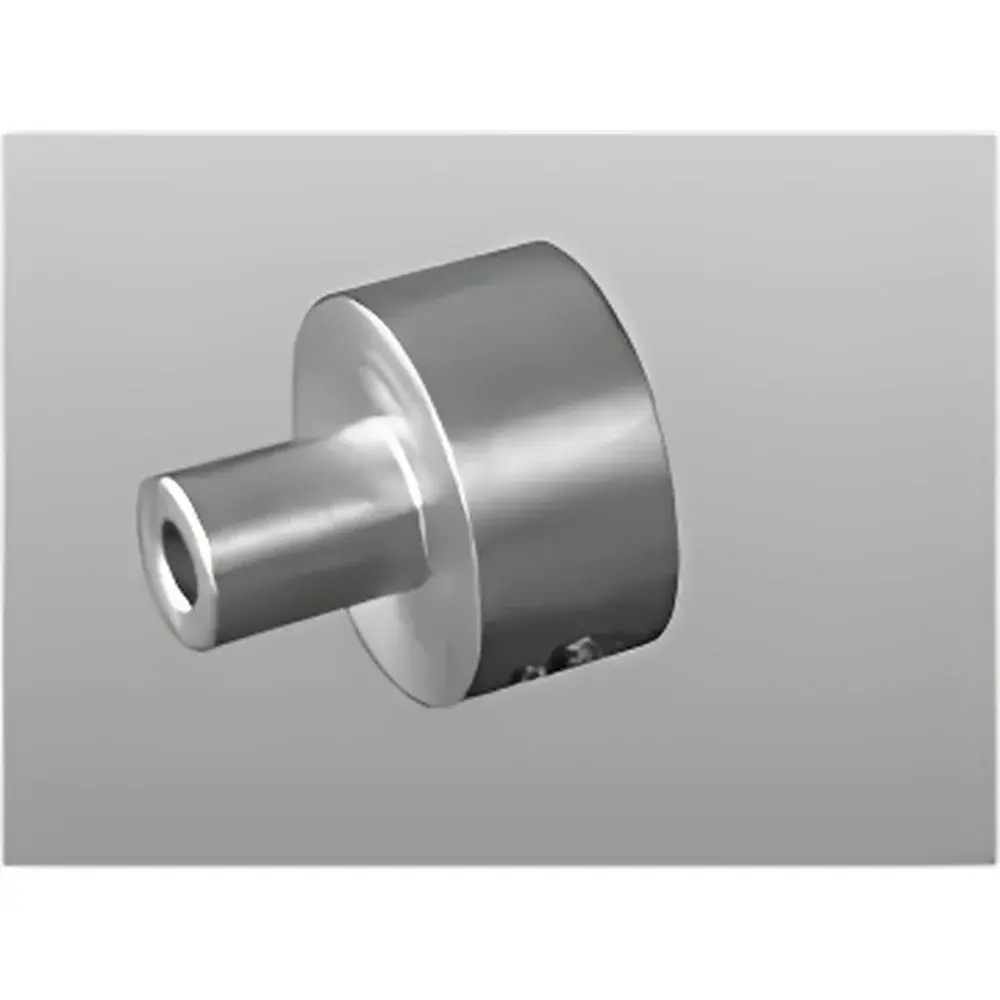
Fiber Optic Clamp Head APFCH-2 by ZOLIX
| Brand | ZOLIX |
|---|---|
| Origin | Beijing, China |
| Manufacturer Type | Direct Manufacturer |
| Product Origin | Domestic (China) |
| Model | APFCH-2 |
| Pricing | Available Upon Request |
| Clamping Method | Rigid Mechanical Grip |
| Compatible Fiber Diameter Range | 0.2–1.5 mm |
| Mounting Interface | Designed for APFC Series Fiber Couplers and APFP-FC Mounting Base |
Overview
The APFCH-2 Fiber Optic Clamp Head is a precision mechanical alignment component engineered for stable, non-damaging fixation of bare or jacketed optical fibers in free-space optical coupling systems. Developed by ZOLIX (Beijing Zolix Instruments Co., Ltd.), this clamp head operates on a rigid, spring-loaded mechanical gripping principle—eliminating reliance on adhesives, thermal contraction, or threaded compression that may induce micro-bending loss or coating deformation. Its design prioritizes axial stability and lateral rigidity during active alignment procedures, making it suitable for integration into manual or motorized translation stages used in fiber-to-fiber, fiber-to-lens, or fiber-to-waveguide coupling setups. The APFCH-2 is not a standalone measurement instrument but a critical mechanical interface element within optical laboratory infrastructure—ensuring repeatable positioning accuracy under low-vibration conditions typical of interferometric, spectroscopic, or quantum optics experiments.
Key Features
- Rigid clamping mechanism with calibrated actuation force—optimized to secure fibers from 0.2 mm to 1.5 mm outer diameter without inducing stress-induced attenuation or cladding deformation.
- Integrated kinematic interface compatible with the APFC-series fiber couplers and the APFP-FC mounting base, enabling rapid assembly and modular reconfiguration of optical paths.
- Machined from high-strength anodized aluminum alloy—providing dimensional stability across ambient temperature fluctuations (15–30 °C) and resistance to oxidation in standard lab environments.
- Zero-slip grip geometry with parallel jaw alignment—minimizing angular deviation (< ±0.1°) during longitudinal translation, essential for maintaining mode field overlap in single-mode coupling applications.
- No-tool installation and release—lever-actuated clamping allows for sub-second fiber insertion/removal while preserving positional repeatability after repeated cycles.
Sample Compatibility & Compliance
The APFCH-2 accommodates standard telecom-grade silica fibers (SMF-28, HI1060), multimode fibers (OM1–OM5), polarization-maintaining fibers (PANDA, Bow-tie), and specialty fibers including hollow-core photonic crystal fibers (HC-PCF) with polymer or acrylate coatings. It is not intended for use with metal-coated, hermetically sealed, or high-temperature fibers (>85 °C continuous operation). While the device itself carries no CE, UKCA, or FDA certification—as it is a passive mechanical component—it conforms to general mechanical safety requirements outlined in ISO 14122-3:2016 (safety of machinery – permanent means of access) when integrated into stage-mounted optical platforms. Its material composition complies with RoHS Directive 2011/65/EU restrictions on hazardous substances.
Software & Data Management
As a purely mechanical component, the APFCH-2 does not incorporate embedded electronics, sensors, or firmware. It requires no driver installation, calibration software, or data logging interface. However, its dimensional compatibility enables seamless integration with third-party motion control ecosystems—including Thorlabs Kinesis, Newport APT, or PI GCS-based controllers—when mounted on compatible translation stages (e.g., ZOLIX AP series or equivalent XYZ stages with M4 or 8-32 UNC tapped holes). Positional metadata generated during automated alignment routines (e.g., coupling efficiency vs. lateral offset) is recorded externally via host software; the clamp head contributes no intrinsic uncertainty to such datasets beyond its specified mechanical repeatability (±1.2 µm translational hysteresis per manufacturer test report).
Applications
- Fiber pigtailing of laser diodes, photodetectors, and modulators in R&D photonics labs.
- Active alignment in free-space fiber collimator assembly lines compliant with Telcordia GR-1312-CORE specifications.
- Stabilized input/output coupling for optical frequency combs, cavity ring-down spectrometers, and ultrafast amplifier chains.
- Modular beam routing in university teaching labs—supporting student experiments in Gaussian beam propagation, interference visibility, and polarization analysis.
- Integration into OEM optical engines where compact footprint (< 25 mm × 18 mm × 12 mm), low mass (< 18 g), and ESD-safe handling are required.
FAQ
Is the APFCH-2 compatible with SMF-28e+ fibers with 250 µm coating?
Yes—the 0.2–1.5 mm clamping range fully covers standard 250 µm coated single-mode fibers, including tight-buffered variants.
Can it be used in vacuum environments?
No—its anodized aluminum housing and elastomer-free actuation are not rated for UHV or HV conditions; outgassing characteristics have not been characterized per ASTM E595.
Does ZOLIX provide torque specifications for the mounting screws?
Yes—recommended tightening torque is 0.35 N·m for M3 stainless steel screws; over-torquing may compromise stage flatness or cause thread stripping.
What is the maximum allowable lateral load during translation?
When mounted on a ZOLIX APF-100 linear stage, the APFCH-2 maintains integrity up to 2.5 N lateral force; exceeding this may affect long-term jaw parallelism.
Is there a version with metric-threaded mounting holes?
The standard APFCH-2 features 8-32 UNC threads; custom M3 or M4 variants are available upon OEM request with minimum order quantity.




