
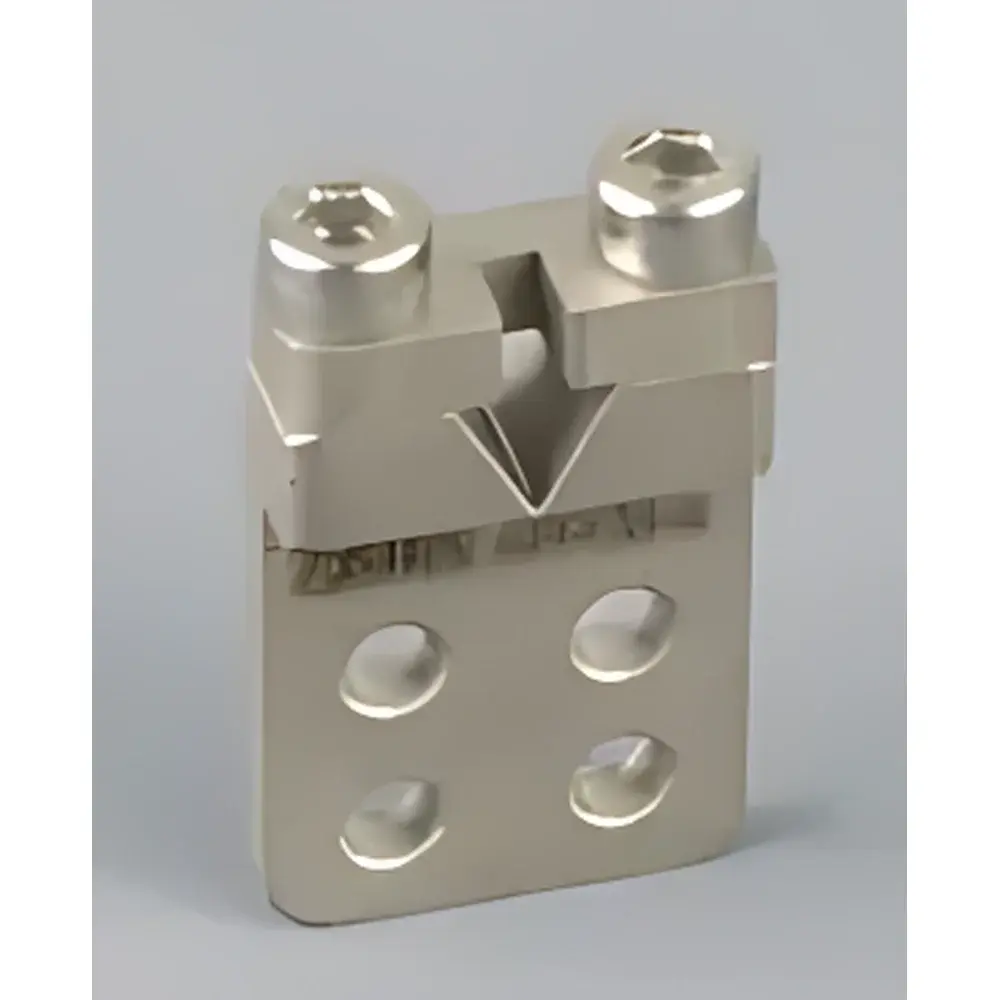
Fiber Optic Clamp Head APFCH-3 by ZOLIX
| Brand | ZOLIX |
|---|---|
| Model | APFCH-3 |
| Origin | Beijing, China |
| Manufacturer Type | Direct Manufacturer |
| Country of Origin | China |
| Compatible Base Plate | BP-16 |
| Compatible Tilting Mount | TSMT5-2 Two-Axis Tilt Stage |
| Fiber Diameter Compatibility | 80–125 µm (standard SMF/PMF), with optional adapters for 250 µm buffered and 900 µm jacketed fibers |
| Mounting Interface | M4 threaded holes (center-to-center spacing: 25.4 mm) |
| Material | 6061-T6 aluminum alloy, black anodized |
| Max. Clamping Force | ≤ 2.5 N (adjustable via precision knurled screw) |
| Repeatability | ±1.5 µm axial positioning after repeated clamp cycles |
Overview
The APFCH-3 Fiber Optic Clamp Head is a precision mechanical interface component engineered for stable, repeatable, and non-damaging fixation of optical fibers in free-space alignment systems. Designed and manufactured in Beijing by ZOLIX—a vertically integrated Chinese OEM specializing in optomechanical instrumentation—the APFCH-3 operates on a spring-assisted, screw-actuated clamping principle to secure bare or coated fiber strands without inducing microbending loss or coating deformation. Its kinematic design ensures minimal lateral shift (< 2 µm) during clamping/unclamping cycles, preserving alignment integrity in interferometric, coupling, and beam-steering configurations. The device is intended for integration into modular optical breadboard environments where sub-microradian angular stability and micron-level translational repeatability are critical—particularly in quantum optics setups, fiber-to-chip coupling stations, and polarization-sensitive interferometry.
Key Features
- Adjustable clamping force via calibrated knurled M3.5 screw, enabling optimization for both fragile single-mode fibers (125 µm cladding) and robust 900 µm jacketed cables
- Integrated alignment reference surfaces: top surface flatness ≤ λ/10 @ 633 nm; side datum faces perpendicular within 15 arcsec
- Standard M4 mounting pattern (25.4 mm center-to-center) compatible with ISO-standard optical posts and translation stages
- Black anodized 6061-T6 aluminum housing providing EMI shielding, thermal stability (CTE: 23.6 × 10⁻⁶ /°C), and corrosion resistance
- No-tool fiber loading: fiber insertion path features chamfered entry (30°) and self-centering V-groove geometry
- Designed for zero-slippage retention under static loads up to 5 N and vibrational environments compliant with IEC 60068-2-6 (10–500 Hz, 2 g RMS)
Sample Compatibility & Compliance
The APFCH-3 accommodates standard telecom-grade fibers including SMF-28, HI1060, PM1550, and polarization-maintaining Panda-type fibers (80–125 µm outer diameter). With optional adapter inserts (sold separately), it supports 250 µm acrylate-coated and 900 µm tight-buffered variants. All contact surfaces are free of sharp edges or burrs per ISO 1101 geometric tolerancing standards. The unit complies with RoHS Directive 2011/65/EU and meets CE marking requirements for mechanical equipment (2006/42/EC). While not certified for medical or aerospace applications, its dimensional traceability follows ISO/IEC 17025-accredited internal calibration protocols at ZOLIX’s Beijing facility.
Software & Data Management
As a passive optomechanical component, the APFCH-3 requires no firmware, drivers, or software integration. However, it is fully interoperable with industry-standard motion control ecosystems—including Thorlabs Kinesis®, Newport APT™, and Zaber T-CA series—when mounted on motorized translation or tilt stages (e.g., TSMT5-2). Alignment verification data generated using external tools (e.g., beam profilers, power meters, or polarization analyzers) can be logged in accordance with GLP-compliant lab notebooks or LIMS platforms. No embedded memory or audit trail functionality is present, consistent with ISO/IEC 17025 Clause 6.4.10 for non-automated instrumentation.
Applications
- Fiber collimator alignment in free-space laser delivery systems
- Polarization-dependent loss (PDL) characterization setups requiring fixed-fiber angular registration
- Integration into automated fiber array positioning stages for photonic integrated circuit (PIC) testing
- Multi-axis alignment of fiber-coupled detectors in Raman spectroscopy and OCT systems
- Stable anchoring point for fiber Bragg grating (FBG) strain sensors during calibration
- Teaching laboratories for hands-on instruction in fiber optics, waveguide coupling, and alignment metrology
FAQ
Is the APFCH-3 compatible with non-ZOLIX base plates?
Yes—its standardized M4 hole pattern (25.4 mm pitch) conforms to ANSI/ISO 8015 and is mechanically interchangeable with base plates from Thorlabs, Newport, Standa, and other vendors supporting 1-inch optical rail or breadboard mounting.
Can the clamp accommodate angled physical contact (APC) connectorized fibers?
No—the APFCH-3 secures bare or coated fiber sections upstream of connectors. APC polishing must be performed prior to clamping; the device does not interface with connector ferrules.
What is the maximum allowable bending radius when clamped?
ZOLIX specifies a minimum bend radius of 30 mm for 125 µm fibers under full clamping torque to avoid attenuation increase > 0.05 dB/km at 1550 nm.
Does ZOLIX provide calibration certificates for individual units?
Calibration documentation (dimensional inspection report per ASME Y14.5) is available upon request at time of order; traceable length measurements are performed using Mitutoyo SJ-410 profilometers validated per ISO 17025.





