
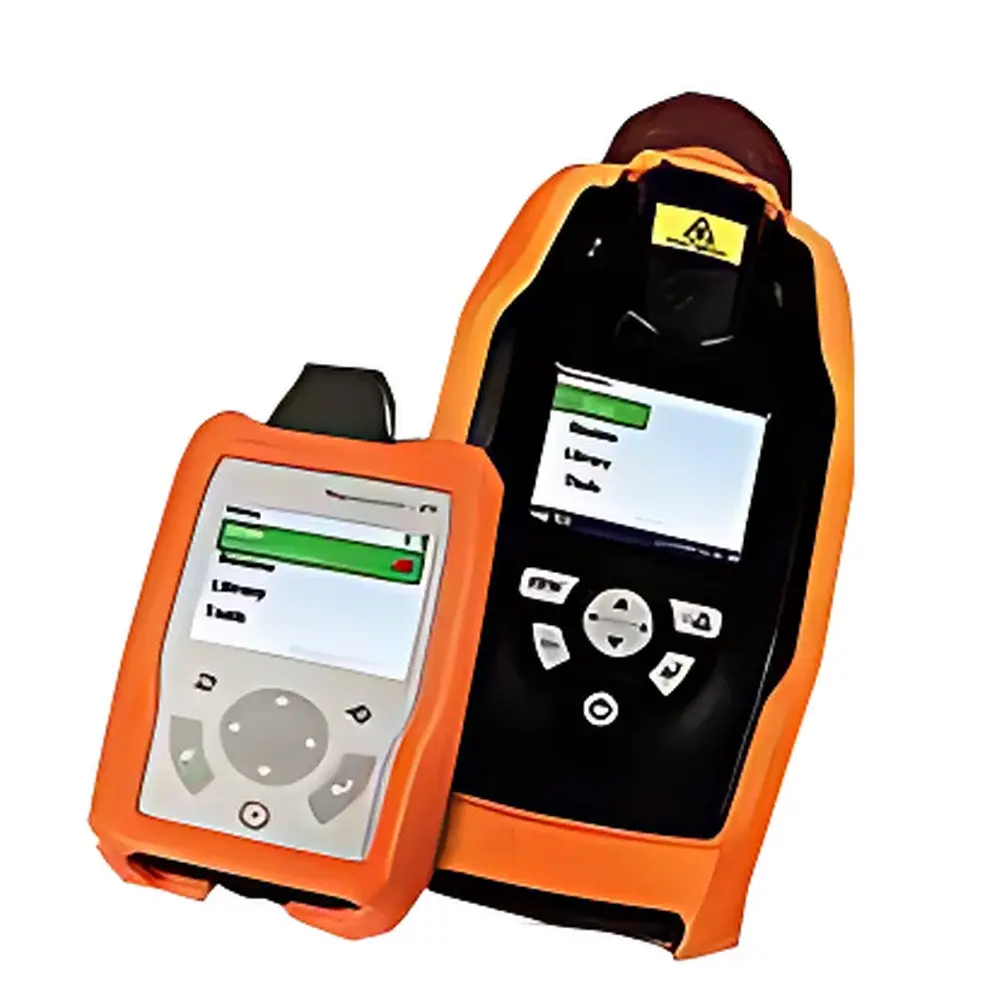
FirstDefender Raman Spectrometer – Handheld Unknown Chemical Identification System
| [Origin | USA |
|---|---|
| Manufacturer Type | Authorized Distributor |
| Origin Category | Imported |
| Model | FirstDefender |
| Price | USD 63,500 (FOB) |
| Raman Shift Range | 250–2875 cm⁻¹ |
| Spectral Resolution | 7–10.5 cm⁻¹ (FWHM) |
| Excitation Wavelength | 785 nm ± 0.5 nm, linewidth ≤2 cm⁻¹, wavenumber accuracy <0.1 cm⁻¹ |
| Laser Output Power | ≤300 mW (adjustable) |
| Integration Time | Manual or auto mode (min. 100 ms) |
| Battery | 7.4 V Li-ion, >5 h operation at 25 °C |
| AC Input | 100–240 VAC, 50/60 Hz |
| Weight | <1.8 kg |
| Dimensions | 30 × 15 × 7.6 cm |
| Operating Temperature | −20 °C to +40 °C |
| Compliance | MIL-STD-810F (shock, vibration, humidity, thermal cycling)] |
Overview
The FirstDefender Raman Spectrometer is a field-deployable, fiber-optic-coupled handheld instrument engineered for rapid, non-destructive identification of unknown solid and liquid chemical substances in real-world operational environments. Based on confocal dispersive Raman spectroscopy, it delivers molecular fingerprinting by measuring inelastic scattering of monochromatic 785 nm laser light—enabling unambiguous discrimination of compounds with structurally distinct vibrational modes. Unlike conventional screening methods (e.g., immunoassays or ion mobility), the FirstDefender provides definitive identification without consumables or reagents, preserving sample integrity and eliminating cross-contamination risk. Its optical architecture is optimized for low-fluorescence interference and high signal-to-noise ratio across the full 250–2875 cm⁻¹ Raman shift range—critical for detecting explosives precursors (e.g., ammonium nitrate, urea nitrate), toxic industrial chemicals (TICs), chemical warfare agents (CWAs), narcotics (e.g., fentanyl analogues, cocaine HCl), and white powder threats. Designed for first-response decision-making, it operates independently of laboratory infrastructure and requires no routine recalibration.
Key Features
- Real-time spectral acquisition and library matching: Identifies pure compounds and multi-component mixtures in ≤5 seconds using embedded chemometric algorithms (e.g., correlation-based matching, multivariate curve resolution).
- Ruggedized field design: Certified to MIL-STD-810F for shock, drop, dust, rain, and thermal extremes (−20 °C to +40 °C); cold-start ready in <60 s.
- Dual sampling modalities: “Point-and-shoot” direct surface analysis or non-invasive through-container detection (glass, PET, HDPE)—eliminating operator exposure and sample handling.
- Self-contained power system: Hot-swappable 7.4 V Li-ion battery supports >5 hours continuous operation; AC adapter included for benchtop use.
- Intuitive touchscreen interface: Graphical workflow guides users through acquisition, library search, and result validation—requiring minimal formal training.
- Maintenance-free optics: Sealed, alignment-free fiber-optic probe with no moving parts; no periodic wavelength calibration needed under normal use conditions.
- Non-destructive analysis: Samples remain physically and chemically unchanged post-measurement—essential for evidentiary chain-of-custody and forensic reanalysis.
Sample Compatibility & Compliance
The FirstDefender accommodates heterogeneous sample forms—including crystalline powders, gels, liquids, pastes, and residues—without preparation. Its 785 nm excitation minimizes fluorescence from organic matrices while maintaining sufficient photon energy for robust Raman scattering. The system complies with international standards governing field-portable analytical instrumentation: ASTM E2592-22 (Standard Guide for Raman Spectroscopy in Forensic Applications), ISO/IEC 17025:2017 (for method validation in accredited labs), and U.S. Department of Defense Test Method Standard MIL-STD-810F (environmental engineering considerations). While not FDA 21 CFR Part 11–compliant out-of-the-box (as it lacks audit-trail logging), raw spectral data export (in .spc and .csv formats) supports integration into validated LIMS or ELN platforms meeting GLP/GMP requirements.
Software & Data Management
Built-in software includes a curated, updatable spectral library containing >12,000 reference spectra—covering explosives (TNT, PETN, RDX, ANFO), TICs (chlorine, phosgene, hydrogen cyanide), CWAs (sarin, VX, mustard gas), pharmaceuticals, and illicit drugs. Library updates are delivered via secure USB or network connection. Spectra are stored with metadata (time/date, GPS coordinates if enabled, operator ID, confidence score). Raw data exports support third-party chemometric tools (e.g., MATLAB, Unscrambler X) for advanced mixture deconvolution or custom model development. No cloud dependency: all processing occurs locally on the device’s ARM-based processor—ensuring data sovereignty and operational security in classified or offline scenarios.
Applications
- Explosives Threat Mitigation: Detects homemade explosive precursors (e.g., ammonium nitrate/fuel oil blends, triacetone triperoxide (TATP)) in bulk containers, suspicious packages, or vehicle-borne IED components—where canine units or trace detectors lack specificity.
- Hazardous Materials Response: Enables immediate on-scene identification during chemical spills, illegal dumpsite investigations, or industrial accident response—reducing reliance on off-site GC-MS confirmation.
- Law Enforcement & Forensics: Validates suspected narcotics, adulterants, or counterfeit pharmaceuticals at checkpoints, border crossings, or crime scenes—supporting probable cause determinations per U.S. Federal Rules of Evidence 702.
- Pharmaceutical Quality Control: Verifies raw material identity (e.g., active pharmaceutical ingredients vs. excipients) during receiving inspection—aligning with ICH Q5A(R2) and USP guidelines for spectroscopic identification.
- Customs & Border Protection: Screens consignments for undeclared hazardous cargo, dual-use chemicals, or controlled substances without unpacking—accelerating clearance while maintaining regulatory compliance.
FAQ
Does the FirstDefender require annual calibration?
No. The instrument employs a fixed-grating monochromator and thermally stabilized laser diode; spectral calibration is factory-performed and remains stable over its operational lifetime under MIL-STD-810F environmental stressors.
Can it identify mixtures containing more than two components?
Yes. Its proprietary mixture analysis engine uses constrained non-negative matrix factorization (CNMF) to resolve ≥3 co-present analytes—validated against NIST SRM 2243 (explosive mixtures) and EPA Method 8270D-relevant TIC blends.
Is the laser Class 3B compliant for safe field use?
Yes. The 785 nm source meets IEC 60825-1:2014 Class 3B requirements; integrated safety interlocks disable emission when the probe tip is not in contact or when ambient light exceeds threshold levels.
What spectral file formats does it support for export?
Spectra export as ASCII (.csv), Galactic (.spc), and JCAMP-DX (.jdx)—ensuring interoperability with commercial chemometrics software and institutional data repositories.
How is data security managed during wireless transfer?
The device supports optional Wi-Fi 5 (802.11ac) with WPA2-Enterprise authentication; all exported files are AES-256 encrypted at rest and in transit when paired with enterprise-grade MDM policies.





