Firstmark MHR Series Miniature LVDT Displacement Sensor
| Brand | — |
|---|---|
| Origin | Germany |
| Manufacturer Type | Authorized Distributor |
| Origin Category | Imported |
| Model | LVDT MHR Series |
| Pricing | Upon Request |
Overview
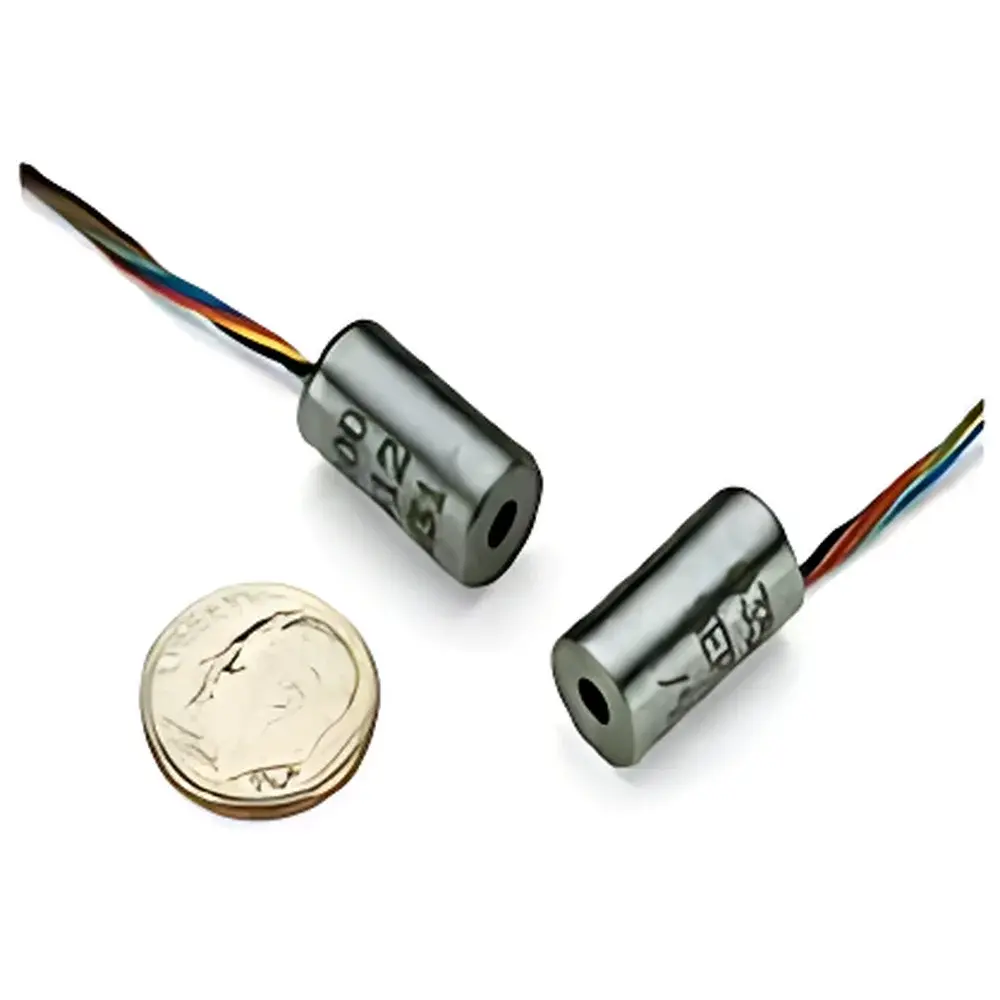
The Firstmark MHR Series Miniature LVDT Displacement Sensor is an electromechanical transducer engineered for high-fidelity, non-contact linear position measurement in space-constrained and weight-sensitive environments. Based on the principle of mutual inductance, the sensor operates by detecting changes in magnetic coupling between a primary coil (energized with AC excitation) and two secondary coils wound differentially on a precision-wound bobbin. A lightweight, non-magnetic stainless steel armature (core) moves axially within the coil assembly, inducing voltage differentials proportional to displacement. This coreless or low-mass core architecture eliminates mechanical loading on delicate mechanisms—making the MHR series particularly suitable for applications involving compliant structures, micro-positioning stages, aerospace actuators, and high-frequency dynamic testing where inertial effects must be minimized.
Key Features
- Ultra-compact form factor with sub-10 mm outer diameter options, enabling integration into miniature assemblies and embedded systems.
- Lightweight ferromagnetic core constructed from high-permeability, low-coercivity stainless steel—reducing mechanical stress on host components while maintaining linearity and repeatability.
- Hermetically sealed magnetic stainless steel housing providing inherent electromagnetic interference (EMI) shielding and electrostatic discharge (ESD) protection per IEC 61000-4-2 Level 4.
- Integrated venting port (standard on high-pressure variants) allowing equalization under differential pressure conditions up to 200 bar—enabling operation in hydraulic cylinders, subsea instrumentation, and sterilizable medical devices.
- Factory-calibrated across full stroke range; each unit supplied with NIST-traceable calibration certificate documenting sensitivity (mV/V/mm), linearity error (±0.25% FS typical), and thermal zero shift (≤0.02% FS/°C).
- Compatible with Schaevitz-brand signal conditioning electronics—including DC-operated demodulators (e.g., SCM-100), AC-excited amplifiers (e.g., LVD-300), and digital interface modules supporting analog voltage/current outputs and RS-485 Modbus RTU.
Sample Compatibility & Compliance
The MHR series is designed for direct integration with metallic, ceramic, or polymer-based moving elements exhibiting minimal hysteresis and thermal expansion mismatch. It supports both static and dynamic measurements up to 1 kHz bandwidth (dependent on signal conditioner). The sensor complies with EN 61326-1:2013 for electromagnetic compatibility in industrial environments and meets RoHS 2015/863/EU material restrictions. For regulated sectors, its traceable calibration documentation satisfies foundational requirements of ISO/IEC 17025:2017 (clause 6.6) and supports audit readiness for GLP and GMP workflows. While not intrinsically safe, explosion-proof enclosures (ATEX Zone 2 / IECEx Zone 2) are available as optional accessories.
Software & Data Management
When paired with Schaevitz’s SC-Link software suite (v4.2+), the MHR sensor enables real-time waveform capture, multi-channel synchronization, and automated calibration verification. The software supports data export in CSV, TDMS, and HDF5 formats—facilitating post-processing in MATLAB, Python (NumPy/Pandas), and LabVIEW. Audit trail functionality logs all configuration changes, zero adjustments, and calibration events in accordance with FDA 21 CFR Part 11 requirements when deployed on validated Windows OS platforms. Firmware updates are delivered via secure USB interface and include cryptographic signature verification.
Applications
- Precision metrology fixtures requiring sub-micron resolution in CNC machine tool wear monitoring.
- Aerospace fuel control valves and actuator feedback loops operating at −55 °C to +175 °C ambient.
- Medical device R&D: catheter tip deflection sensing, implantable pump stroke verification, and surgical robot joint position feedback.
- Automotive powertrain testing: turbocharger vane position, variable valve timing (VVT) solenoid displacement, and piezoelectric injector needle lift detection.
- Materials science: creep and relaxation testing of viscoelastic polymers under sustained load with minimal parasitic force introduction.
FAQ
What is the maximum operating temperature for the standard MHR series?
Standard units operate continuously from −40 °C to +125 °C; high-temp variants (MHR-HT) extend to +175 °C with modified coil insulation and core metallurgy.
Can the MHR sensor be used in vacuum environments?
Yes—units with welded stainless steel housings and vacuum-rated potting compounds (option code “VAC”) are certified for operation down to 10⁻⁶ mbar.
Is custom stroke length available?
Yes—stroke lengths from ±0.25 mm to ±25 mm are offered as standard; bespoke ranges up to ±50 mm can be engineered subject to mechanical resonance analysis.
Does the sensor require external excitation?
Yes—it requires a stable 3–10 Vrms, 1–10 kHz sinusoidal AC excitation source; integrated DC-to-AC converters are available in compatible Schaevitz signal conditioners.
How is linearity error defined and measured?
Linearity error is calculated per ANSI/NCSL Z540.3 as the maximum deviation from the best-fit straight line (least-squares method) over the full-scale range, expressed as a percentage of full-scale output.