
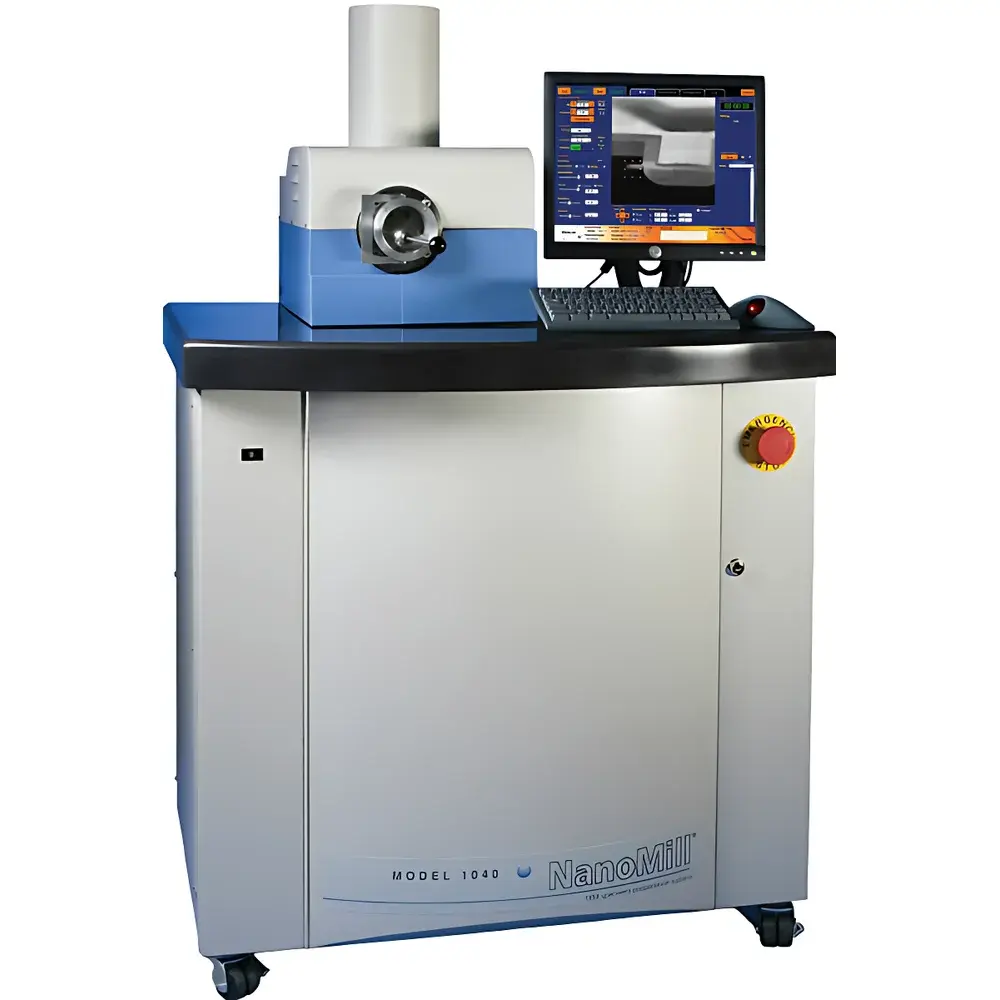
Fischione Model 1040 Focused Ion Beam Milling System
| Brand | Fischione |
|---|---|
| Origin | USA |
| Model | 1040 |
| Ion Beam Energy Range | 50–8,000 eV |
| Minimum Beam Energy | 50 eV |
| Focused Beam Spot Size | ≤1 µm |
| Imaging Mode | Argon Ion-Induced Secondary Electron Imaging |
| Cooling Stage | Liquid Nitrogen Cooled (−196 °C) |
| Beam Steering Accuracy | <100 nm positional repeatability |
| Vacuum Requirement | ≤5×10⁻⁶ Torr |
Overview
The Fischione Model 1040 Focused Ion Beam (FIB) Milling System is a high-precision, ultra-low-energy ion beam instrument engineered for site-specific thinning and final polishing of electron-transparent specimens for transmission electron microscopy (TEM) and scanning transmission electron microscopy (STEM). Unlike conventional broad-beam ion mills, the Model 1040 employs a differentially pumped, electrostatically focused argon ion column capable of delivering a sub-micrometer beam with energy tunability down to 50 eV. This enables controlled, non-damaging removal of surface amorphous layers while minimizing ion-induced lattice disorder, thermal diffusion, and redeposition—critical requirements for atomic-resolution structural and compositional analysis. The system operates under high vacuum conditions (≤5×10⁻⁶ Torr), ensuring stable beam performance and minimal hydrocarbon contamination during extended milling cycles.
Key Features
- Ultra-low-energy ion beam capability (50–8,000 eV), optimized for final-stage polishing without introducing subsurface damage or preferential sputtering.
- Electrostatic focusing optics delivering a beam spot size ≤1 µm at the specimen surface, enabling precise targeting of regions-of-interest (ROIs) as small as 200 nm in diameter.
- Integrated argon ion-induced secondary electron (SE) imaging mode, providing real-time, charge-free topographic contrast during milling—eliminating the need for separate SEM inspection steps.
- Liquid nitrogen cryo-stage maintaining specimen temperature at −196 °C, suppressing thermally activated defect migration and reducing beam-induced heating artifacts in beam-sensitive materials (e.g., oxides, organometallics, polymers).
- High-accuracy beam steering with <100 nm positional repeatability, supported by motorized X-Y-Z stage and digital beam alignment routines calibrated against fiducial markers.
- Differential pumping architecture isolating the ion source from the sample chamber, extending filament lifetime and improving beam stability over multi-hour milling sessions.
Sample Compatibility & Compliance
The Model 1040 accommodates standard 3-mm TEM grids, half-grids, and bulk samples up to 15 mm in diameter and 5 mm in thickness. It supports conductive, semi-conductive, and insulating specimens—including ceramic thin films, battery electrode cross-sections, geological lamellae, and biological cryo-lamellae (when pre-mounted on conductive substrates). All operational parameters are logged with timestamped metadata in accordance with GLP-compliant documentation practices. The system’s software architecture supports audit-trail functionality and user-access controls aligned with FDA 21 CFR Part 11 requirements for regulated laboratories engaged in materials qualification per ASTM E1558, ISO/IEC 17025, and USP <1084> guidelines.
Software & Data Management
Control and monitoring are executed via Fischione’s proprietary Windows-based application, featuring intuitive graphical interfaces for beam parameter configuration, stage navigation, and real-time SE image acquisition. The software supports script-driven batch milling protocols, allowing reproducible processing of multiple specimens using identical beam profiles and dwell times. All acquired images, milling logs, and parameter sets are stored in vendor-neutral TIFF and CSV formats. Optional integration with third-party LIMS platforms is available through standardized OPC UA communication protocols. Data integrity is ensured via automatic checksum verification and SHA-256 hashing of archived session files.
Applications
- Final thinning of site-specific TEM lamellae prepared by dual-beam FIB-SEM, especially for interface analysis in heterostructured devices (e.g., CMOS gate stacks, perovskite solar cells).
- Artifact-free preparation of radiation-sensitive materials such as metal–organic frameworks (MOFs), zeolites, and hydrated biological tissues.
- Removal of ion-damaged surface layers from focused ion beam–cut specimens prior to atomic-resolution HAADF-STEM or EELS mapping.
- Controlled etching of nanoscale features (e.g., quantum dots, nanowires) for dimensional metrology and crystallographic orientation validation.
- Preparation of cross-sectional samples from multilayer thin-film stacks used in magnetic memory devices (STT-MRAM, GMR sensors) where interfacial interdiffusion must be preserved.
FAQ
What is the minimum ion beam energy achievable on the Model 1040?
The system delivers stable, focused argon ion beams down to 50 eV, enabling ultra-gentle surface cleaning and final polishing without inducing detectable lattice displacement.
Can the Model 1040 be used for insulating samples without conductive coating?
Yes—the argon ion-induced secondary electron imaging mode provides inherent charge compensation, eliminating the need for carbon or platinum sputter coating during milling and observation.
Is liquid nitrogen refilling automated?
No; the cryo-stage uses a manual-fill Dewar design compatible with standard lab LN₂ transfer systems. Continuous cooling duration exceeds 8 hours per fill at −196 °C under typical vacuum and beam load conditions.
Does the system support automated milling recipes?
Yes—script-based protocol execution allows full automation of multi-step milling sequences, including beam rastering, energy ramping, and stage repositioning, with programmable pause points for intermediate TEM inspection.
What vacuum level is required for optimal beam stability?
A base pressure ≤5×10⁻⁶ Torr is required prior to beam operation; the differential pumping system maintains this condition throughout extended use without requiring frequent vent-pump cycles.





