
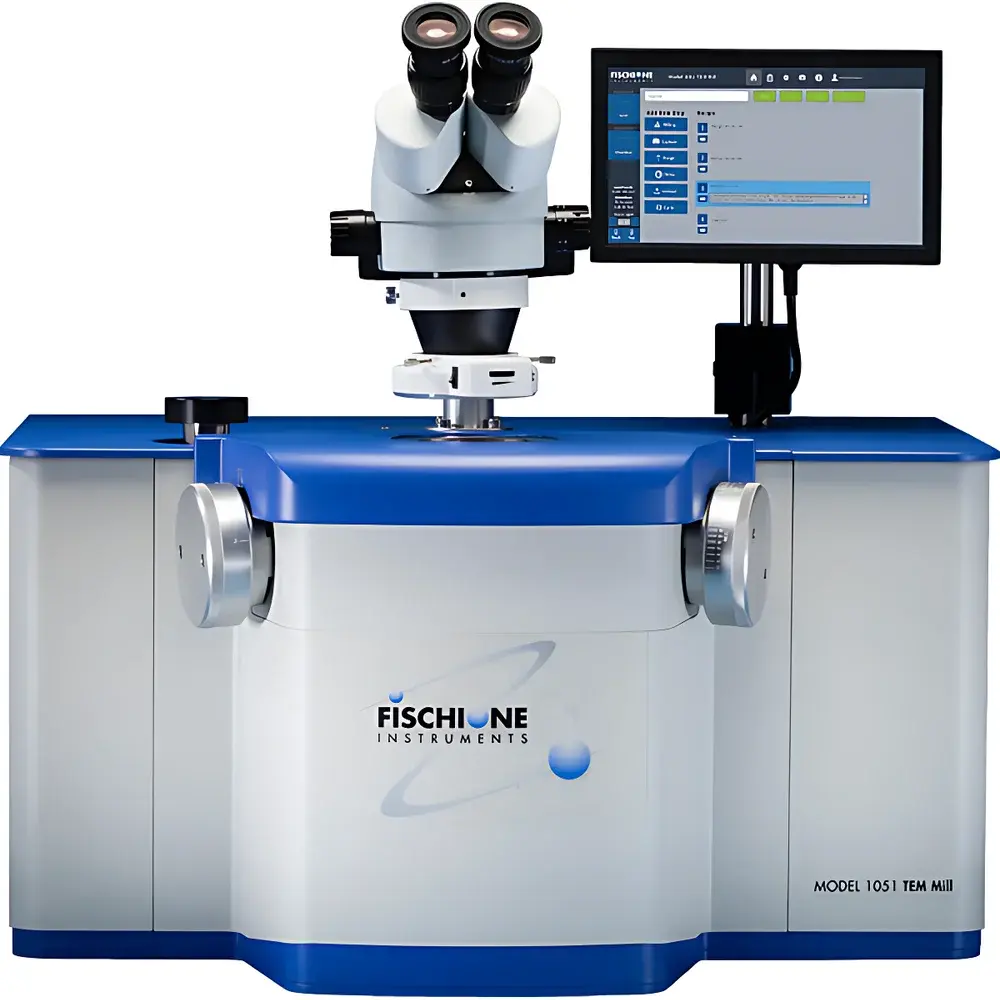
Fischione Model 1051 Dual-Beam Ion Milling System
| Brand | Fischione |
|---|---|
| Origin | USA |
| Model | 1051 |
| Maximum Sample Diameter | 3 mm |
| Tilting Angle Range | −15° to +10° |
| Ion Beam Energy | 100 eV – 10 keV |
Overview
The Fischione Model 1051 is a high-precision dual-beam ion milling system engineered for the preparation of electron-transparent thin sections from bulk solid specimens—primarily for transmission electron microscopy (TEM), scanning transmission electron microscopy (STEM), and atom probe tomography (APT). It operates on the principle of physical sputtering: accelerated noble gas ions (typically Ar⁺) bombard the sample surface at controlled incidence angles, gradually removing material via momentum transfer. Unlike single-beam systems, the Model 1051 integrates two independently adjustable electromagnetic focusing ion guns, enabling simultaneous high-energy milling (for rapid material removal) and low-energy ion polishing (for artifact-free final thinning and surface smoothing). This dual-beam architecture ensures superior control over subsurface damage, amorphous layer thickness, and edge sharpness—critical parameters in high-resolution structural and compositional analysis.
Key Features
- Dual independent ion guns with electromagnetic beam focusing—each capable of continuous energy tuning from 100 eV to 10 keV while maintaining consistent beam spot profile and current density across the full range.
- Integrated Faraday cup detectors mounted in-line with each ion gun, enabling real-time, absolute measurement of ion beam current without interrupting operation or compromising vacuum integrity.
- Precision tilting stage with continuously adjustable incidence angle from −15° to +10°, facilitating controlled angular milling for cross-sectional, plan-view, or bevelled-edge preparation.
- X–Y motorized sample stage allows sub-micrometer positioning accuracy, ensuring reproducible targeting of regions of interest (ROIs) under optical or SEM pre-alignment.
- In-situ real-time observation via integrated high-resolution optical microscope (optional CCD camera upgrade available), synchronized with stage motion and beam parameters for dynamic process monitoring and endpoint detection.
- 360° continuous rotation or programmable oscillation mode mitigates ion channeling effects and promotes uniform thinning; automatic beam blanking logic prevents over-milling during sample repositioning.
- Modular vacuum architecture compatible with optional liquid nitrogen cryo-stage (−140°C operational capability) to suppress radiation-induced diffusion, thermal drift, and beam-induced phase transformations in beam-sensitive materials (e.g., polymers, biological composites, battery cathodes).
Sample Compatibility & Compliance
The Model 1051 accommodates specimens up to 3 mm in diameter and ≤ 2 mm in thickness, including metals, ceramics, semiconductors, geological samples, and composite laminates. Its low-energy ion capability (<1 keV) enables artifact-minimized thinning of brittle or layered materials such as perovskites, 2D transition metal dichalcogenides (TMDs), and oxide heterostructures. The system meets ISO 14644-1 Class 5 cleanroom compatibility requirements when operated within a dedicated glovebox-integrated transfer environment. Optional inert-gas (N₂ or Ar) or ultra-high-vacuum (UHV) transfer locks enable air-free sample loading—essential for oxygen- or moisture-sensitive specimens (e.g., Li-ion battery electrodes, alkali-metal compounds, organometallic frameworks). All control firmware and data logs comply with GLP audit trail requirements and support 21 CFR Part 11–compliant electronic signatures when paired with validated laboratory information management systems (LIMS).
Software & Data Management
The 10-inch fully configurable touchscreen interface runs Fischione’s proprietary IonMill™ Control Suite v4.x, featuring intuitive workflow-driven menus, parameter presets (e.g., “TEM Cross-section”, “APT Tip Prep”, “Polymer Surface Polish”), and scriptable multi-step protocols. All operational parameters—including beam energy, current, tilt angle, rotation speed, dwell time, and cooling stage temperature—are timestamped and exported in CSV/JSON format. Raw optical video streams (up to 30 fps) are saved with synchronized metadata. Audit logs record user login sessions, parameter changes, emergency stops, and maintenance alerts—retained for ≥18 months per internal data retention policy. Remote diagnostics and firmware updates are supported via encrypted Ethernet connection (TLS 1.2+), with optional integration into enterprise Active Directory authentication.
Applications
- Preparation of site-specific TEM lamellae from FIB-prepared lift-outs, minimizing curtaining and Ga implantation artifacts.
- Final polishing of focused ion beam (FIB)-milled APT tips to achieve <50 nm apex radii with minimal residual damage.
- Generation of damage-free cross-sections in multilayer semiconductor devices (e.g., FinFETs, HEMTs) for EDS/EELS mapping.
- Thin-sectioning of geological thin sections containing volatile-bearing minerals (e.g., hydrous silicates, carbonates) using cryogenic milling.
- Surface decontamination and top-layer removal in forensic metallurgy and failure analysis of solder joints or coating interfaces.
- Controlled etching of photonic crystal slabs and plasmonic nanostructures for optical characterization.
FAQ
What vacuum level does the Model 1051 maintain during operation?
The chamber achieves and sustains ≤2 × 10⁻⁶ Torr (base pressure) using a combination of turbomolecular and ion getter pumping; process pressure remains stable at ≤5 × 10⁻⁵ Torr during active milling.
Can the system accommodate non-circular samples?
Yes—custom sample holders (e.g., rectangular stubs, grid-based mounts) are supported via interchangeable stage inserts; maximum bounding dimension must remain within 3 mm diameter envelope.
Is remote operation supported?
Fully supported via secure VNC-over-SSH with role-based access controls; requires local network configuration approval and firewall exception for port 22.
How often does the ion source require maintenance?
Typical source lifetime exceeds 1,200 operating hours; filament replacement and aperture cleaning are recommended every 600 hours or per logbook inspection protocol.
Does the system meet CE or UL certification standards?
Certified to IEC 61000-6-2 (immunity) and IEC 61000-6-4 (emissions); UL 61010-1 listing applies to North American configurations with NRTL-marked power supply and interlock circuitry.



