
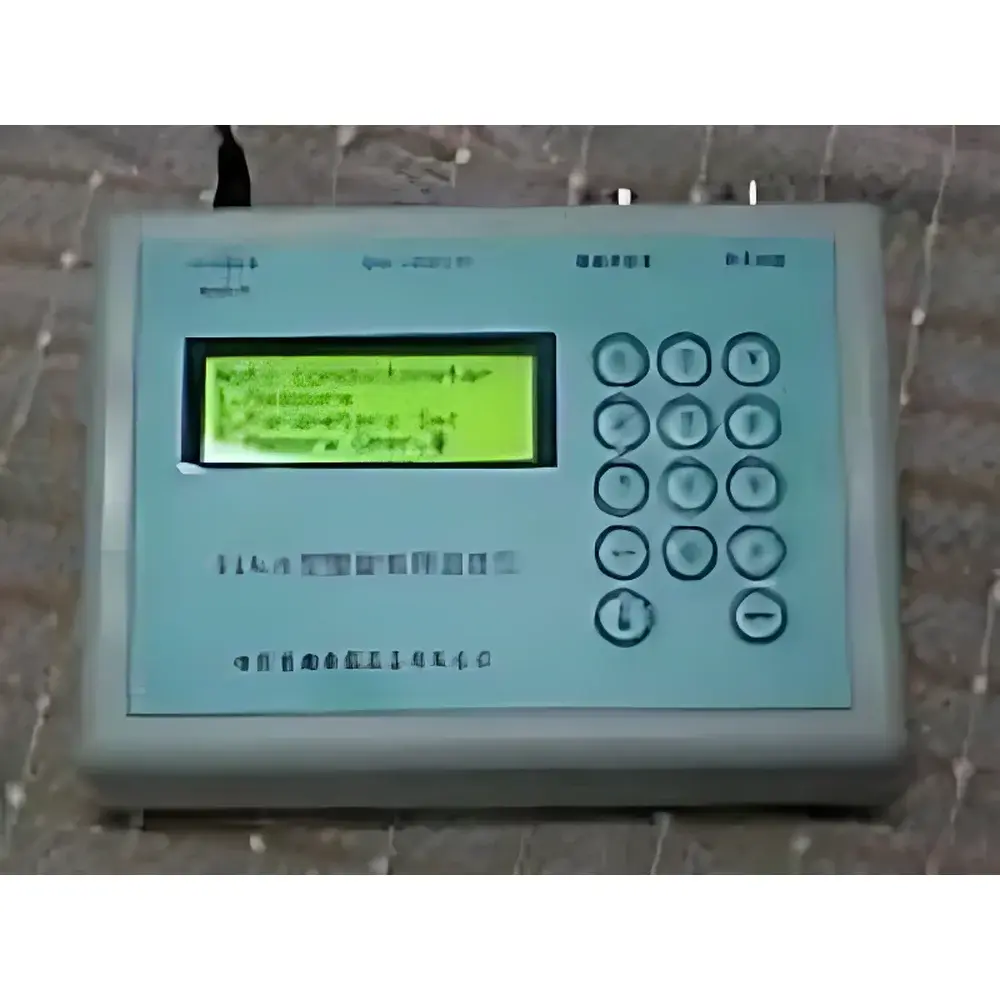
FJA-6 Intelligent Conductivity and Temperature Meter
| Origin | Jiangsu, China |
|---|---|
| Manufacturer Type | Authorized Distributor |
| Origin Category | Domestic (China) |
| Model | FJA-6 |
| Price | Upon Request |
| Form Factor | Benchtop |
| Conductivity Range | 1 μS to 100 mS (5 auto-ranging spans) |
| Accuracy | ±1.5% of reading |
| Temperature Compensation Error | <±2% |
| Stability | ±0.1% FS ±1 digit/hour |
| Dimensions | 183 × 130 × 60 mm |
| Weight | <0.5 kg |
| Operating Temp | 0–45 °C |
| RH Limit | ≤85% |
| Power Supply | 5 V DC |
Overview
The FJA-6 Intelligent Conductivity and Temperature Meter is a precision benchtop instrument engineered for reliable, temperature-compensated measurement of electrical conductivity in aqueous electrolyte solutions, ultrapure water, and soil extracts. It operates on the fundamental principle of two-electrode AC conductometry—applying a low-frequency alternating current across a calibrated cell to determine solution resistance, then converting it to conductivity (σ, in S/m or μS/cm) using cell constant correction. Built-in digital temperature compensation (DTC) applies the standard linear or non-linear (user-selectable) algorithms per ISO 7888 and ASTM D1125 to normalize all readings to the reference temperature of 25 °C—eliminating manual correction and minimizing operator-induced variability. Its dual-sensor interface supports both standard laboratory conductivity cells (e.g., K = 0.1, 1.0, or 10 cm⁻¹) and TYC-2–compatible soil salinity probes, enabling cross-domain use from QC labs to field-deployed environmental monitoring stations where stable AC power is available.
Key Features
- Dual-mode operation: Simultaneous display of real-time conductivity (μS/cm or mS/cm) and temperature (°C), with automatic conversion to 25 °C-equivalent values via embedded DTC algorithm.
- Five-step auto-ranging conductivity measurement: Covers 1 μS to 100 mS full scale across five discrete spans—(1) 1–10 μS, (2) 10–100 μS, (3) 100 μS–1 mS, (4) 1–10 mS, and (5) 10–100 mS—with resolution down to 0.1 μS in low-range mode.
- High metrological stability: Drift limited to ±0.1% of full scale plus ±1 digit per hour, verified under controlled lab conditions per IEC 61000-4-3 EMI immunity guidelines.
- Compact benchtop architecture: Housing dimensions of 183 × 130 × 60 mm and mass <0.5 kg facilitate integration into crowded analytical workspaces or transport to mobile field labs.
- Robust environmental tolerance: Rated for continuous operation at ambient temperatures from 0 °C to 45 °C and relative humidity up to 85% non-condensing—compliant with IEC 60529 IP20 enclosure classification.
Sample Compatibility & Compliance
The FJA-6 interfaces seamlessly with standardized two-electrode conductivity cells meeting DIN EN 27888 and ISO 7888 dimensional and calibration traceability requirements. When paired with TYC-2–type soil salinity sensors (or equivalent CE-marked analog-output probes), it enables direct extraction of apparent electrical conductivity (ECa, dS/m) from saturated paste or 1:5 soil–water suspensions—supporting routine monitoring per USDA ARS protocols and FAO irrigation water quality guidelines. All conductivity measurements are traceable to NIM (National Institute of Metrology, China)–certified reference standards. While not inherently 21 CFR Part 11–compliant (lacking audit trail or electronic signature functionality), its stable analog front-end and deterministic firmware support GLP-aligned manual data recording workflows when used within documented SOPs.
Software & Data Management
The FJA-6 operates as a standalone, microcontroller-driven meter with no onboard data logging or PC connectivity. Readings are displayed in real time on a high-contrast LCD screen with dual-parameter annotation (e.g., “42.3 μS/cm @ 25°C / 22.1°C”). For regulated environments requiring data integrity, users integrate the device into validated external capture systems—for example, via RS-232 or USB-to-serial adapters (optional accessories) feeding into LIMS or ELN platforms configured for raw value ingestion, timestamp stamping, and operator ID tagging. Firmware revision tracking and calibration verification logs must be maintained manually per ISO/IEC 17025 Clause 6.4.10.
Applications
- Quality control of pharmaceutical purified water (PW) and water-for-injection (WFI) per USP and EP 2.2.38.
- Monitoring conductivity drift in HPLC mobile phase reservoirs and ultrafiltration permeate streams.
- Environmental assessment of surface water, groundwater, and wastewater effluents per EPA Method 120.1.
- Soil salinity mapping for agricultural land management—tracking temporal ECa trends in response to irrigation scheduling or leaching events.
- Educational laboratories: Demonstrating Kohlrausch’s law, ion mobility effects, and temperature dependence of electrolyte conduction.
FAQ
Does the FJA-6 support calibration verification with standard KCl solutions?
Yes—it accepts manual calibration using certified 0.01 mol/L (1413 μS/cm), 0.1 mol/L (12.88 mS/cm), and 1.0 mol/L (111.8 mS/cm) KCl reference solutions per ISO 7888 Annex B.
Can the instrument store calibration coefficients internally?
No—the FJA-6 does not retain user-entered cell constants or calibration offsets between power cycles; recalibration is required before each analytical session.
Is the 5 V DC power supply included with the unit?
Yes—a regulated 5 V DC adapter compliant with IEC 60950-1 is supplied; operation from USB power banks (5 V ±5%, ≥1 A) is also supported.
What is the maximum cable length supported for TYC-2 soil probe connections?
For optimal signal integrity and noise rejection, probe cable length should not exceed 10 meters when using shielded twisted-pair wiring per IEC 61000-6-2.
Does the device meet any international electromagnetic compatibility (EMC) standards?
It conforms to IEC 61326-1 Class B emission limits and basic immunity per IEC 61000-4-x series for industrial environments, though formal test reports are available upon request from the authorized distributor.




