
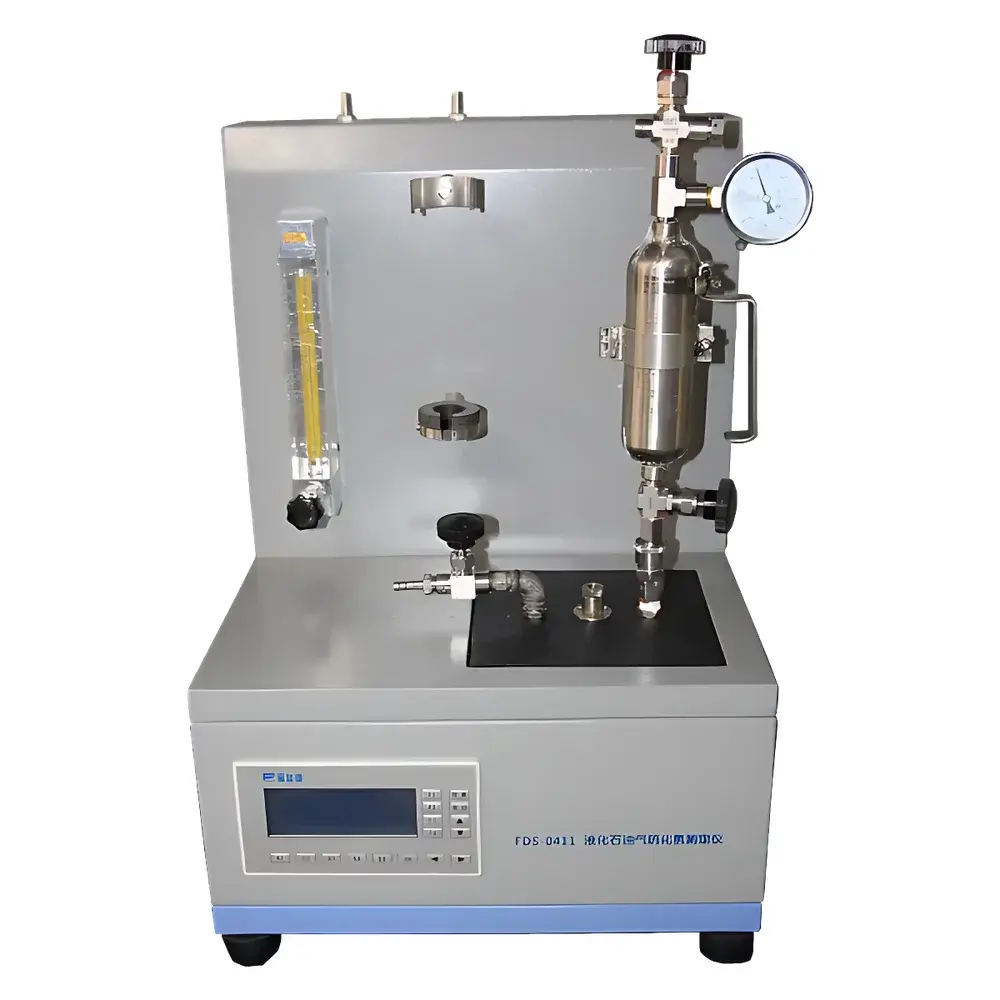
Fland FDS-0411 Hydrogen Sulfide Analyzer for Liquefied Petroleum Gas (LPG)
| Brand | Fland / csfriend |
|---|---|
| Origin | Hunan, China |
| Manufacturer Type | Authorized Distributor |
| Country of Manufacture | China |
| Model | FDS-0411 |
| Power Consumption | 1000 W |
| Supply Voltage | AC 220 V, 50 Hz |
| Temperature Control | Digital PID Controller with Auto-Tuning |
| Gas Flow Regulation | Adjustable Needle Valve with Precision Flowmeter |
| Heating Method | Immersed Electric Heating Element |
| Compliant Standards | ASTM D2420, SH/T 0125 |
Overview
The Fland FDS-0411 Hydrogen Sulfide Analyzer is a dedicated benchtop instrument engineered for the quantitative determination of hydrogen sulfide (H₂S) concentration in liquefied petroleum gas (LPG) samples, in strict accordance with internationally recognized test methods—primarily ASTM D2420 (“Standard Test Method for Hydrogen Sulfide in Liquefied Petroleum Gases (LPG) (Lead Acetate Method)”) and the Chinese industry standard SH/T 0125. The analyzer operates on the principle of colorimetric reaction: H₂S in the vapor phase reacts quantitatively with lead acetate-impregnated filter paper to form brown-black lead sulfide, the intensity of which is directly proportional to the H₂S concentration. Sample gas is passed through a temperature-controlled reaction chamber at a precisely regulated flow rate, ensuring consistent reaction kinetics and minimizing interference from condensable hydrocarbons or moisture. This gravimetric-colorimetric hybrid approach delivers high reproducibility for routine quality control in refineries, gas terminals, and LPG bottling facilities.
Key Features
- Integrated digital PID temperature controller with auto-tuning capability—maintains stable thermal equilibrium across the reaction zone (typically 30–60 °C), compensating for ambient drift and load variations to ensure reaction consistency.
- Precision glass reaction cylinder fabricated to exact dimensional and surface-finish specifications per ASTM D2420 Annex A; constructed from borosilicate glass to resist thermal shock and chemical etching during repeated exposure to acidic H₂S-laden streams.
- Independent flow regulation system comprising a stainless-steel needle valve and a calibrated rotameter (range: 0–1000 mL/min), enabling operator-adjusted flow rates with ±2% full-scale accuracy—critical for adherence to the 500 ±50 mL/min stipulation in ASTM D2420.
- Immersion-type electric heating element with thermal cut-off protection, delivering uniform heat distribution without hot-spot formation that could promote premature decomposition of lead acetate reagent strips.
- Robust aluminum alloy chassis with insulated housing, designed for continuous operation in industrial laboratory environments (IP20 rating); power input fully filtered to suppress electromagnetic interference affecting analog sensor stability.
Sample Compatibility & Compliance
The FDS-0411 accepts pressurized LPG samples delivered via standard CGA-125 or DISS-716 fittings, with inlet pressure tolerance up to 1.6 MPa (gauge). It accommodates both propane- and butane-dominant LPG blends, including commercial-grade fuel and refinery off-gas streams. The instrument’s design inherently excludes interference from mercaptans, carbonyl sulfide (COS), and elemental sulfur under specified operating conditions. Full traceability is supported via physical logbook entries aligned with GLP documentation requirements. While the FDS-0411 itself does not incorporate electronic data logging, its operational parameters—including setpoint temperature, actual chamber temperature, flow rate, and exposure duration—are manually recordable in formats compliant with internal QA procedures and auditable against ISO/IEC 17025 Clause 7.7 (Results Reporting).
Software & Data Management
The FDS-0411 is a hardware-only analytical platform with no embedded firmware, microprocessor-based control, or proprietary software interface. All operational parameters are adjusted and monitored via analog/digital front-panel indicators (temperature display, flowmeter scale). This architecture eliminates cybersecurity vulnerabilities, ensures long-term calibration stability without firmware obsolescence, and simplifies validation under FDA 21 CFR Part 11 Annex 11 contexts where electronic records are not generated. Users maintain manual test records using standardized laboratory notebooks or LIMS-integrated paper forms, with retention periods governed by organizational SOPs and regional regulatory mandates (e.g., 5-year archival for refinery QC records per API RP 2510).
Applications
- Routine H₂S screening of inbound LPG cargoes at import terminals to verify compliance with UNECE R115 sulfur limits (<10 ppm v/v).
- Final product release testing in LPG blending plants prior to cylinder filling—ensuring conformance with EN 589 and GB 11174 specifications.
- Troubleshooting sour gas breakthrough in amine treater units by correlating FDS-0411 field measurements with online H₂S analyzers.
- Educational use in petrochemical engineering laboratories for method validation exercises and inter-laboratory comparison studies under ISO 5725-2 protocols.
- Supporting root-cause analysis during nonconformance investigations involving odorant degradation or pipeline corrosion events linked to H₂S presence.
FAQ
Does the FDS-0411 require external calibration gases or certified reference materials?
No. Calibration is performed using NIST-traceable lead acetate test papers with documented H₂S response curves; periodic verification is conducted via spiked LPG standards prepared gravimetrically per ASTM D6299 guidelines.
Can the instrument be used for natural gas or refinery fuel gas analysis?
Not without modification. The FDS-0411 is specifically configured for LPG-phase sampling (liquid-vapor equilibrium conditions); application to dry gas streams requires alternate sampling manifolds and flow conditioning per ASTM D6667.
Is the glass reaction cylinder supplied with spare parts and replacement certification?
Yes. Each unit ships with two certified borosilicate cylinders, each accompanied by a material test report (MTR) verifying thermal expansion coefficient (3.3 × 10⁻⁶/K) and hydrolytic class HGB per ISO 719.
What maintenance intervals are recommended for sustained accuracy?
Daily visual inspection of flowmeter float and heater insulation integrity; quarterly verification of PID controller setpoint fidelity using a Class A platinum RTD probe; annual replacement of lead acetate paper holder gaskets to prevent bypass leakage.
Does the analyzer meet explosion-proof requirements for Zone 1 installation?
No. The FDS-0411 is rated for indoor laboratory use only (non-hazardous location). Installation in classified areas requires integration within an approved purge cabinet meeting IEC 60079-13 requirements.






