
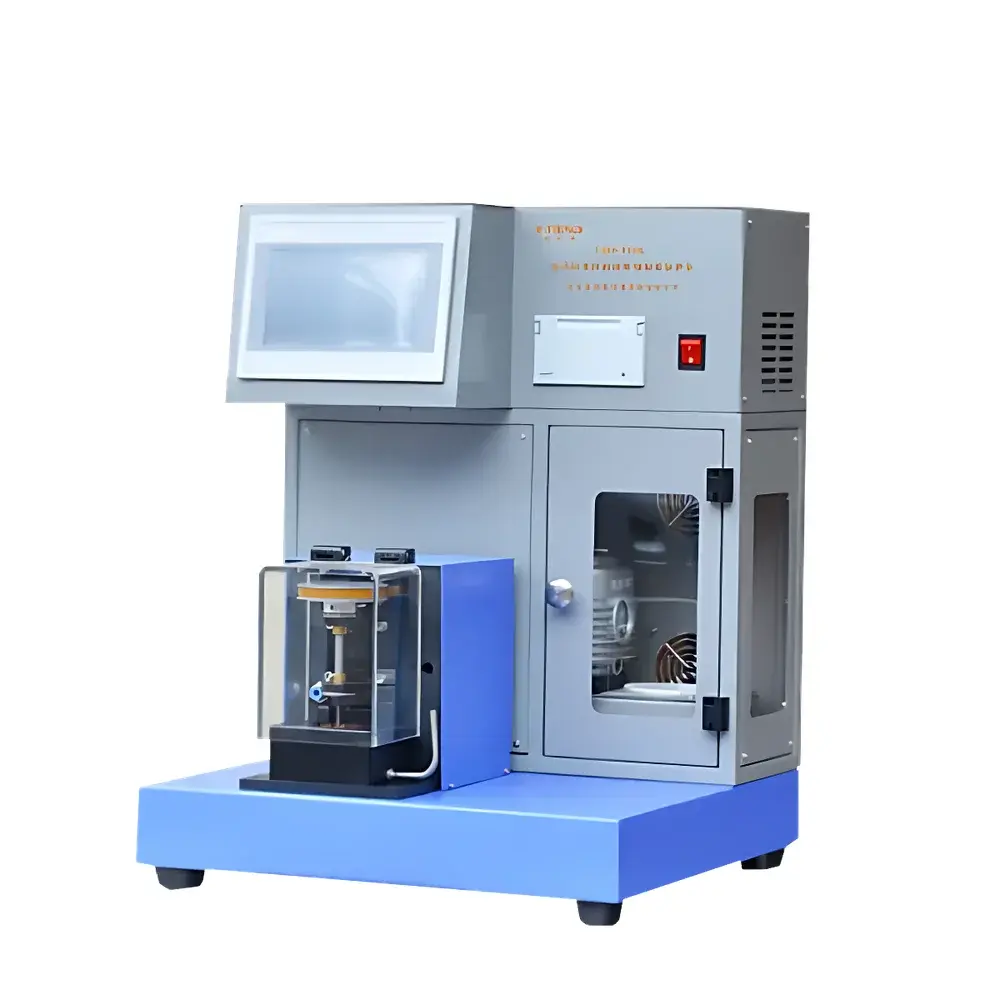
Flanland FDH-1402 Engine Oil Apparent Viscosity Tester
| Brand | Flanland / csfriend |
|---|---|
| Origin | Hunan, China |
| Manufacturer Type | Authorized Distributor |
| Country of Manufacture | China |
| Model | FDH-1402 |
| Pricing | Upon Request |
| Cooling Method | Imported Compressor-Based Refrigeration |
| Temperature Range | Ambient to –35.0 ± 0.1 °C |
| Circulation System | Imported Low-Temperature Circulating Pump |
| Temperature Control | PLC-Based Precision Control |
| Current Regulation | Software-Controlled Automatic Locking |
| Display Interface | Multi-Language Touchscreen (English, Chinese, Russian) |
| Calibration Method | Certified Reference Oils (ASTM D5293 / SAE J300 Compliant) |
| Power Supply | AC 220 V ±10%, 50 Hz |
| Structural Design | Integrated All-in-One Unit (Testing, Rinsing, and Thermal Conditioning in Single Enclosure) |
Overview
The Flanland FDH-1402 Engine Oil Apparent Viscosity Tester is an integrated, microprocessor-controlled instrument engineered for precise determination of low-temperature apparent viscosity of engine oils—specifically designed to meet the requirements of ASTM D5293 (Cold-Cranking Simulator, CCS), SAE J300 viscosity classification, and related ISO 3104/ISO 2160 protocols. It operates on the principle of rotational viscometry under controlled shear stress at sub-zero temperatures, simulating cold-start conditions where engine oil must flow rapidly through narrow passages in the lubrication system. Unlike conventional mechanical rheometers, the FDH-1402 employs a software-synchronized current-locking mechanism to maintain consistent torque application during dynamic viscosity measurement, eliminating variability associated with manual or electromechanical lock systems. Its fully enclosed thermal chamber—driven by a high-efficiency imported compressor and stabilized via a closed-loop low-temperature circulating pump—ensures rapid, uniform cooling across the full operational range from ambient down to –35.0 ± 0.1 °C.
Key Features
- Multi-language touchscreen interface (English, Chinese, Russian) supporting intuitive navigation and real-time parameter visualization—including current draw, rotational speed, apparent viscosity (mPa·s), and time-temperature-viscosity curves.
- Embedded self-diagnostic firmware that continuously monitors refrigeration performance, temperature stability, motor response, and sensor integrity; faults are displayed with actionable error codes and contextual guidance.
- PLC-based temperature regulation architecture delivering ±0.1 °C thermal accuracy over extended test cycles, validated against NIST-traceable reference thermometers.
- Automated workflow sequence: auto-initiated temperature ramping, dwell stabilization, viscosity measurement, post-test rinse cycle, data computation, result archiving, and optional thermal-printed reporting—all executed with single-button initiation.
- Role-based access control system with configurable user accounts (Operator, Technician, Administrator), each assigned granular permissions for method editing, calibration logging, audit trail review, and system configuration.
- Monolithic chassis design integrates sample cup, rotor assembly, refrigeration unit, rinse reservoir, and waste collection—eliminating external plumbing, auxiliary chillers, or manual cleaning steps.
Sample Compatibility & Compliance
The FDH-1402 accommodates standard ASTM D5293 sample volumes (17 mL) in precision-machined stainless-steel test cups compatible with both mineral and synthetic engine oils—including API SP, ILSAC GF-6A/B, ACEA A3/B4, and JASO DL-1 formulations. Instrument validation follows internal SOPs aligned with ISO/IEC 17025:2017 general requirements for testing laboratories. Calibration is performed using certified reference oils traceable to NIST Standard Reference Materials (SRMs) or equivalent national metrology institutes. The system supports compliance documentation for GLP environments, including electronic signature capability and audit-ready event logs covering all critical operations (temperature setpoint changes, calibration events, user logins, and result exports).
Software & Data Management
The embedded operating system records timestamped raw data (torque, angular velocity, bath temperature, elapsed time) at 10 Hz resolution, storing complete test profiles locally on industrial-grade flash memory. Export options include CSV and PDF formats with embedded metadata (operator ID, method version, calibration date, instrument serial number). All data modifications are logged with immutable timestamps and user attribution, satisfying FDA 21 CFR Part 11 requirements for electronic records and signatures when deployed in regulated QC/QA settings. Firmware updates are delivered via secure USB interface with cryptographic verification to ensure integrity and traceability.
Applications
- Low-temperature viscosity grading of passenger car motor oils (PCMOs) per SAE J300 winter grade definitions (e.g., 0W-20, 5W-30).
- Quality assurance testing during engine oil formulation development and batch release.
- Comparative analysis of additive package performance under simulated cold-cranking conditions.
- Supporting OEM lubricant specification validation (e.g., GM dexos1™ Gen 3, Ford WSS-M2C962-A, MB-Approval 229.71).
- Research applications in tribology labs assessing shear-thinning behavior and yield stress onset at sub-zero temperatures.
FAQ
What standards does the FDH-1402 comply with?
It is designed and validated for ASTM D5293 (CCS), SAE J300, and ISO 3104 methodology requirements.
Is the instrument suitable for GMP-regulated environments?
Yes—its role-based access control, electronic audit trail, and 21 CFR Part 11–compatible data handling support GMP/GLP-compliant operation.
How is calibration verified?
Using certified reference oils with documented uncertainty budgets; calibration certificates include traceability statements to national metrology institutes.
Can the system be integrated into a LIMS?
Yes—CSV export and optional RS-232/Ethernet interfaces enable bidirectional communication with laboratory information management systems.
What maintenance is required for the refrigeration system?
Annual inspection of compressor oil level and condenser coil cleanliness; no routine refrigerant recharge is needed under normal operating conditions.




