
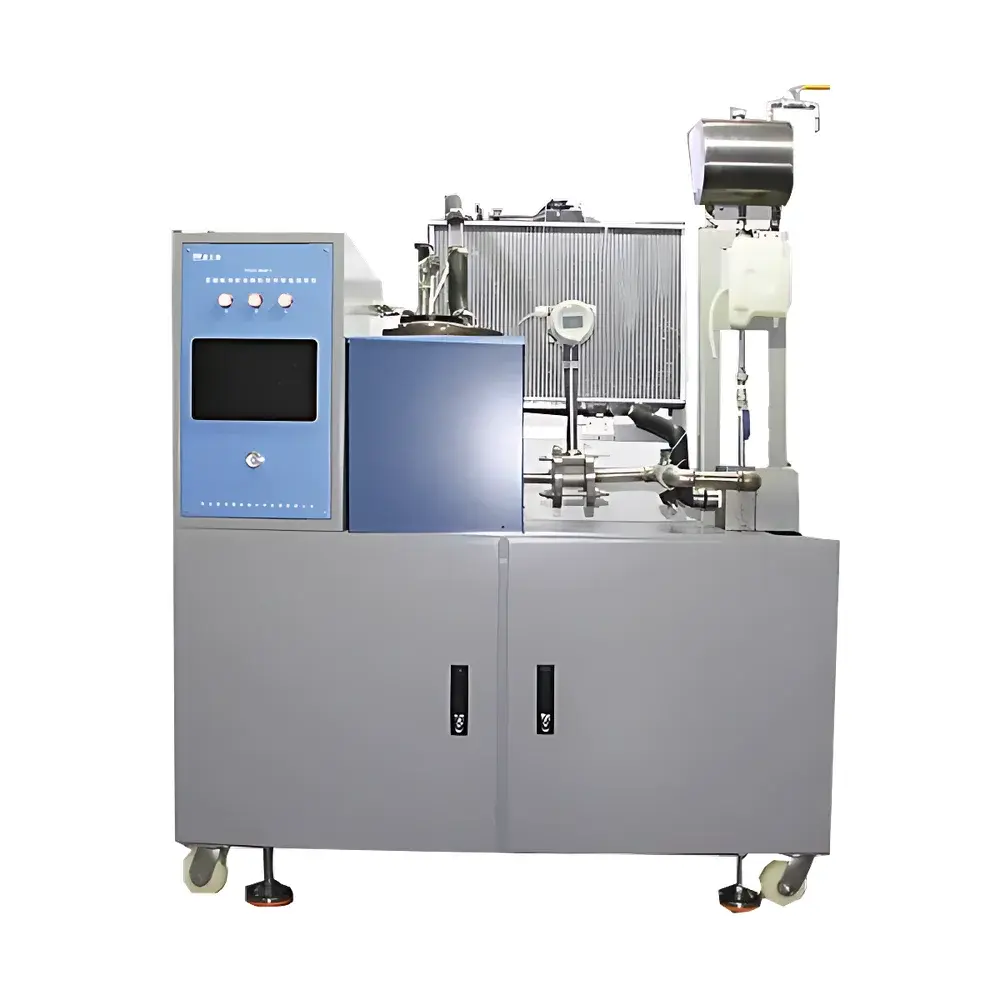
Flanland FDY-0807 Engine Coolant Simulated Service Corrosion Tester
| Brand | Flanland / csfriend |
|---|---|
| Origin | Hunan, China |
| Model | FDY-0807 |
| Liquid Flow Rate | 1.3–1.6 L/s |
| Temperature Control Range | Ambient to 100 °C (Accuracy: ≤1 °C) |
| Operating Duration | Up to 1064 h (programmable start/stop) |
| Pressure Range | 80–103 kPa |
| Data Storage Capacity | >200 test records |
| Display | Touch-enabled LCD panel |
| Control System | Embedded software with optional remote monitoring interface |
| Power Supply | AC 380 V ±10%, 50 Hz |
| Total Power Consumption | 4.8 kW |
| Safety Features | Over-temperature protection, pressure relief valve, power-loss memory function |
| Optional Modules | Automated weighing system (interface to analytical balance), auto-sampling unit |
Overview
The Flanland FDY-0807 Engine Coolant Simulated Service Corrosion Tester is an engineered platform designed to replicate long-term thermal–hydrodynamic stress conditions encountered by engine cooling systems during real-world operation. It operates on the principle of accelerated corrosion simulation under controlled flow, temperature, and pressure parameters—aligning with standardized test methodologies such as ASTM D2570 (Standard Test Method for Simulated Service Corrosion Testing of Engine Coolants), SAE J1034, and GB/T 25972–2010 (Chinese national standard for coolant corrosion evaluation). The instrument subjects metal coupon assemblies—including copper, solder, steel, aluminum, and brass—to continuous circulation of coolant under precisely regulated thermal gradients and fluid dynamics, enabling quantitative assessment of material degradation, pitting depth, mass loss, and inhibitor depletion kinetics over extended durations up to 1064 hours.
Key Features
- Integrated touchscreen HMI with real-time visualization of temperature, pressure, flow rate, elapsed time, and system status—eliminating reliance on external instrumentation or manual logging.
- Programmable timer architecture supporting multi-stage scheduling: users define custom start/stop intervals, pause/resume sequences, and automatic shutdown upon completion or threshold violation.
- Power-loss memory retention ensures continuity of test execution; upon restoration of mains supply, the system resumes from the exact operational state prior to interruption.
- Motor-driven circulation loop with adjustable flow control (1.3–1.6 L/s) and calibrated pressure regulation (80–103 kPa), maintaining laminar-to-transitional flow regimes appropriate for simulating radiator and water pump environments.
- Dual-layer safety design: electronic over-temperature cutoff integrated into the heating circuit, plus a mechanical pressure relief valve mounted on the reservoir lid compliant with ASME BPVC Section VIII requirements.
- Modular expansion capability—including factory-integrated RS-232/RS-485 communication ports and Ethernet-ready firmware—for seamless integration into centralized lab management networks.
Sample Compatibility & Compliance
The FDY-0807 accommodates standardized corrosion test specimens per ASTM G1–03, including 10 mm × 20 mm × 1.5 mm coupons fabricated from ASTM B111 copper, ASTM B32 solder (50Sn–50Pb), ASTM A572 structural steel, ASTM B209 aluminum alloy 3003, and ASTM B16 leaded brass. Specimen racks support simultaneous exposure of up to eight material types under identical hydraulic and thermal boundary conditions. All operational parameters meet traceability requirements for GLP-compliant laboratories: temperature sensors are NIST-traceable Pt100 RTDs (Class A), pressure transducers conform to IEC 61298-2, and timing circuits are synchronized to internal quartz oscillators with ±0.01% stability over 1000 h. The system supports audit-ready documentation generation aligned with ISO/IEC 17025 clause 7.8 and FDA 21 CFR Part 11 when paired with validated software modules.
Software & Data Management
The embedded control software provides full lifecycle test management—from method setup and parameter validation to raw data export and report generation. Each test record stores timestamped metadata (start time, ambient conditions, operator ID), continuous sensor logs (sampled at 1 Hz), and final analytical outputs (mass change Δm in mg, corrosion rate in mpy or mm/y). Data export formats include CSV, PDF, and XML, compatible with LIMS platforms such as LabWare LIMS and Thermo Fisher SampleManager. Optional remote monitoring enables secure web-based access via TLS 1.2–encrypted HTTP(S) sessions; authorized users can view live telemetry, trigger emergency stop commands, and download historical datasets without local network presence. Audit trails capture all user actions—including configuration changes, calibration events, and data modifications—with immutable timestamps and digital signatures.
Applications
- Evaluation of organic acid technology (OAT), hybrid organic acid technology (HOAT), and traditional silicate-based coolant formulations for passenger vehicles, heavy-duty diesel engines, and electric vehicle battery thermal management systems.
- Comparative benchmarking of corrosion inhibitor packages across supplier tiers under identical simulated service conditions.
- Accelerated aging studies supporting IATF 16949-compliant PPAP submissions for OEM coolant approval processes.
- Research into synergistic effects between glycol concentration, pH drift, and dissolved ion accumulation on localized corrosion initiation in aluminum heat exchangers.
- Validation of coolant recycling protocols used in fleet maintenance centers and remanufacturing facilities.
FAQ
What standards does the FDY-0807 comply with for coolant corrosion testing?
It is configured to execute test protocols defined in ASTM D2570, SAE J1034, JIS K2234, and GB/T 25972–2010, with hardware-level calibration traceable to national metrology institutes.
Can the instrument operate unattended for the full 1064-hour cycle?
Yes—its autonomous control logic, non-volatile memory, and redundant safety interlocks permit fully unattended operation, provided environmental conditions (ventilation, power stability, coolant volume) remain within specification.
Is the automated weighing interface compatible with third-party analytical balances?
It supports standard METTLER TOLEDO, SARTORIUS, and SHIMADZU balances via RS-232 ASCII protocol; configuration requires selection of appropriate baud rate, parity, and termination characters in the device settings menu.
Does the remote monitoring system require a static IP address or VPN?
No—it operates over dynamic DNS with TLS-authenticated client certificates; deployment options include direct internet exposure behind enterprise firewalls or isolated VLAN segmentation with port-forwarding rules.
How is temperature uniformity verified across the test chamber?
Three independent Pt100 sensors are distributed at inlet, mid-loop, and outlet positions; deviation between readings is logged continuously and must remain ≤0.5 °C during steady-state operation per internal verification SOP-CLT-007.
Related Products







