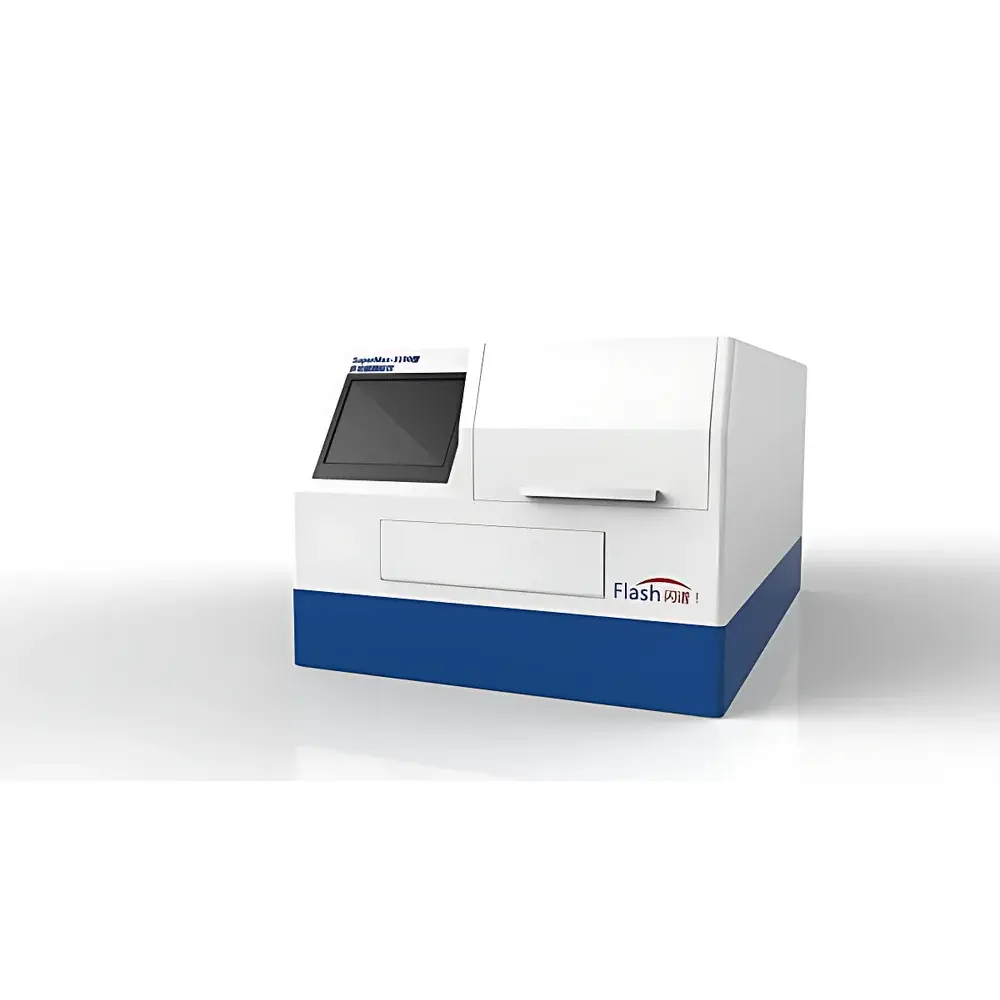
Flash Spectrum SuPerMax-3100 Multimode Microplate Reader
| Brand | Flash Spectrum |
|---|---|
| Origin | Shanghai, China |
| Model | SuPerMax-3100 |
| Function Type | Multimode |
| Automation Level | Fully Automated Microplate Reader Workstation |
| Assay Modes | Endpoint Fluorescence, Absorbance, Chemiluminescence (ELISA/EIA) |
| Curve Fitting Options | Multiple nonlinear regression models (e.g., 4PL, 5PL, linear, quadratic, log-log) |
| Detectors | Photodiode (Absorbance), PMT (Fluorescence), Photon Counting PMT (Chemiluminescence) |
| Wavelength Range | 190–1000 nm |
| Wavelength Accuracy | ±1.0 nm |
| Wavelength Repeatability | <0.2 nm |
| Excitation & Emission Monochromators | Dual high-resolution grating monochromators |
| Bandwidth | Adjustable from 2 to 20 nm |
| Temperature Control Range | Ambient to 65 °C |
| Plate Formats | Standard 96-well (customizable to 24-, 384-, 1536-well) |
| Dispensing Capability | Dual-channel liquid handler (expandable to quad-channel) |
| Reading Modes | Top-read and bottom-read fluorescence |
| Kinetic & Spectral Scanning | Supported |
| Software Compliance | IQ/OQ/PQ validated |
Overview
The Flash Spectrum SuPerMax-3100 Multimode Microplate Reader is an engineered platform for quantitative and kinetic analysis of biological assays in life science research and pharmaceutical development. Built upon a dual-grating monochromator architecture, it enables precise excitation and emission wavelength selection across a broad spectral range (190–1000 nm), supporting absorbance, fluorescence intensity, time-resolved fluorescence, fluorescence polarization (optional), and chemiluminescence detection modalities. Its optical design—featuring separate photodiode, high-gain PMT, and photon-counting PMT detectors—ensures optimal signal-to-noise performance across assay types. The instrument integrates temperature-controlled incubation (up to 65 °C), orbital shaking, and on-board liquid handling, enabling end-to-end automation of complex ELISA, enzyme kinetics, cell-based, and reporter gene workflows without external peripherals.
Key Features
- Dual high-resolution grating monochromators for independent excitation and emission wavelength programming (190–1000 nm), with bandwidth tunable from 2 to 20 nm
- Triple-detector architecture: silicon photodiode for absorbance (OD 0–4.0), low-noise PMT for fluorescence, and photon-counting PMT for ultra-low-light chemiluminescence
- Temperature-controlled microplate incubation (ambient to 65 °C) with programmable ramping and hold profiles
- Integrated dual-channel dispenser (expandable to four channels), delivering 20–2000 µL per well with ≤2% CV precision
- Top- and bottom-reading fluorescence modes, plus single-well multi-point scanning for heterogeneous cell-layer assays
- Kinetic, endpoint, and spectral scanning acquisition modes—including full excitation/emission matrix scanning for spectral fingerprinting
- On-board orbital shaker (200–1200 rpm) with programmable duration and pause intervals
- USB 2.0 interface for direct PC control; compatible with Windows-based S-Pro Microplate Analysis Workstation software
Sample Compatibility & Compliance
The SuPerMax-3100 supports standardized microplate formats including 96-, 384-, and 1536-well plates, as well as cuvette-based measurements via an integrated standard spectrophotometer path. It accommodates diverse sample types—from purified proteins and nucleic acids to adherent and suspension cells—and is routinely employed in UV-based quantification (A260/A280), fluorometric assays (e.g., PicoGreen®, GFP, luciferase), enzymatic activity profiling (kinases, phosphatases, proteases), ATP and ROS detection, cytotoxicity (MTT/XTT/LDH), and SNP genotyping. Regulatory compliance includes full IQ/OQ/PQ documentation, audit-trail-enabled software meeting FDA 21 CFR Part 11 requirements, and operational alignment with GLP and GMP quality systems. All firmware and calibration protocols are traceable to NIST-traceable standards.
Software & Data Management
The S-Pro Microplate Analysis Workstation provides a unified environment for instrument control, protocol definition, real-time data visualization, and statistical analysis. It supports over 20 built-in curve-fitting algorithms—including four-parameter logistic (4PL), five-parameter logistic (5PL), sigmoidal, exponential decay, and Michaelis-Menten—essential for dose-response, IC50, EC50, and Km determination. Raw data export is available in CSV, Excel, and XML formats; metadata tagging enables sample tracking, user authentication, and role-based access control. Electronic signatures, session logs, and change history are fully auditable. The software architecture permits integration with LIMS and ELN platforms via standard API interfaces.
Applications
- High-throughput screening (HTS) of compound libraries in drug discovery
- Quantitative immunoassays (ELISA, EIA) and cytokine profiling
- Enzyme kinetics and inhibitor characterization (e.g., kinase, protease, phospholipase assays)
- Nucleic acid quantification and integrity assessment (dsDNA, ssDNA, RNA)
- Reporter gene assays (luciferase, β-galactosidase, GFP variants)
- Intracellular signaling analysis (cAMP, Ca2+, ATP, ROS)
- Cell viability, proliferation, and cytotoxicity assessment (MTT, XTT, LDH, resazurin)
- Microbial growth monitoring and endotoxin detection
- SNP genotyping and molecular probe hybridization studies
FAQ
Does the SuPerMax-3100 support fluorescence polarization (FP) measurements?
Yes—FP capability is available as an optional hardware module, enabling measurement of molecular binding events and conformational changes.
Can the instrument perform kinetic assays with reagent injection during reading?
Yes—the integrated dual-channel dispenser supports synchronized dispensing and kinetic acquisition, with minimum interval resolution of 1 second.
Is the software validated for regulated environments such as pharmaceutical QC labs?
Yes—S-Pro software includes full 21 CFR Part 11 compliance features: electronic signatures, audit trails, user access tiers, and password policies.
What plate formats are supported natively without adapter plates?
Standard 96-well plates are fully supported; 384- and 1536-well formats require optional optical adapters calibrated for reduced crosstalk and optimal focal depth.
How is wavelength accuracy verified and maintained?
Wavelength calibration uses certified holmium oxide and didymium filters; automated self-check routines run at startup and can be scheduled daily or weekly.
Is remote monitoring or networked operation possible?
While the base configuration uses USB connectivity, optional Ethernet interface kits enable LAN-based control and centralized fleet management in core facilities.