
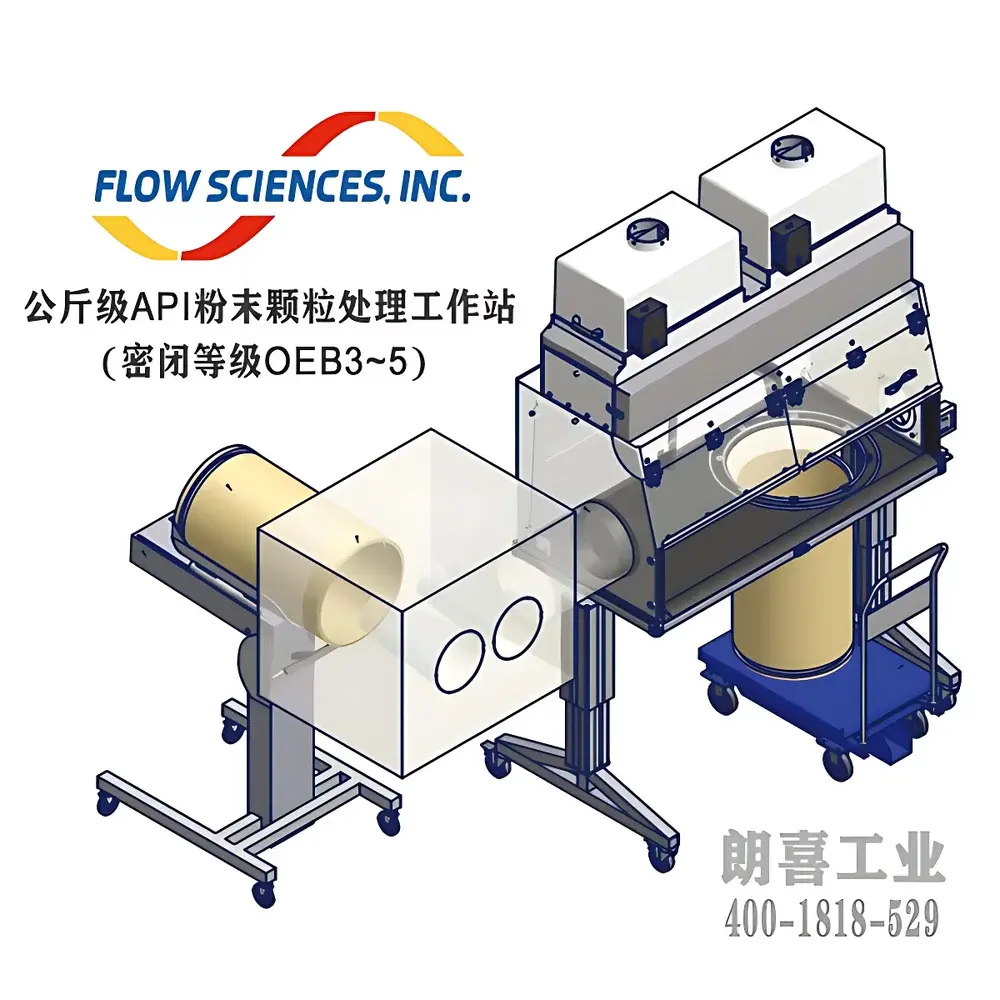
Flow Sciences FSOEB High-Containment API Powder Handling Workstation
| Brand | Flow Sciences (FSI) |
|---|---|
| Origin | USA |
| Manufacturer Type | Authorized Distributor |
| Origin Category | Imported |
| Model | FSOEB |
| Pricing | Available Upon Request |
Overview
The Flow Sciences FSOEB High-Containment API Powder Handling Workstation is an engineered containment solution designed for the safe, reproducible handling of highly potent active pharmaceutical ingredients (APIs) in laboratory, pilot-scale, and manufacturing environments. Built upon Couette-flow–optimized airflow dynamics and validated negative-pressure containment architecture, the FSOEB operates within Occupational Exposure Band (OEB) levels 3 to 5—corresponding to occupational exposure limits (OELs) as low as 10 ng/m³. Unlike conventional rigid isolators, this workstation integrates a flexible glovebox-style front panel with integrated sleeve ports and a motorized drum manipulator arm, enabling full operator separation from hazardous powders during weighing, dispensing, sampling, and container transfer operations. Its modular design supports seamless integration into existing cleanroom infrastructure and complies with core principles of ISO 14644-1 (cleanroom classification), ISO 10648-2 (containment performance), and ICH Q5C (stability testing of biotechnological products requiring controlled environments).
Key Features
- Validated OEB3–OEB5 containment performance per ISO 10648-2 Annex B protocols, confirmed via tracer gas (SF₆) challenge testing and particle aerosol challenge (using polydisperse NaCl aerosols ≤5 µm)
- Integrated motorized drum manipulator arm with 3-axis articulation, programmable positioning, and torque-limited gripper—capable of handling drums from 5 L to 200 L with ±0.5° angular repeatability
- Flexible front shield constructed from FDA-compliant, static-dissipative PVC with dual-layer laminar airflow (LAF) sleeves; each sleeve features independent HEPA-filtered supply (≥99.99% @ 0.3 µm) and exhaust filtration (dual-stage: prefilter + ULPA @ 99.9995% @ 0.12 µm)
- Real-time differential pressure monitoring across all critical zones (interior vs. ambient, glovebox vs. antechamber), logged with timestamped audit trail per FDA 21 CFR Part 11 requirements
- Structural frame fabricated from electropolished 316L stainless steel with welded seams and passivated surface finish—certified to ASTM A967 for corrosion resistance in high-humidity and solvent-exposed settings
- Modular footprint (standard configuration: 1200 mm W × 800 mm D × 2100 mm H) with optional floor-mounted or benchtop mounting kits and integrated utility raceways for vacuum, compressed air, and electrical feedthroughs
Sample Compatibility & Compliance
The FSOEB accommodates a broad range of powder handling tasks involving crystalline APIs, amorphous intermediates, micronized excipients, and cytotoxic oncology compounds. Compatible vessel types include glass vials (2–50 mL), HDPE/SS-lined bottles (100–500 mL), stainless-steel drums (30–200 L), and flexible intermediate bulk containers (FIBCs) up to 1 m³. All internal surfaces are non-porous and chemically resistant to common solvents (e.g., IPA, acetone, dichloromethane) and cleaning agents (e.g., sodium hypochlorite, hydrogen peroxide vapor). The system meets GMP-aligned engineering controls per EU Annex 1 (2022 revision), supports GLP documentation workflows, and enables qualification under ASTM E2955-14 (Standard Guide for Evaluating Containment Performance of Isolators and Gloveboxes).
Software & Data Management
The onboard control unit runs embedded Linux-based firmware with a 7-inch capacitive touchscreen interface. It records and exports operational data—including airflow velocity profiles (ISO 14644-3 compliant), pressure differentials, filter saturation status, door interlock events, and manipulator position logs—in CSV and PDF formats. Audit trails are immutable, time-stamped, and user-authenticated (role-based access: Operator, Technician, QA Reviewer). Data export supports direct integration with LIMS (e.g., LabWare, Thermo Fisher SampleManager) and electronic batch record (EBR) systems. Optional OPC UA server module enables real-time telemetry to MES platforms such as Siemens Opcenter or Rockwell FactoryTalk.
Applications
- High-potency API weighing and dispensing under OEB4/OEB5 conditions
- Charge transfer between reactors, dryers, and milling equipment without open handling
- Stability sample preparation and packaging under inert atmosphere (N₂ or Ar purge option available)
- Process development support for continuous manufacturing lines requiring closed powder transfer
- QC lab handling of reference standards and impurity spikes with trace-level exposure control
- Facility retrofitting where traditional hard-wall isolators are cost-prohibitive or space-constrained
FAQ
What OEB levels does the FSOEB validate to—and how is validation documented?
The FSOEB is validated to OEB3 through OEB5 per ISPE’s “Risk-Based Approach to Containment” guidelines. Full validation packages—including IQ/OQ/PQ protocols, SF₆ leak testing reports, and particle challenge results—are provided with each unit.
Can the manipulator arm be retrofitted to handle custom container geometries?
Yes—the end-effector is configurable with interchangeable grippers (clamping, vacuum, magnetic) and supports CAD-based path programming for non-standard vessels.
Is the system compatible with nitrogen purging for oxygen-sensitive compounds?
Standard configurations include two dedicated N₂ inlet ports with mass flow controllers; inert atmosphere mode maintains <10 ppm O₂ throughout operation.
How frequently must HEPA/ULPA filters be replaced, and is predictive maintenance supported?
Filter life is monitored via real-time ΔP sensors; typical service intervals range from 6–12 months depending on usage intensity. Predictive alerts are triggered at 80% pressure drop threshold and logged in the audit trail.
Does Flow Sciences provide installation qualification (IQ) support for regulated facilities?
Yes—FSI-certified field engineers perform on-site IQ execution, including dimensional verification, airflow mapping, and interlock functional testing, with deliverables compliant with EU GMP Annex 15 and FDA Process Validation Guidance.



