
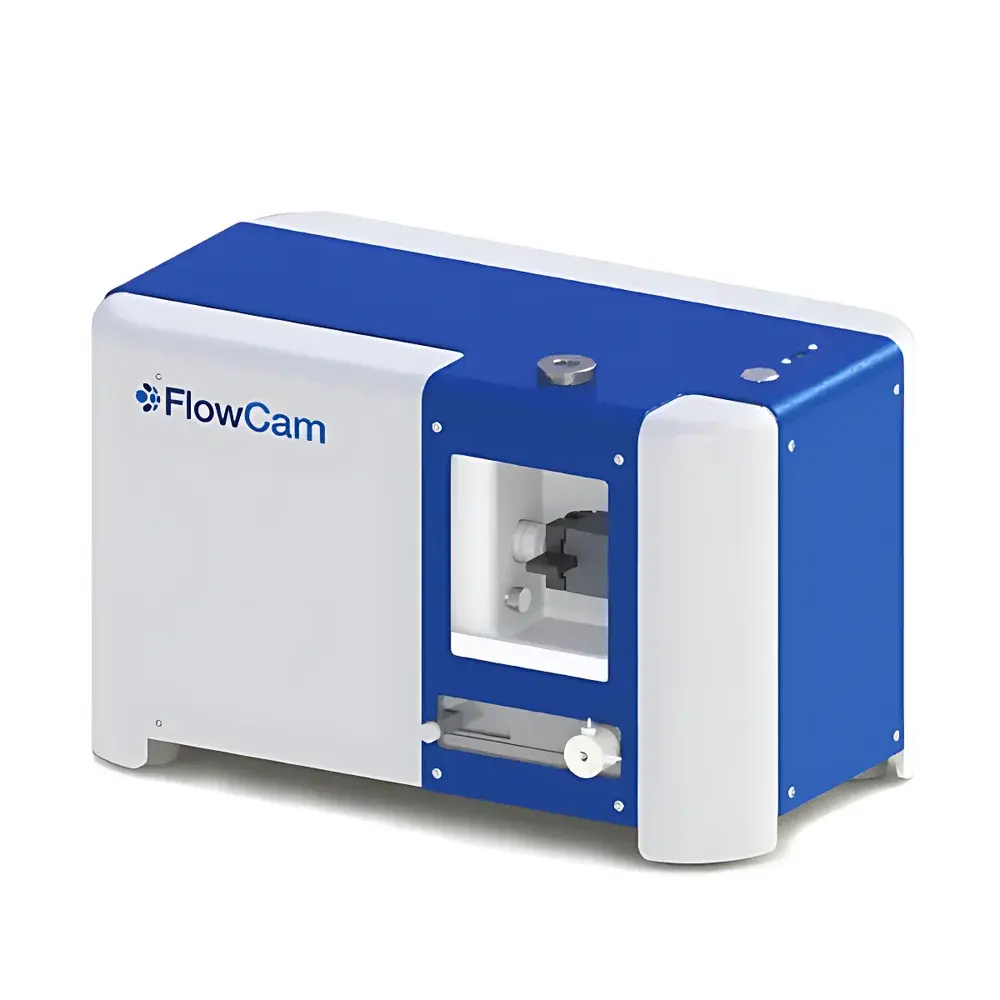
FlowCam 5000 Flow Imaging Microscope System
| Brand | FlowCam |
|---|---|
| Origin | Japan |
| Model | FlowCam 5000 |
| Particle Size Range | 3–300 µm |
| Camera Resolution | 1920 × 1200 pixels (color CMOS) |
| Frame Rate | up to 100 fps |
| Optical Configurations | 4X (300 µm depth), 10X (100 µm depth), 20X (50 µm depth) |
| Sample Flow Rate | 0.05–2 mL/min |
| Max Particle Concentration | 4 × 10⁶ particles/mL (at 3 µm) |
| Dimensions | 44 × 25 × 27 cm |
| Weight | 10 kg (operational), 24 kg (shipping) |
| Power Consumption | ≤92 W |
Overview
The FlowCam 5000 Flow Imaging Microscope System is an engineered solution for high-throughput, non-destructive, image-based particle characterization in liquid suspensions. Developed by Yokogawa Fluid Imaging Technologies and manufactured in Japan, it implements flow imaging microscopy (FIM)—a validated orthogonal method to light obscuration—as defined in USP <1788> for subvisible particle analysis in biopharmaceutical development and quality control. Unlike static microscopy or ensemble-averaging techniques, the FlowCam 5000 captures individual particle images in real time as they transit a precision optical flow cell under laminar flow conditions. Each particle is imaged across its full width and depth at high magnification, enabling direct measurement of size, shape, transparency, and color—without assumptions or statistical modeling. The system’s compact footprint (44 × 25 × 27 cm), integrated computing platform, and modular optical design support deployment in regulated laboratories, field environments, and mobile analytical units without infrastructure modification.
Key Features
- Real-time flow imaging microscopy with synchronized fluid sensing and image capture
- Three interchangeable optical configurations: 4X (300 µm flow cell depth), 10X (100 µm), and 20X (50 µm), each optimized for specific particle size ranges (2–300 µm)
- High-resolution color CMOS camera (1920 × 1200 pixels) with adjustable shutter speed up to 100 frames per second
- Manual focusing mechanism with calibrated Z-axis positioning for consistent depth-of-field control
- Micro-infusion pump system with selectable syringe volumes (0.5, 1, or 5 mL) for precise, low-shear sample delivery
- Integrated VisualSpreadsheet software for automated image segmentation, parameter extraction, and multivariate classification
- Compliance-ready architecture supporting audit trails, user access controls, and electronic signature capability per FDA 21 CFR Part 11 requirements
- Self-contained operation: no external PC or peripherals required; all processing occurs onboard
Sample Compatibility & Compliance
The FlowCam 5000 accepts aqueous and organic suspensions, including buffers, cell culture media, purified water, seawater, and process streams—provided viscosity remains below 10 cP and particulate loadings stay within specified concentration limits (up to 4 × 10⁶ particles/mL at 3 µm). It is routinely applied in GLP- and GMP-regulated environments for biopharmaceutical particulate assessment per ICH Q5A(R2), USP <788>, <789>, and <1788>. Its orthogonal imaging methodology provides morphological context missing from light obscuration or laser diffraction, making it essential for root cause analysis of protein aggregates, silicone oil droplets, glass delamination fragments, and microbial contaminants. The instrument meets ISO/IEC 17025 traceability requirements when operated with certified calibration standards (e.g., NIST-traceable polystyrene microspheres). All data files retain native TIFF image metadata, original acquisition timestamps, and full parameter sets—enabling full reprocessing and regulatory review.
Software & Data Management
VisualSpreadsheet is a validated, single-platform software suite designed exclusively for FlowCam instruments. It supports method definition, acquisition control, real-time image preview, batch processing, and advanced morphometric analytics. Over 40 quantitative descriptors—including area, aspect ratio, circularity (Hu and standard), convexity, roughness, fiber straightness, biovolume estimates, RGB intensity distributions, and edge gradient profiles—are computed per particle. Users may apply Boolean logic filters (e.g., “circularity < 0.6 AND red/green ratio > 1.8”) to isolate subpopulations, generate histograms, export CSV/Excel reports, or produce annotated image galleries. Software versioning, change logs, and electronic signatures comply with ALCOA+ principles. Data integrity is preserved via immutable file structures: raw images, metadata, and analysis results are stored together in proprietary .fcm files, which remain readable across software updates. Optional ALH (Automated Liquid Handler) integration enables unattended multi-sample sequencing with barcode tracking and LIMS compatibility.
Applications
- Biopharmaceutical Development: Subvisible particle profiling of monoclonal antibodies, viral vectors, mRNA-LNPs, and cell therapies; aggregate morphology classification; silicone oil quantification; container closure integrity assessment
- Environmental Monitoring: Phytoplankton community analysis (diatoms, cyanobacteria, dinoflagellates); HAB (harmful algal bloom) early warning; microplastic identification and polymer typing in freshwater/marine systems
- Materials Science: Characterization of CMP slurries, toner particles, ceramic precursors, ion-exchange resins, and additive manufacturing powders
- Food & Beverage: Yeast viability and budding state assessment; starch granule morphology; fat globule distribution in dairy emulsions; contaminant screening (fibers, insect parts, mineral fragments)
- Water Quality: Real-time monitoring of filter breakthrough events; taste-and-odor organism enumeration (e.g., Geosmin-producing actinomycetes); diatom-based source water fingerprinting
- Academic Research: Quantitative plankton ecology; sediment grain shape analysis; pollen viability and dispersal modeling; microcapsule release kinetics validation
FAQ
What regulatory standards does the FlowCam 5000 support?
The system aligns with USP <1788> as a recommended orthogonal method for subvisible particle analysis and supports compliance with FDA 21 CFR Part 11, EU Annex 11, and ISO/IEC 17025 through configurable audit trails, electronic signatures, and secure data handling protocols.
Can the FlowCam 5000 differentiate between biological and non-biological particles?
Yes—using combined morphological parameters (e.g., convexity, texture, edge gradient) and spectral features (RGB ratios, transparency), VisualSpreadsheet enables supervised classification models to distinguish cells, spores, algae, and debris with documented reproducibility in peer-reviewed studies.
Is calibration required before each analysis?
While daily system suitability checks using traceable reference particles are recommended, the FlowCam 5000 maintains optical and hydraulic stability between calibrations due to its rigid mechanical architecture and temperature-compensated flow control—reducing routine recalibration frequency compared to traditional microscopes.
How is data integrity ensured during long-term deployments?
All acquired images and derived parameters are saved in tamper-evident .fcm files containing embedded hash values. Software enforces write-once-read-many (WORM) behavior for archived datasets, and optional network backup ensures redundancy without compromising chain-of-custody.
Does the FlowCam 5000 support Good Manufacturing Practice (GMP) workflows?
Yes—when deployed with appropriate SOPs, qualified hardware/software, and trained personnel, the FlowCam 5000 satisfies GMP expectations for particulate testing in final container release, stability studies, and process validation per ICH Q5A(R2) and WHO TRS 1010 Annex 5.



