
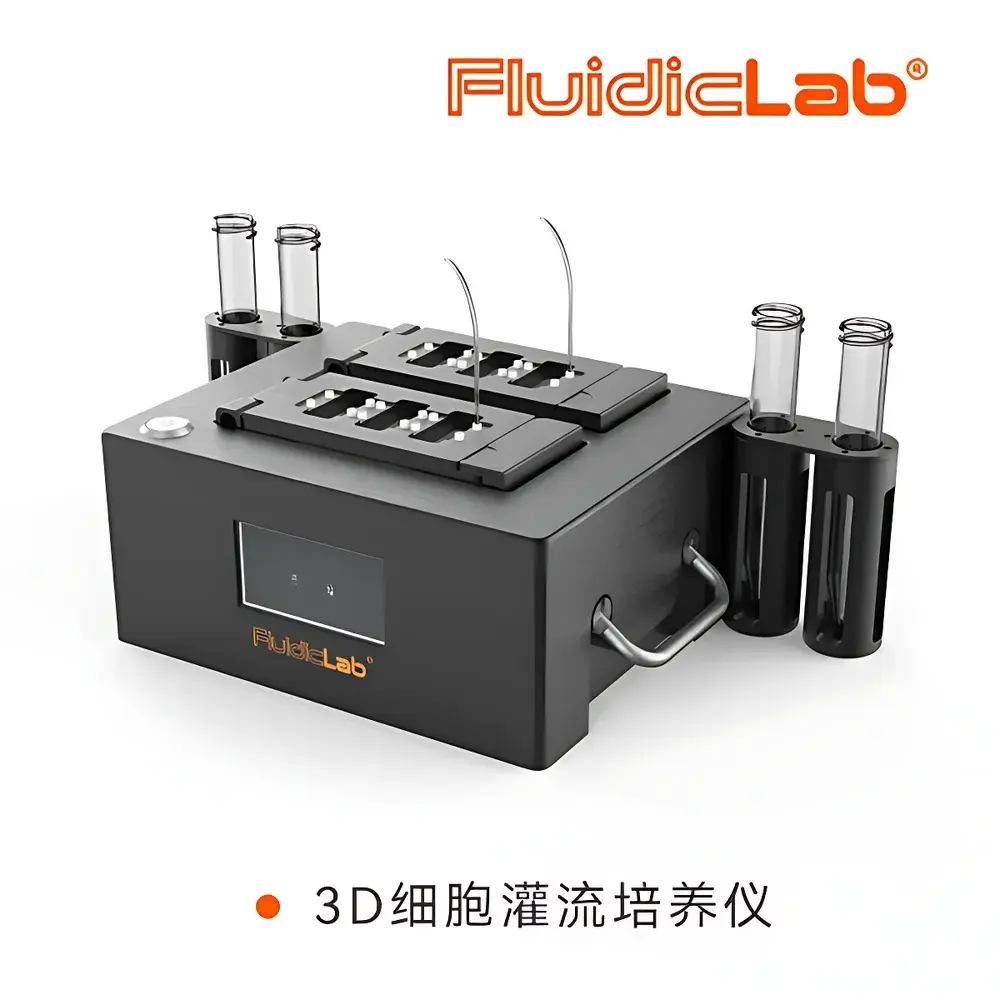
FluidicLab CCS-01 Microfluidic 3D Cell Perfusion Culture System
| Brand | FluidicLab |
|---|---|
| Origin | Shanghai, China |
| Manufacturer Type | Direct Manufacturer |
| Country of Origin | China |
| Model | CCS-01 |
| Instrument Type | Automated |
| Reservoir Volume | 15 mL |
| Dimensions (H×W×D) | 18 × 17.7 × 16 cm (including reservoir) |
| Temperature Control Range | 15–40 °C |
| Minimum Perfusion Volume | 1 mL |
| Flow Rate Range | 0.8–400 µL/min |
| Independent Fluid Channels | 2 or 4 |
| Tubing Compatibility | Tygon® L/S 0.38 mm ID / 0.8 mm OD |
| Pressure Limit | ≤0.1 MPa |
| Power Supply | AC 220 V, 50 Hz, <10 VA |
| Operating Temperature | 15–40 °C |
| Weight | 1.5 kg |
Overview
The FluidicLab CCS-01 Microfluidic 3D Cell Perfusion Culture System is an engineered platform designed to support long-term, physiologically relevant culture of organ-on-a-chip and organoid models under controlled dynamic flow conditions. Unlike static 2D monolayer cultures, the CCS-01 delivers continuous, low-shear perfusion through microfluidic channels—mimicking in vivo hemodynamic forces such as laminar shear stress and interstitial fluid transport. This mechanical stimulation is essential for maintaining epithelial barrier integrity, promoting polarized cell morphology, enhancing extracellular matrix deposition, and sustaining metabolic activity in 3D tissue constructs. The system operates within standard CO₂ incubators (15–40 °C), enabling seamless integration into existing cell culture workflows without requiring environmental modification. Its compact footprint (18 × 17.7 × 16 cm) and low power consumption (<10 VA) ensure compatibility with Class II biosafety cabinets and shared incubator spaces in academic and industrial laboratories.
Key Features
- Incubator-compatible design: Fully functional inside standard humidified CO₂ incubators at 15–40 °C, eliminating thermal drift and condensation risks during extended operation.
- Dual- or quad-channel architecture: Supports parallel culture of one (2-channel) or two (4-channel) standardized organ chips, enabling comparative experimental designs or multi-tissue co-culture studies.
- Precision micro-perfusion: Programmable flow rates from 0.8 to 400 µL/min per channel, calibrated for Tygon® tubing with inner diameters of 0.38 mm and 0.5 mm—ensuring reproducible shear stress profiles across biological replicates.
- Remote wireless control: Integrated Wi-Fi module enables real-time adjustment of flow parameters via web interface or mobile application, allowing operators to modify perfusion dynamics without opening the incubator door.
- Low-volume reservoir system: 15 mL integrated reservoirs minimize media consumption while supporting ≥1 mL minimum perfusion volume per cycle—reducing assay costs and waste generation by up to 70% compared to gravity-fed or syringe-pump alternatives.
- Modular chip interface: Standardized Luer-lock and microfluidic port geometry ensures compatibility with commercial and custom-fabricated organ chips (e.g., Emulate, Mimetas, or in-house PDMS/glass devices), facilitating rapid protocol transfer and validation.
Sample Compatibility & Compliance
The CCS-01 supports a broad range of 3D cellular models including intestinal, hepatic, renal, pulmonary, and blood-brain barrier organ chips, as well as spheroid- and scaffold-based organoids. All wetted materials—including fluidic pathways, reservoirs, and tubing interfaces—are USP Class VI-certified and non-cytotoxic per ISO 10993-5. The system complies with GLP-aligned documentation standards: audit trails for flow parameter changes are timestamped and user-logged, supporting traceability requirements under FDA 21 CFR Part 11 when paired with validated software configurations. While not certified as medical device hardware, the CCS-01 meets ISO/IEC 17025-relevant performance verification criteria for flow stability (±2% CV over 72 h) and temperature uniformity (±0.5 °C across reservoir and chip interface).
Software & Data Management
The CCS-01 is managed through a browser-based control suite compatible with Windows, macOS, and Linux. Each session generates a structured JSON log containing timestamps, setpoints, actual flow rates (via calibrated motor step counts), and ambient temperature readings. Export options include CSV and HDF5 formats for downstream analysis in MATLAB, Python (Pandas/NumPy), or commercial platforms such as GraphPad Prism. Firmware updates are delivered over-the-air via HTTPS-secured channels. For regulated environments, optional configuration locking and role-based access control (RBAC) modules are available to enforce SOP adherence and prevent unauthorized parameter modifications.
Applications
- Physiological modeling: Recapitulation of vascular perfusion, interstitial flow, and cyclic strain in tumor-on-chip or neurovascular unit models to study metastasis, immune cell trafficking, or blood–tissue barrier function.
- Drug development: Long-duration (≥14-day) exposure assays for pharmacokinetic–pharmacodynamic (PK-PD) correlation, metabolite accumulation profiling, and off-target toxicity screening under dynamic nutrient/oxygen gradients.
- Tissue engineering: Controlled delivery of morphogens and mechanical cues during stem cell differentiation and maturation—enabling scalable production of transplantable tissue constructs.
- Microbiome–host interaction: Co-culture of human epithelium with anaerobic gut microbiota under oxygen-controlled perfusion, supporting studies on barrier dysfunction and microbial metabolite signaling.
- Standardization & scalability: Platform adoption in core facilities for high-throughput organoid banking, biobanking, and QC testing of iPSC-derived lineages prior to CRISPR editing or transplantation.
FAQ
Can the CCS-01 be used outside of a CO₂ incubator?
Yes—while optimized for incubator use, it functions at ambient temperatures between 15–40 °C. External humidity control is recommended for >48 h runs to prevent evaporation from open reservoirs.
What tubing types are validated for use with the CCS-01?
Tygon® L/S 0.38 mm ID (0.8 mm OD) and L/S 0.5 mm ID (1.6 mm OD) are factory-calibrated. Other silicone or fluoropolymer tubing may be used but require manual flow recalibration using gravimetric or particle-tracking validation.
Is the system compatible with imaging platforms?
All chip carriers are designed for direct transfer to inverted microscopes, confocal systems, or high-content imagers without disassembly—preserving spatial orientation and flow continuity during live-cell imaging.
How is sterility maintained during multi-day experiments?
Reservoir caps feature hydrophobic PTFE membranes permitting gas exchange while blocking microbial ingress. Optional sterile filtration (0.22 µm) can be integrated upstream of each channel inlet.
Does the CCS-01 support closed-loop feedback control?
Not natively—but analog voltage outputs (0–5 V) are available for integration with external sensors (e.g., dissolved O₂, pH, or impedance electrodes) to trigger predefined flow adjustments via third-party DAQ systems.




