
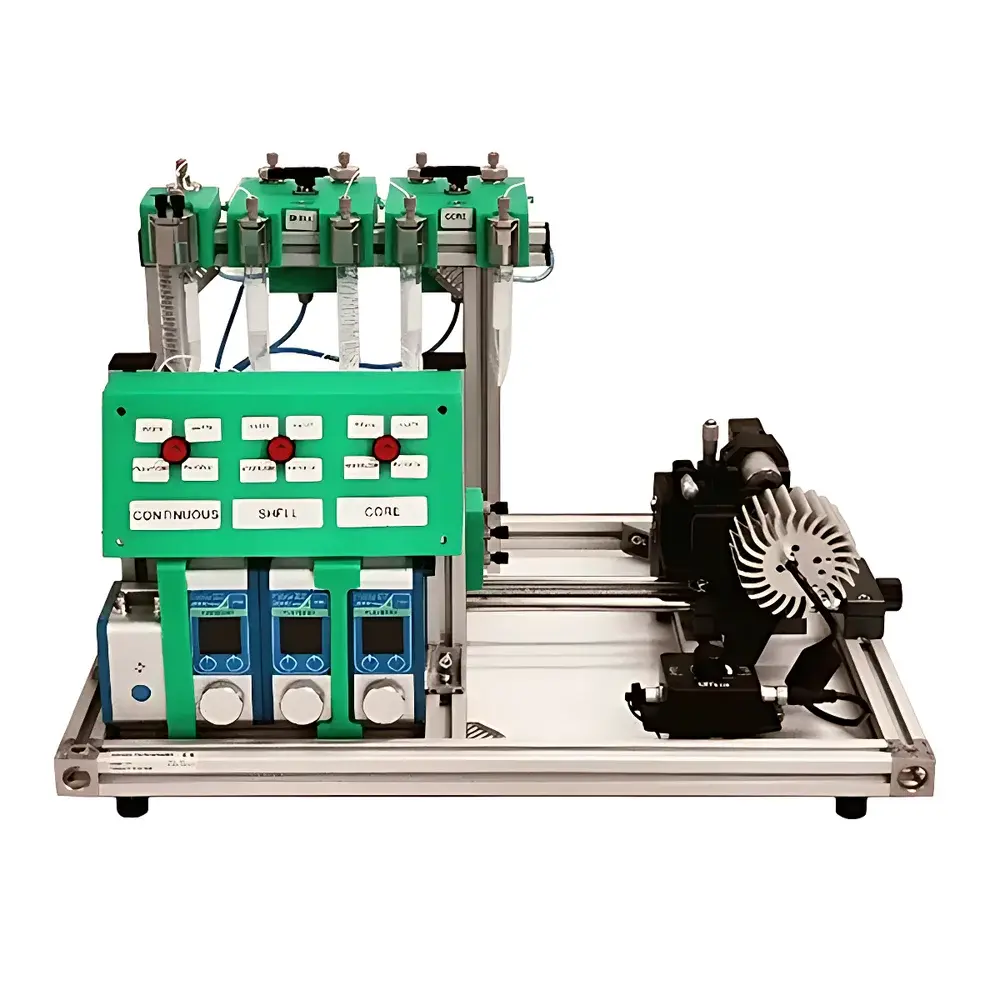
Fluigent Droplet Generation System
| Brand | Fluigent |
|---|---|
| Origin | France |
| Model | Fluigent-Droplet |
| Flow Rate Range | 1.5 µL/min to 5 mL/min (selectable) |
| Maximum Pressure | 0–7 bar |
| Compliance | CE-marked, RoHS-compliant |
| Pump Type | Precision Pneumatic Pressure Controller (FLOW-EZ series) |
| Sensor Integration | Real-time mass flow monitoring with ±1% full-scale accuracy |
| Chip Interface | Standardized PDMS/glass/silicon microfluidic chip mounting via modular夹具 (chip holder) |
| Control Architecture | Standalone or PC-synchronized via Fluigent’s MAESFLO™ software |
Overview
The Fluigent Droplet Generation System is a modular, pressure-driven microfluidic platform engineered for reproducible, monodisperse droplet formation across single-emulsion (e.g., water-in-oil), double-emulsion (e.g., w/o/w, o/w/o), and complex core-shell architectures. Unlike peristaltic or syringe-based systems, this system employs Fluigent’s FLOW-EZ pneumatic pressure controllers—certified ISO 9001-manufactured instruments—to deliver ultra-stable pressure output (0–7 bar, resolution <0.01 bar) and precise volumetric flow control (1.5 µL/min to 5 mL/min) without pulsation or backflow. Droplet generation relies on hydrodynamic focusing or co-flow geometries within microfabricated chips, where interfacial tension, capillary number (Ca), and flow rate ratios govern size, frequency, and polydispersity. The system operates on the principle of continuous-phase pressure regulation coupled with real-time feedback from integrated thermal mass flow sensors, enabling closed-loop stability critical for GLP-compliant formulation development.
Key Features
- Modular architecture supporting single-, double-, and multi-phase emulsification workflows without hardware reconfiguration
- FLOW-EZ pressure controllers with digital PID regulation, <0.5% pressure drift over 24 h, and <10 ms response time
- Real-time flow monitoring via calibrated thermal mass flow sensors (±1% FS accuracy, NIST-traceable calibration certificate available)
- Standardized chip holder accommodating PDMS, glass, silicon, and hybrid microfluidic devices (up to 100 mm × 50 mm footprint)
- Integrated filtration options (0.22 µm PTFE or PVDF membrane filters) for solvent- and bio-compatible operation
- MAESFLO™ software interface supporting automated protocol scripting, data logging (CSV/TXT export), and synchronization with high-speed imaging systems
Sample Compatibility & Compliance
The system accommodates aqueous, organic, and fluorinated carrier phases—including PBS, ethanol, chloroform, FC-40, and HFE-75—as well as viscous polymer solutions (e.g., PLGA in DCM, alginate in CaCl₂). Chip materials are compatible with standard photolithography, soft lithography, and UV-curable resins. All Fluigent components comply with EU Directive 2014/30/EU (EMC), 2011/65/EU (RoHS), and carry CE marking. When configured with audit-trail-enabled MAESFLO™ v4.2+ and external timestamped storage, the system meets FDA 21 CFR Part 11 requirements for electronic records and signatures in regulated environments. Protocols align with ASTM D7589 (emulsion stability testing) and ISO 13320 (laser diffraction particle sizing) for downstream characterization.
Software & Data Management
MAESFLO™ provides deterministic control over pressure ramps, step profiles, and multi-channel coordination. It supports Python API integration for custom automation (e.g., coupling with LabVIEW or MATLAB for closed-loop size feedback). All sensor data—including pressure, flow, temperature (optional), and timestamp—are logged at user-defined intervals (10 Hz max) with metadata tagging (operator ID, protocol version, chip lot number). Export formats include CSV, HDF5, and XML for compatibility with MATLAB, Python (pandas), and LIMS platforms. Audit trails record all parameter changes, user logins, and software updates—retained for ≥36 months per GLP archive policies.
Applications
- Pharmaceutical R&D: Encapsulation of APIs into PLGA, chitosan, or liposomal carriers; controlled-release kinetics modeling; high-throughput screening of emulsion stability under accelerated conditions
- Cosmetic science: Monodisperse fragrance or vitamin E microcapsules for sustained dermal delivery; silicone-in-water emulsions with <3% CV diameter distribution
- Food colloids: Encapsulation of probiotics or omega-3 oils in whey protein or maltodextrin matrices; texture engineering via droplet size modulation
- Diagnostic microsystems: Generation of picoliter-volume reaction chambers for digital PCR or single-cell lysis assays
- Materials synthesis: Templated fabrication of porous silica, magnetic nanoparticles, or hydrogel microparticles with tunable crosslinking density
- Chemical process intensification: Segmented flow reactors for exothermic oxidation or Suzuki coupling with residence time control <1 s
FAQ
What chip formats are natively supported?
Standard chip footprints include 25 mm × 75 mm (microscope slide format) and 10 mm × 10 mm (compact cartridge); custom layouts up to 100 mm × 50 mm are accommodated via adjustable clamping mechanism.
Can the system generate double emulsions with <5% polydispersity index (PDI)?
Yes—when paired with Raydrop® dual-orifice chips and optimized flow ratios, typical PDI values range from 1.8% to 3.2% (measured by dynamic light scattering post-collection).
Is remote operation supported?
Yes—MAESFLO™ includes Ethernet and USB-C connectivity; secure remote access is enabled via SSH-tunneled VNC or RESTful API endpoints.
Do you offer chip fabrication services?
Yes—our Beijing-based microfabrication lab provides rapid prototyping (SU-8, PDMS, glass) and low-volume production (≤500 units/chip design) with NDA-backed IP protection.
How is calibration maintained over time?
Annual recalibration service includes sensor verification against NIST-traceable flow standards, pressure transducer linearity checks, and firmware validation per ISO/IEC 17025 guidelines.



