
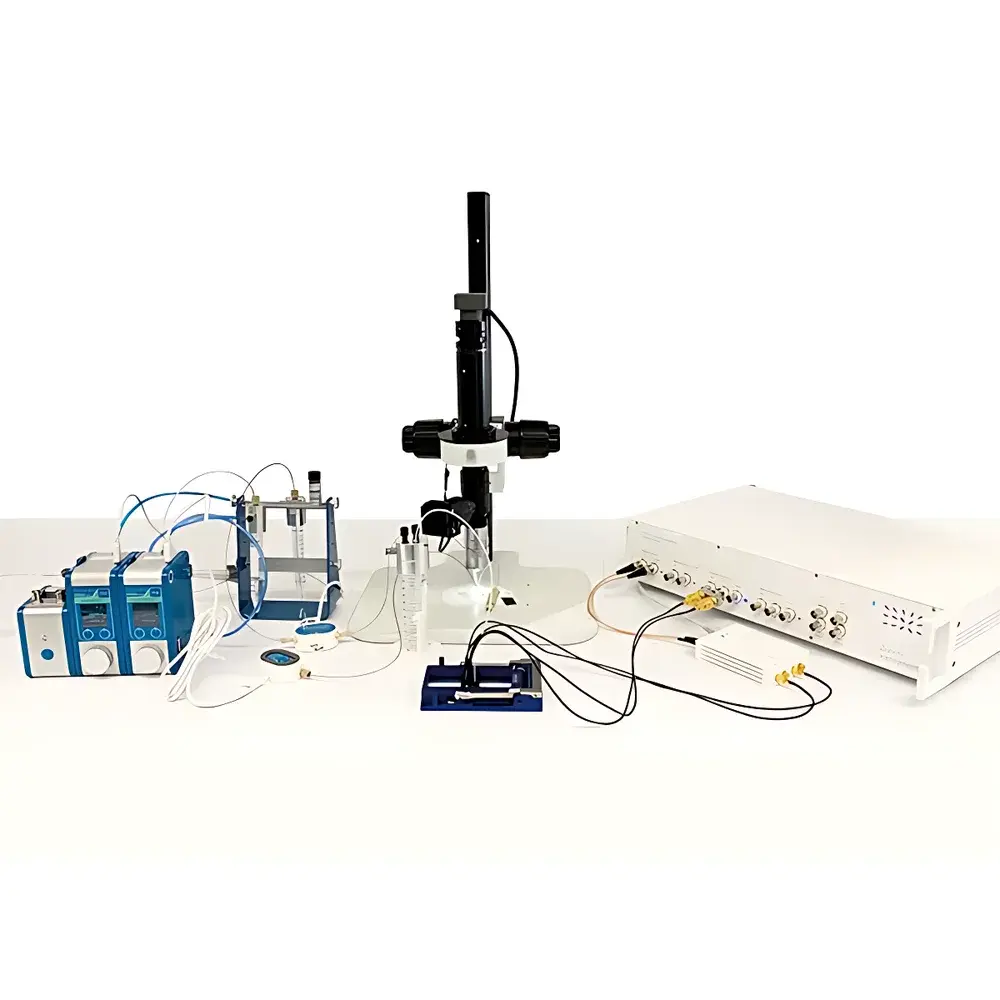
Fluigent EISP Microfluidic Dynamic Electrical Impedance Spectroscopy System
| Brand | Fluigent |
|---|---|
| Origin | France |
| Manufacturer Type | Authorized Distributor |
| Origin Category | Imported |
| Model | Fluigent-EISP |
| Pricing | Contact for Quotation |
Overview
The Fluigent EISP Microfluidic Dynamic Electrical Impedance Spectroscopy System is a precision-engineered platform for label-free, real-time, high-throughput analysis of biological and synthetic particles in microfluidic environments. It operates on the fundamental principle of electrochemical impedance spectroscopy (EIS), where a small-amplitude alternating current (AC) voltage is applied across integrated microelectrode pairs embedded in a microfluidic chip. As cells, droplets, or microparticles traverse the sensing region—typically defined by the inter-electrode gap—their dielectric properties perturb the local electric field, inducing measurable changes in complex impedance (Z*, expressed as magnitude and phase). These perturbations are captured with high temporal resolution via lock-in amplification, enabling quantitative detection of particle size, morphology, membrane integrity, and internal conductivity without fluorescent labeling or fixation. The system is co-developed by Fluigent (France), Micronit (Switzerland), and Zurich Instruments (Switzerland), integrating robust microfluidic actuation, low-noise signal conditioning, and synchronized optical validation.
Key Features
- Modular architecture combining pressure-driven microfluidics (Fluigent MFCS™-EZ or Flow EZ series), high-precision flow sensors, and custom EIS microchips (e.g., EISH1530)
- Dual-pair electrode configuration within the microchannel for differential impedance sensing, minimizing common-mode noise and enhancing signal fidelity
- Integrated Zurich Instruments HF2LI Lock-in Amplifier for multi-frequency impedance acquisition (up to 50 MHz bandwidth, 128 kHz sampling rate), supporting simultaneous measurement at up to six discrete frequencies per particle transit
- Optically synchronized detection using inverted microscope equipped with high-speed CCD camera (≥1000 fps), enabling correlative impedance–morphology analysis
- EISH1530 EIS Test Package includes standardized microfluidic chip, reusable chip holder with precision alignment features, fluidic interconnects (PEEK/PTFE tubing, nanoport fittings), and shielded coaxial electrical interfaces for minimal crosstalk
- Engineered for reproducible chip mounting and leak-tight operation—reducing chip failure rate and improving measurement repeatability (CV < 3% for monodisperse bead standards)
Sample Compatibility & Compliance
The EISP system supports aqueous suspensions of mammalian cells (e.g., Jurkat, HeLa), bacteria (E. coli, S. aureus), yeast, lipid vesicles, polymer microspheres, and water-in-oil or oil-in-water emulsion droplets (1–100 µm diameter range). Sample conductivity must fall within 0.01–1.5 S/m to ensure optimal signal-to-noise ratio. All microfluidic chips are fabricated from biocompatible, plasma-cleanable glass or silicon-glass hybrid substrates, compliant with ISO 10993-5 (cytotoxicity) and USP Class VI requirements. The system architecture supports GLP/GMP-aligned workflows: audit trails for instrument parameters, user access control, and raw data export in HDF5 and CSV formats—facilitating compliance with FDA 21 CFR Part 11 when deployed with validated software configurations.
Software & Data Management
Data acquisition and real-time processing are performed via Zurich Instruments LabOne® software, providing intuitive graphical interface for frequency sweep setup, harmonic analysis, and time-resolved impedance trace visualization. Custom Python and MATLAB APIs enable integration into automated pipelines for machine learning–based classification (e.g., live/dead cell discrimination, droplet composition inference). Raw impedance transients are timestamped and cross-referenced with optical frame numbers, ensuring traceability. All processed datasets include metadata tags (chip ID, flow rate, temperature, excitation frequency, gain settings), supporting FAIR (Findable, Accessible, Interoperable, Reusable) data principles. Exported files comply with MIAME and MIAPE reporting guidelines for impedance-based assays.
Applications
- Label-free cell counting and viability assessment in bioprocessing and CAR-T manufacturing
- High-throughput droplet screening in digital PCR and single-cell encapsulation workflows
- Real-time monitoring of bacterial growth kinetics and antibiotic susceptibility testing
- Characterization of extracellular vesicles and exosomes based on dielectric dispersion profiles
- Quality control of colloidal dispersions and functionalized nanoparticles in pharmaceutical formulations
- Microfluidic impedance cytometry for point-of-care diagnostics under ISO 15197:2013 analytical performance criteria
FAQ
What sample volume is required per measurement?
Typical analysis requires 10–100 µL of suspended sample, depending on concentration and desired statistical confidence.
Can the system be integrated with existing microfluidic platforms?
Yes—standardized fluidic (1/16″ OD PTFE/PEEK) and electrical (SMA/SMB) interfaces allow seamless coupling with third-party chips or custom PDMS devices.
Is temperature control supported?
The system is compatible with external stage-mounted Peltier modules (±0.1 °C stability) and can be retrofitted with integrated thermal regulation upon request.
What is the minimum detectable particle size?
Under optimized conditions (low-noise electrodes, high-conductivity buffer), reliable detection extends down to ~1.2 µm polystyrene beads (equivalent to ~1.5 µm mammalian lymphocytes).
Does the EISP system support regulatory submissions?
While the hardware itself is not FDA-cleared, its modular design, data integrity features, and documentation support IQ/OQ/PQ validation protocols required for IVD and GMP applications.



