
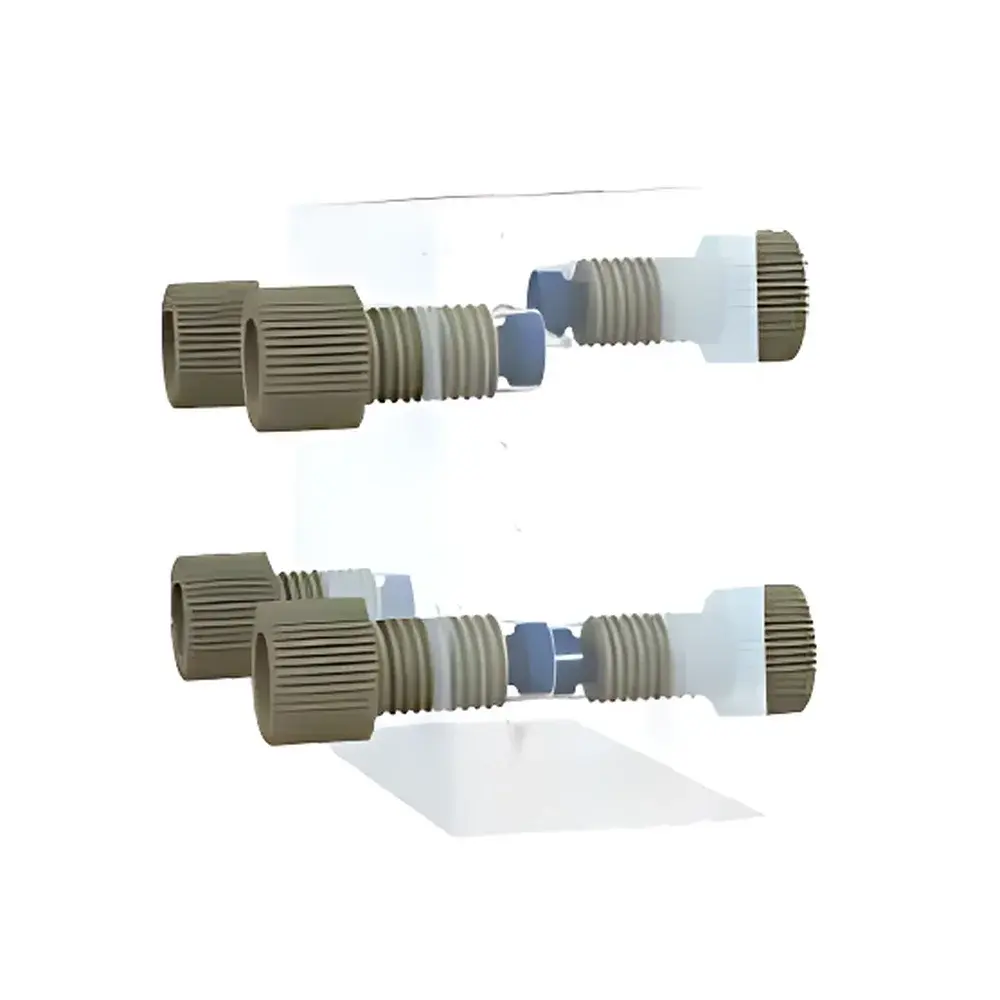
Fluigent EZ-Loop High-Precision Microfluidic Recirculation Valve
| Brand | Fluigent (France) |
|---|---|
| Origin | France |
| Model | EZ-Loop |
| Valve Type | 3-Port, 2-Position Recirculation Valve |
| Actuation | Pneumatic (External Pressure Source Required) |
| Material Compatibility | Compatible with Aqueous, Organic, and Mildly Corrosive Fluids |
| Operating Pressure Range | Up to 7 bar (100 psi) |
| Internal Volume per Path | < 0.5 µL |
| Switching Time | < 100 ms |
| Repeatability | ±0.5% of full-scale flow |
| Compliance | CE Marked, RoHS Compliant |
| Software Integration | Fully Supported by Fluigent’s Oxygen™ Automation Platform (v4.0+) |
Overview
The Fluigent EZ-Loop is a purpose-engineered 3-port, 2-position microfluidic recirculation valve designed for precise, bidirectional fluid routing without flow reversal at the chip level. Unlike conventional multiport selectors or solenoid-based switches, the EZ-Loop employs a patented rotary actuation mechanism that physically rotates an internal ceramic rotor to alternate between two independent flow paths—ensuring zero dead volume, minimal carryover (< 0.1%), and uninterrupted unidirectional flow across the microfluidic device. This architecture is fundamentally distinct from standard switching valves: it enables true closed-loop recirculation in perfusion systems, where maintaining consistent shear stress, nutrient gradient integrity, and laminar flow directionality is critical—particularly in long-term organ-on-chip (OoC) and 3D cell culture applications. The valve operates pneumatically via an external regulated pressure source (typically 2–7 bar), eliminating electromagnetic interference and enabling use inside CO₂ incubators or near sensitive optical setups.
Key Features
- Zero-reversal recirculation: Maintains constant flow polarity across the microfluidic chip during valve actuation—critical for preserving endothelial monolayer integrity and avoiding shear-induced cell detachment.
- Ultra-low internal volume (< 0.5 µL per path): Minimizes sample dilution and transit delay; ideal for low-volume assays (e.g., single-cell secretion profiling or limited primary tissue perfusates).
- Sub-100 ms switching time with < 0.5% volumetric repeatability: Enables high-frequency perfusion protocols (e.g., pulsatile flow mimicking cardiac cycles) with deterministic timing control.
- Ceramic rotor and PEEK/PTFE wetted materials: Chemically resistant to aqueous buffers, ethanol, DMSO, and common cell culture media; compatible with sterilization via autoclaving (valve body only) or 70% ethanol flush.
- Direct integration with Fluigent Oxygen™ software: Supports scriptable sequence definition (e.g., “infuse 30 s → pause 10 s → recirculate 120 s”) with real-time event logging and hardware synchronization via TTL triggers.
- Modular mounting: Standard 1/4″-28 UNF ports accept 1/16″ OD tubing; compatible with Fluigent’s Flow-EZ and MFCS™-EZ pressure controllers for fully automated closed-loop flow regulation.
Sample Compatibility & Compliance
The EZ-Loop is validated for continuous operation with biological fluids including DMEM/F12, HBSS, collagenase solutions, and whole blood analogs (up to 10 cP viscosity). It meets ISO 13485 design control requirements for medical research instrumentation and carries CE marking under Directive 2014/30/EU (EMC) and 2014/35/EU (LVD). When deployed in GLP-compliant workflows—such as preclinical pharmacokinetic modeling or regulatory-grade tissue model validation—the valve supports audit-trail-enabled operation via Oxygen™’s FDA 21 CFR Part 11-compliant mode (user authentication, electronic signatures, immutable action logs). Its inert fluid path eliminates leachables, satisfying USP extractables testing thresholds for Class VI polymers.
Software & Data Management
Oxygen™ v4.2+ provides native driver support for the EZ-Loop, enabling synchronized control alongside Fluigent’s pressure pumps, flow sensors, and temperature modules. Users define recirculation sequences using a graphical timeline editor or Python API (via fluigent-sdk), with automatic compensation for system compliance and tubing elasticity. All valve state transitions are timestamped with microsecond precision and exported in HDF5 format—including correlated pressure/flow traces—ensuring full traceability for publication or regulatory submission. Batch export templates conform to MIAME/MINSEQE metadata standards, facilitating integration into LIMS environments.
Applications
- Organ-on-chip perfusion: Sustained recirculation of conditioned media in liver, kidney, or blood-brain barrier chips without flow stagnation or backpressure spikes.
- Microphysiological system (MPS) automation: Integration into multi-organ array platforms requiring phase-synchronized media exchange across interconnected units.
- Controlled drug exposure studies: Precise temporal delivery of compounds followed by washout and re-exposure cycles within the same chamber.
- Microbial biofilm maintenance: Continuous low-shear nutrient replenishment while preventing detachment during imaging intervals.
- OEM instrument development: Embedded recirculation logic in diagnostic microfluidic analyzers (e.g., point-of-care sepsis panels requiring serial plasma fractionation).
FAQ
Does the EZ-Loop require electrical power at the valve head?
No—it is purely pneumatic and requires only a clean, dry compressed air or nitrogen supply (2–7 bar). No onboard electronics or wiring are needed at the valve location.
Can the EZ-Loop be used with viscous fluids like Matrigel or fibrinogen solutions?
Yes, provided viscosity remains ≤ 20 cP and particulates are filtered below 5 µm. Pre-wetting with ethanol followed by buffer conditioning is recommended for hydrogel precursors.
Is firmware update capability available?
Firmware resides exclusively in the Oxygen™ controller unit—not on the valve—and updates are performed via USB or Ethernet without interrupting connected hardware.
How is leak integrity verified during qualification?
Fluigent provides a standardized leak test protocol (ISO 15197 Annex B equivalent) using helium mass spectrometry; typical leak rate is < 1×10⁻⁹ mbar·L/s at 7 bar.
What is the mean time between failures (MTBF) under continuous recirculation duty?
Based on accelerated life testing at 5 Hz cycling, MTBF exceeds 2.1×10⁶ cycles (≈ 4.8 years at 12 h/day, 5 days/week).



