Fluigent Flow EZ–Based High-Performance Microfluidic Perfusion System for Cell Culture
| Brand | Fluigent |
|---|---|
| Origin | France |
| Model | Fluigent-perfusion |
| Automation Level | Fully Automated |
| Reservoir Capacity | mL-scale |
| Flow Rate Range | nL/min to mL/min |
| Flow Velocity Range | nL/min to mL/min |
Overview
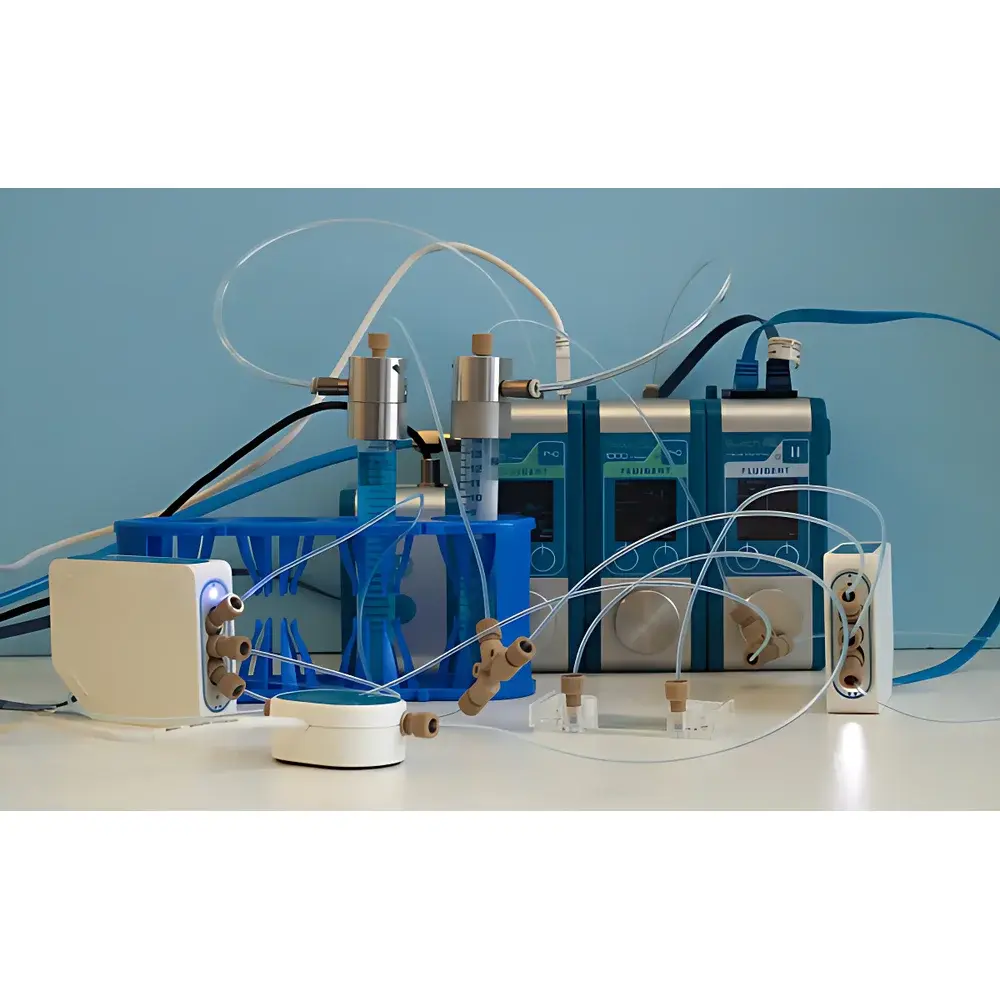
The Fluigent Flow EZ–Based High-Performance Microfluidic Perfusion System is an engineered solution for precise, stable, and programmable fluid delivery in live-cell microenvironmental studies. Built around Fluigent’s patented pressure-driven flow control architecture, the system leverages the Flow EZ precision pressure pump—capable of sub-mbar pressure resolution—and integrated high-speed microfluidic switching valves to achieve deterministic, pulseless perfusion across multiple parallel channels. Unlike peristaltic or syringe-based systems, this platform operates on a closed-loop pressure-to-flow principle, eliminating backflow, pulsation, and mechanical wear while maintaining nanoliter-level volumetric accuracy over extended durations (≥72 h continuous operation). It is specifically designed for applications demanding spatiotemporal fidelity in nutrient delivery, drug stimulation, waste removal, and microenvironmental gradient generation—core requirements in long-term live-cell imaging, organ-on-chip assays, and electrophysiological recordings.
Key Features
- Pressure-driven actuation with Flow EZ pump: 0–2000 mbar range, <±0.1% full-scale pressure stability, and real-time digital pressure feedback via USB/RS232 interface.
- Automated multi-port microvalve manifold: Up to 8 independent fluid paths with <50 ms switching latency and <1 µL dead volume per valve, enabling seamless sequence injection, recirculation, and timed bolus delivery.
- Modular Flow Unit integration: Optional mass-flow sensor modules (e.g., MFCS-EZ) provide closed-loop flow rate verification and active compensation for viscosity or temperature-induced drift.
- Plug-and-play compatibility: Standardized 1/16″ OD PTFE tubing connections, Luer-lock reservoir interfaces, and support for standard microfluidic chip formats (e.g., PDMS, glass, thermoplastic).
- Robust architecture for GMP-adjacent workflows: All wetted materials are USP Class VI compliant; system supports audit-trail logging when paired with Fluigent’s MAESFLO software under 21 CFR Part 11–configured environments.
Sample Compatibility & Compliance
The system accommodates a broad spectrum of biological samples—from adherent monocultures (e.g., HEK293, iPSC-derived neurons) to complex 3D co-cultures in microengineered scaffolds and organ-chips. It maintains sterility through gas-tight reservoirs, optional inline 0.22 µm filtration, and compatibility with laminar-flow hood integration. Regulatory alignment includes adherence to ISO 13485 design principles for medical device–related research use, and full traceability of pressure/flow logs meets GLP documentation standards for preclinical assay validation. The absence of moving parts in contact with media ensures minimal shear stress (<0.5 Pa) on sensitive primary cells and stem cell populations.
Software & Data Management
Control and orchestration are executed via Fluigent’s MAESFLO software (v4.2+), a Windows-based application supporting scriptable experimental protocols (Python API available), real-time pressure/flow monitoring, and synchronized timestamping with external devices (e.g., microscope shutters, electrophysiology amplifiers). All operational parameters—including valve state transitions, pressure setpoints, and duration-triggered events—are recorded in CSV and HDF5 formats with millisecond resolution. For regulated environments, optional MAESFLO Secure Mode enables electronic signatures, user role management, and immutable audit trails compliant with FDA 21 CFR Part 11 Annex 11 requirements.
Applications
- Long-term time-lapse live-cell imaging under controlled perfusion: Enables >48 h observation of morphological dynamics without media depletion or metabolite accumulation.
- Electrophysiological patch-clamp experiments requiring rapid solution exchange (e.g., agonist/antagonist application in neuronal or cardiac preparations).
- Gradient-based chemotaxis assays using dual-reservoir mixing configurations with spatially resolved concentration profiles (e.g., CXCL12 gradients for immune cell migration).
- Microphysiological system (MPS) maintenance: Sustained perfusion of liver-on-chip or blood-brain barrier models with physiological shear stress (0.5–5 dyn/cm²) and pulsatile flow patterns.
- High-content screening with automated reagent switching: Integration into automated microscopy platforms for multiplexed pharmacological profiling.
FAQ
What is the minimum controllable flow rate, and how is it verified?
The system achieves stable flow down to 1 nL/min using calibrated pressure–viscosity–geometry relationships; verification is performed via gravimetric measurement or integrated thermal mass-flow sensors (optional Flow Unit module).
Can the system be integrated with third-party microscopes or electrophysiology rigs?
Yes—TTL/USB/RS232 trigger inputs and outputs enable hardware synchronization with commercial imaging systems (e.g., Zeiss LSM, Nikon NIS-Elements) and amplifiers (e.g., Axon Instruments, HEKA).
Is sterilization of fluidic pathways supported?
All disposable fluidic components (tubing, reservoirs, connectors) are autoclavable or gamma-irradiated; the Flow EZ pump housing is cleanroom-compatible and may be decontaminated with 70% ethanol or isopropanol.
Does the system support gradient generation without external mixers?
Yes—via time-multiplexed valve sequencing across ≥2 independent pressure-controlled inlets, enabling dynamic linear or stepwise concentration gradients directly at the chip inlet.
What regulatory documentation is provided for GxP-aligned labs?
Fluigent supplies IQ/OQ documentation templates, material compliance certificates (USP Class VI, REACH, RoHS), and software validation packages upon request for GLP, GCP, or early-phase translational research use.