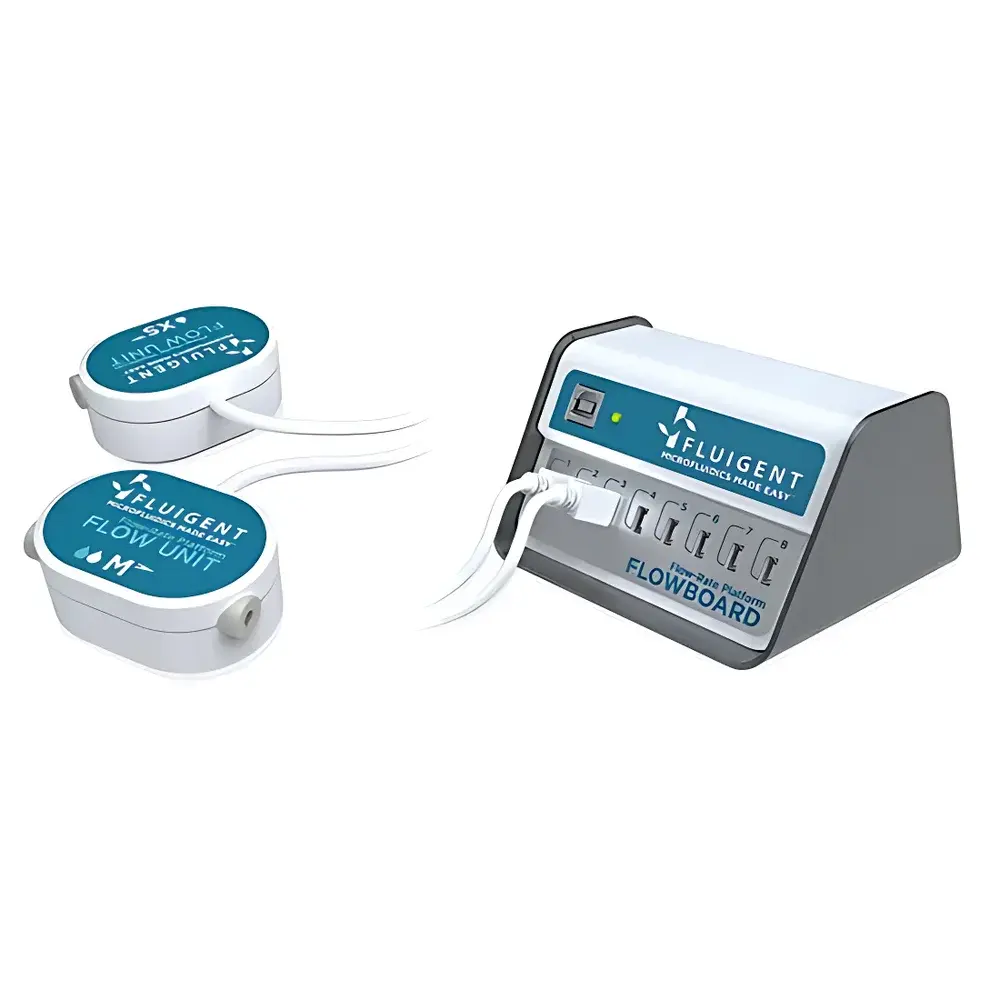
Fluigent Flow Unit High-Precision Microfluidic Thermal Mass Flow Sensor
| Brand | Fluigent |
|---|---|
| Origin | France |
| Model | Flow Unit |
| Flow Range Options | 7 nL/min to 5 mL/min |
| Accuracy | 5–20% MV (varies by range and flow rate) |
| Detection Limit | 3.7 nL/min (XS) to 3 µL/min (XL) |
| Max Pressure | 200 bar (XS/S), 100 bar (M), 12 bar (L), 5 bar (XL) |
| Channel ID | 25 µm to 1.8 mm |
| Construction | PEEK & Fused Silica |
| Compatible Media | Water, Isopropanol |
| Interface | Analog (0–5 V / 4–20 mA) & Digital (I²C, SPI) |
| Supported Platforms | FLOWBOARD (up to 8 units), Flow-EZ, AIO Software |
Overview
The Fluigent Flow Unit is a high-precision, thermal-based mass flow sensor engineered for real-time, inline measurement of liquid flow rates in microfluidic systems. Operating on the principle of thermal dispersion—where a microheater element induces localized heating and two symmetrically positioned temperature sensors detect the resulting asymmetric thermal plume—the Flow Unit delivers calibrated flow data without moving parts or pressure drop penalties. Its solid-state architecture ensures long-term stability, minimal drift, and immunity to particulate clogging, making it especially suitable for low-volume, high-sensitivity applications in life science and analytical research. Unlike pressure-driven inference methods, this sensor provides direct volumetric flow measurement independent of fluid density or viscosity changes—critical when handling diverse solvents (e.g., water, isopropanol) or complex biological media across dynamic experimental protocols.
Key Features
- Five interchangeable sensor modules (XS, S, M, L, XL) covering an aggregate flow range from 7 nL/min to 5 mL/min, enabling optimal signal-to-noise ratio per application requirement.
- Microfabricated flow channel constructed from chemically inert PEEK and fused silica, ensuring compatibility with aggressive solvents and sterility-critical workflows.
- Integrated analog (0–5 V / 4–20 mA) and digital (I²C, SPI) outputs for seamless integration into custom control architectures or third-party DAQ systems.
- Modular scalability via Fluigent’s FLOWBOARD controller: up to eight Flow Units synchronized on a single board, with timestamped, sub-millisecond sampling resolution.
- No zero-point drift during continuous operation; factory-calibrated traceable to NIST-traceable reference standards using gravimetric flow verification.
- Maximum operating pressure support up to 200 bar (XS/S variants), enabling use in high-pressure microfluidics, HPLC interfacing, and capillary electrochromatography.
Sample Compatibility & Compliance
The Flow Unit is validated for aqueous and polar organic media—including deionized water, PBS buffers, ethanol, and isopropanol—across its full operational range. Each variant undergoes individual calibration with both water and isopropanol to account for thermal property differences, ensuring accuracy consistency across solvent families. While not certified for explosive or highly corrosive media (e.g., concentrated acids, halogenated solvents), its material selection complies with ISO 10993-5 (cytotoxicity) and USP Class VI biocompatibility requirements for short-term contact applications. For regulated environments, raw sensor output supports audit-ready data logging under FDA 21 CFR Part 11-compliant software configurations when deployed with AIO Software’s electronic signature and change-tracking modules. System-level validation documentation—including IQ/OQ templates—is available upon request for GLP/GMP-aligned laboratories.
Software & Data Management
Native integration with Fluigent’s AIO (All-in-One) Software enables real-time visualization, multi-channel synchronization, automated calibration curve application, and export of time-stamped CSV/TXT datasets. The software supports programmable trigger logic (e.g., flow threshold alerts, pulse detection), batch parameter scripting, and API access via Python SDK for custom automation pipelines. When used with FLOWBOARD, all eight channels maintain independent gain/offset correction and linearization coefficients stored onboard—eliminating recalibration after hardware reconfiguration. Exported data includes metadata headers compliant with MIAME/MINSEQE conventions, facilitating downstream analysis in MATLAB, Python (Pandas/NumPy), or LabVIEW. Audit trails record user actions, configuration changes, and sensor health diagnostics—fully aligned with ALCOA+ data integrity principles.
Applications
- Droplet generation monitoring: Real-time feedback control of monodisperse droplet frequency and size in T-junction or flow-focusing geometries.
- Single-cell analysis platforms: Precise perfusion rate management in microfluidic cell culture, organ-on-chip, and electrophysiology assays.
- Reagent delivery quantification: Validation of picoliter-scale dispensing accuracy in digital PCR, CRISPR editing, or enzymatic reaction kinetics studies.
- Chemical synthesis optimization: In-line stoichiometric control in segmented-flow reactors, photochemical microreactors, and multistep cascade systems.
- Rheological characterization support: Coupled with pressure sensors and syringe pumps to compute apparent viscosity in non-Newtonian fluids under controlled shear conditions.
- OEM instrumentation integration: Embedded flow verification in clinical analyzers, point-of-care diagnostic cartridges, and portable environmental sensors.
FAQ
What is the minimum detectable flow rate for each Flow Unit variant?
The detection limit ranges from 3.7 nL/min (XS) to 3 µL/min (XL), defined as the lowest flow yielding a signal ≥3× RMS noise floor under specified thermal equilibrium conditions.
Can the Flow Unit measure gas-phase flow?
No—it is designed exclusively for liquid-phase microfluidics; thermal dispersion characteristics differ significantly between gases and liquids, and calibration is solvent-specific.
Is recalibration required after changing the working fluid?
Yes—while factory calibrations include water and isopropanol, switching to other solvents (e.g., glycerol/water mixtures) necessitates user-performed two-point calibration using known flow references.
How does temperature fluctuation affect measurement stability?
Each unit incorporates on-chip temperature compensation; ambient drift ≤±0.1°C/min introduces <0.3% full-scale error, verified per ISO 9001 environmental testing protocols.
Does the Flow Unit require upstream/downstream straight-tube sections?
No—its planar microchannel geometry and thermal sensing design eliminate dependence on fully developed laminar flow profiles, permitting direct integration into complex chip interconnects.