
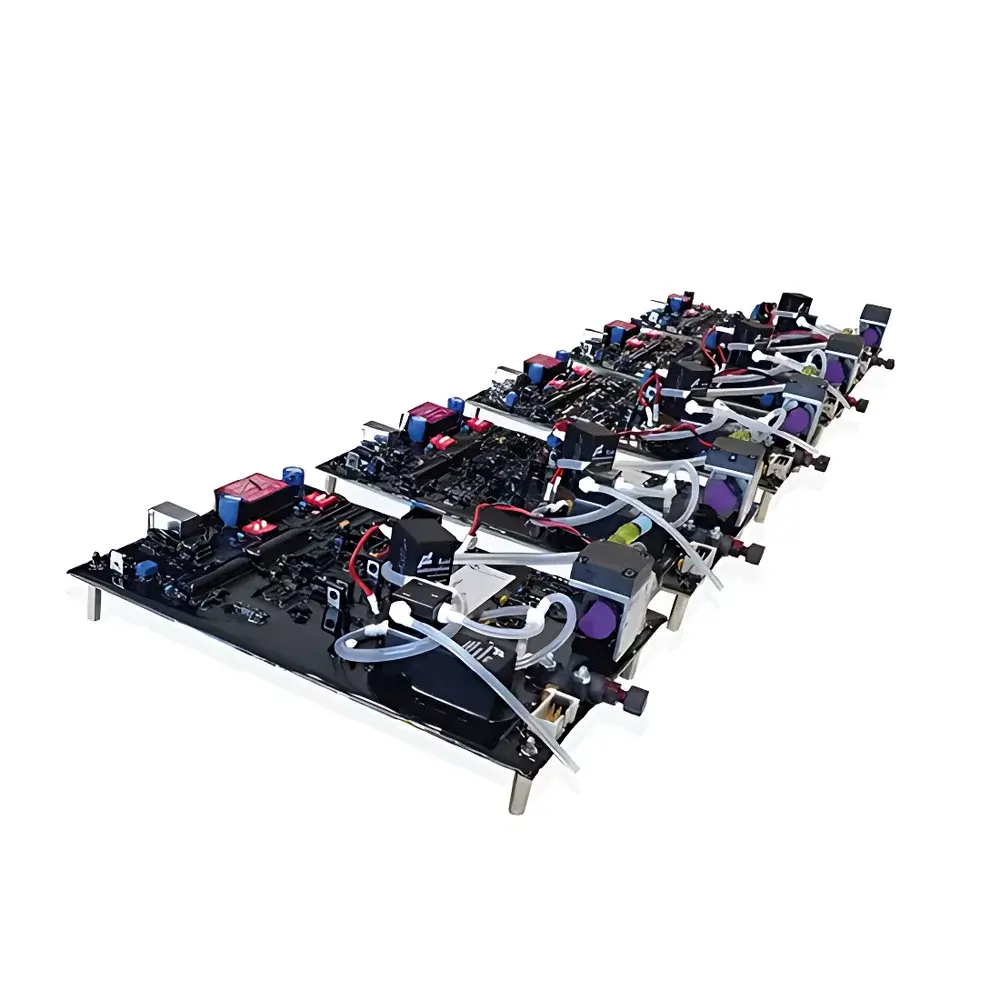
Fluigent P-OEM High-Precision Microfluidic Pressure Controller
| Brand | Fluigent |
|---|---|
| Origin | France |
| Model | P-OEM |
| Pressure Range | −800 mbar to +7000 mbar |
| Resolution | 0.03% of full scale |
| Stability | < 0.1% FS |
| Channels | 1–8 configurable |
| Response Time | < 40 ms |
| Settling Time | < 100 ms |
| Input Interface | 6 mm OD tubing |
| Compatible Gases | Non-corrosive, non-explosive (e.g., N₂, CO₂) |
| Power Supply | 24 V / 0.6 A |
| Power Consumption | 15 W |
| Operating Temperature | 5–40 °C |
| Software Support | AIO, MAT, SDK (C/C++, MATLAB, Python, LabVIEW, Java, VB) |
Overview
The Fluigent P-OEM is a high-precision, modular pressure-driven microfluidic controller engineered for demanding OEM integration and research-grade fluidic automation. Unlike syringe-based actuation, the P-OEM operates on closed-loop pneumatic pressure regulation—applying calibrated positive or negative pressure to reservoirs connected via gas-tight tubing, thereby driving laminar flow through microchannels with exceptional temporal fidelity and zero pulsatility. Its core architecture leverages piezoresistive pressure sensing and fast-response solenoid valves to achieve sub-100 ms pressure settling and real-time compensation against backpressure fluctuations. Designed from inception for seamless system-level integration, the P-OEM serves as the actuation backbone in automated lab-on-a-chip platforms, precision perfusion rigs, and industrial microfluidic instrumentation where deterministic, repeatable flow control at nanoliter-to-microliter per minute scales is non-negotiable.
Key Features
- Configurable channel count: 1–8 independent pressure channels in a single compact chassis, each with isolated gas paths and dedicated pressure transducers.
- Wide dynamic pressure range: selectable spans from ±25 mbar up to ±7000 mbar (±7 bar), including vacuum capability down to −800 mbar—enabling both gentle cell manipulation and high-throughput droplet generation.
- High-resolution control: 0.03% full-scale pressure resolution ensures reproducible setpoint accuracy across all ranges, critical for quantitative assays requiring inter-run comparability.
- Ultra-fast transient response: <40 ms system response time and <100 ms settling time support dynamic protocols such as rapid valve sequencing, oscillatory flow, or feedback-controlled perfusion.
- OEM-optimized interface: TTL-triggered digital I/O, analog voltage input/output (0–10 V), and RS-485 communication enable direct synchronization with motion controllers, cameras, or PLCs in embedded systems.
- Gas compatibility compliance: validated for use with inert, non-reactive gases (N₂, CO₂, dry air); incompatible with corrosive, condensable, or explosive media per ISO 8573-1 Class 4 purity guidelines.
Sample Compatibility & Compliance
The P-OEM is compatible with aqueous buffers, organic solvents (e.g., ethanol, isopropanol), oils, and low-viscosity polymer solutions commonly used in microfluidics—provided fluid paths remain external to the controller. It does not contact liquids directly; instead, it pressurizes upstream reservoirs via gas-permeation-resistant tubing (e.g., PTFE, FEP). As a Class I electrical device conforming to IEC 61010-1, it meets CE marking requirements for laboratory equipment. While not FDA-cleared, its deterministic pressure delivery supports GLP-compliant method development and aligns with ASTM D3574 (foam testing), ISO 15189 (medical lab quality), and USP (analytical instrument qualification) frameworks when deployed within validated workflows.
Software & Data Management
Fluigent provides three interoperable software layers: (1) AIO (All-in-One) — a GUI for real-time monitoring, manual setpoint adjustment, and logging of pressure/flow status; (2) MAT (Microfluidic Automation Tool) — a scriptable environment supporting time-based profiles, conditional triggers (e.g., “hold pressure until sensor signal exceeds threshold”), and multi-channel coordination; and (3) SDK — a documented C/C++, MATLAB, Python, LabVIEW, Java, and VB API enabling full programmatic control and audit-trail generation. All software modules support timestamped data export (CSV, HDF5), user-access controls, and optional 21 CFR Part 11-compliant electronic signature modules for regulated environments.
Applications
- Cell handling & sorting: Stable, pulseless perfusion for live-cell imaging, microchannel trapping, and dielectrophoretic separation.
- Organ-on-chip & tissue perfusion: Physiologically relevant shear stress application (0.01–20 dyn/cm²) in endothelialized microvessels.
- Droplet microfluidics: Monodisperse emulsion generation via flow-focusing or T-junction geometries under constant capillary number control.
- Micro-ELISA & immunoassay automation: Precise reagent metering, washing cycles, and incubation timing without cross-contamination.
- Rheological characterization: Controlled pressure ramps for viscoelastic sample loading into micro-rheometers or extensional flow devices.
- Fiber optic sensor calibration: Stable hydrostatic pressure application for Fabry–Pérot or Bragg grating reference testing.
FAQ
Can the P-OEM be used with conductive or high-viscosity fluids?
Yes—provided the fluid remains isolated from the controller’s internal gas circuit. External fluidic paths must use chemically resistant materials (e.g., PEEK, stainless steel, glass) and maintain backpressures within the selected channel’s rated range.
Is remote firmware update supported?
Yes, via USB or RS-485 using Fluigent’s Device Manager utility; updates preserve user-configured calibration tables and I/O mappings.
Does the P-OEM support pressure ramping with programmable slope?
Yes—MAT and SDK allow linear, exponential, or custom-profile ramps with user-defined dP/dt limits and endpoint hold functions.
What maintenance is required?
No routine calibration or consumables are needed; periodic verification using an NIST-traceable pressure standard is recommended annually for GxP applications.
Can multiple P-OEM units be synchronized?
Yes—via shared TTL clock signals or master-slave RS-485 daisy chaining, enabling phase-aligned pressure modulation across >16 channels.



