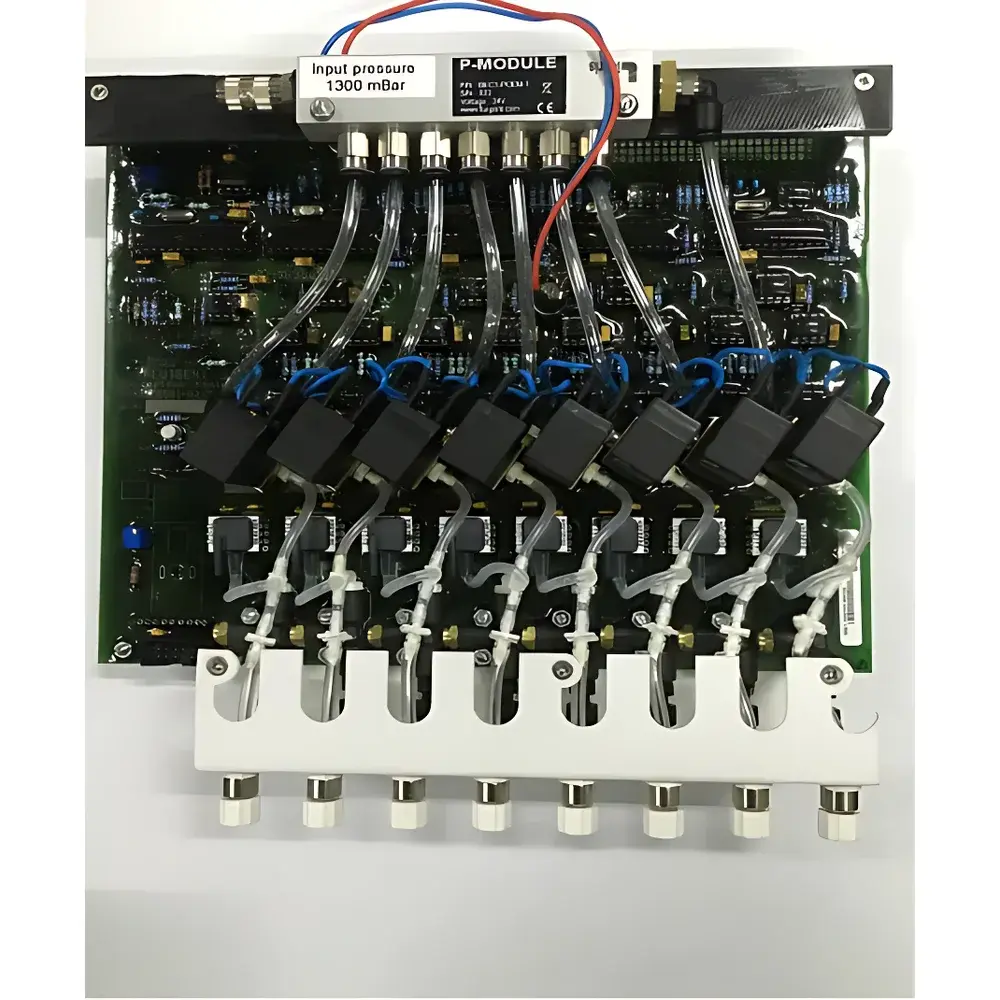
Fluigent OEM Precision Pressure Controller
| Brand | Fluigent |
|---|---|
| Origin | France |
| Model | OEM Precision Pressure Controller |
| Pressure Range Options | 0–25 mbar, 0–69 mbar, 0–345 mbar, 0–1000 mbar, 0–7000 mbar, −25–0 mbar, −69–0 mbar, −345–0 mbar, −800–0 mbar |
| Pressure Resolution | 0.03% of full scale |
| Pressure Stability | <0.1% FS |
| Number of Channels | 1–8 (independently configurable) |
| System Response Time | <40 ms |
| Settling Time | <100 ms |
| Pressure Input Interface | 6 mm OD tubing |
| Compatible Gases | Non-corrosive, non-explosive gases (e.g., N₂, CO₂) |
| Power Supply | 24 V DC, 0.6 A |
| Power Consumption | 15 W |
| Operating Temperature | 5–40 °C |
| Software Integration | Fully programmable via Fluigent’s MAESFLO™ and AFM software suites |
| Compliance | Designed for integration into ISO 13485–aligned instrumentation |
Overview
The Fluigent OEM Precision Pressure Controller is an engineered pressure regulation module designed for seamless integration into advanced microfluidic instrumentation. It operates on the principle of closed-loop pneumatic pressure control, utilizing high-fidelity piezoresistive pressure sensors and fast-response solenoid valves to deliver dynamic, stable, and repeatable pressure output across a wide operational range—from vacuum (−800 mbar) to positive pressure (up to 7 bar). Unlike conventional syringe pump–based fluid delivery systems, this controller enables true pressure-driven flow with sub-millisecond actuation latency, making it ideal for applications demanding precise temporal control over fluidic forces—such as cell deformation studies, droplet generation kinetics, or real-time perfusion in organ-on-chip platforms. Its modular architecture allows system designers to embed calibrated pressure regulation directly into compact diagnostic devices, analytical platforms, or research-grade microfluidic workstations without compromising on metrological integrity.
Key Features
- Multi-range pressure capability: Selectable full-scale ranges from ±25 mbar up to ±7000 mbar, enabling optimal resolution and signal-to-noise ratio per application requirement.
- Independent channel operation: Each of the 1–8 channels functions autonomously, eliminating crosstalk and ensuring simultaneous yet decoupled pressure control across parallel microfluidic networks.
- High-speed dynamic response: System response time <40 ms and settling time <100 ms enable rapid transitions between setpoints—critical for pulsed flow protocols and feedback-controlled assays.
- Sub-0.1% full-scale stability: Achieved through temperature-compensated sensor electronics and active drift correction algorithms embedded in firmware.
- OEM-optimized mechanical design: Compact PCB-mount form factor with standardized 6 mm OD gas inlet ports, 24 V DC power interface, and I²C/SPI digital communication lines for host MCU integration.
- Gas compatibility assurance: Certified for use with inert, non-corrosive, non-explosive gases including nitrogen, carbon dioxide, and dry air—compatible with cleanroom and biosafety level 2 (BSL-2) environments.
Sample Compatibility & Compliance
The controller is intended for use with liquid and gaseous phases in microfluidic circuits fabricated from PDMS, glass, silicon, thermoplastics (e.g., COP, PMMA), and fluoropolymer tubing. It does not contact samples directly; instead, it regulates upstream gas pressure applied to fluid reservoirs or flexible diaphragms—ensuring full chemical isolation. All internal wetted materials comply with USP Class VI and ISO 10993–1 biocompatibility standards. When integrated into final medical devices, the module supports traceability per ISO 13485 and facilitates design history file (DHF) documentation. For regulated diagnostics, its deterministic behavior and deterministic timing characteristics support validation under FDA 21 CFR Part 11 when paired with compliant software layers (e.g., MAESFLO™ with audit trail enabled).
Software & Data Management
Fluigent provides two complementary software frameworks: MAESFLO™ (for Windows-based configuration, real-time monitoring, and script-driven protocol execution) and AFM (Application Flow Manager), a lightweight SDK supporting C++, Python, LabVIEW, and MATLAB APIs. Both tools expose low-level register access, PID tuning parameters, and timestamped pressure/flow data streams at ≥1 kHz sampling rates. Raw sensor outputs are delivered with 16-bit resolution and factory-calibrated polynomial coefficients. Data export formats include CSV, HDF5, and TDMS—ensuring compatibility with third-party analysis pipelines used in academic labs and industrial R&D settings. Optional firmware updates maintain backward compatibility while extending support for new sensor models and regulatory reporting features.
Applications
- Single-cell mechanobiology: Precise negative pressure application for membrane aspiration or controlled detachment in microchannel traps.
- Droplet microfluidics: Synchronized pressure modulation across multiple inlets to generate monodisperse emulsions at kHz frequencies.
- Organ-on-chip perfusion: Maintaining physiological shear stress profiles (0.01–20 dyn/cm²) via continuous pressure ramping over hours or days.
- Micro-ELISA and affinity binding assays: Programmable step-and-hold pressure sequences to drive sequential reagent loading, washing, and detection steps.
- Fiber optic sensor calibration: Stable pressure biasing of Fabry–Pérot or Bragg grating transducers during sensitivity characterization.
- 3D bioprinting support systems: Coordinated pressure control across multiple bioink reservoirs for multi-material extrusion synchronization.
- Lab-on-chip QC testing: Automated pressure leak checks and flow resistance mapping prior to device release.
FAQ
Can this controller be used with aqueous or organic solvents?
Yes—provided the fluid path remains isolated from the controller via gas-liquid interfaces (e.g., pressure-driven reservoirs or pneumatic diaphragm actuators). The controller itself only handles clean, dry, non-corrosive gases.
Is analog voltage output available for external DAQ systems?
Standard models feature digital I²C/SPI interfaces only; however, custom variants with 0–5 V or 4–20 mA analog outputs can be supplied under OEM agreement.
What is the recommended maintenance interval?
No scheduled maintenance is required under normal operating conditions. Periodic verification against NIST-traceable pressure standards is advised annually for metrologically critical deployments.
Does the controller support fail-safe shutdown modes?
Yes—configurable hardware watchdog timers and overpressure/undervoltage lockout circuits ensure automatic valve closure upon host communication loss or power anomaly.
Can I integrate multiple controllers on a single bus?
Up to 127 units may be addressed on one I²C bus using unique 7-bit slave addresses; SPI daisy-chaining is also supported for high-throughput embedded implementations.