
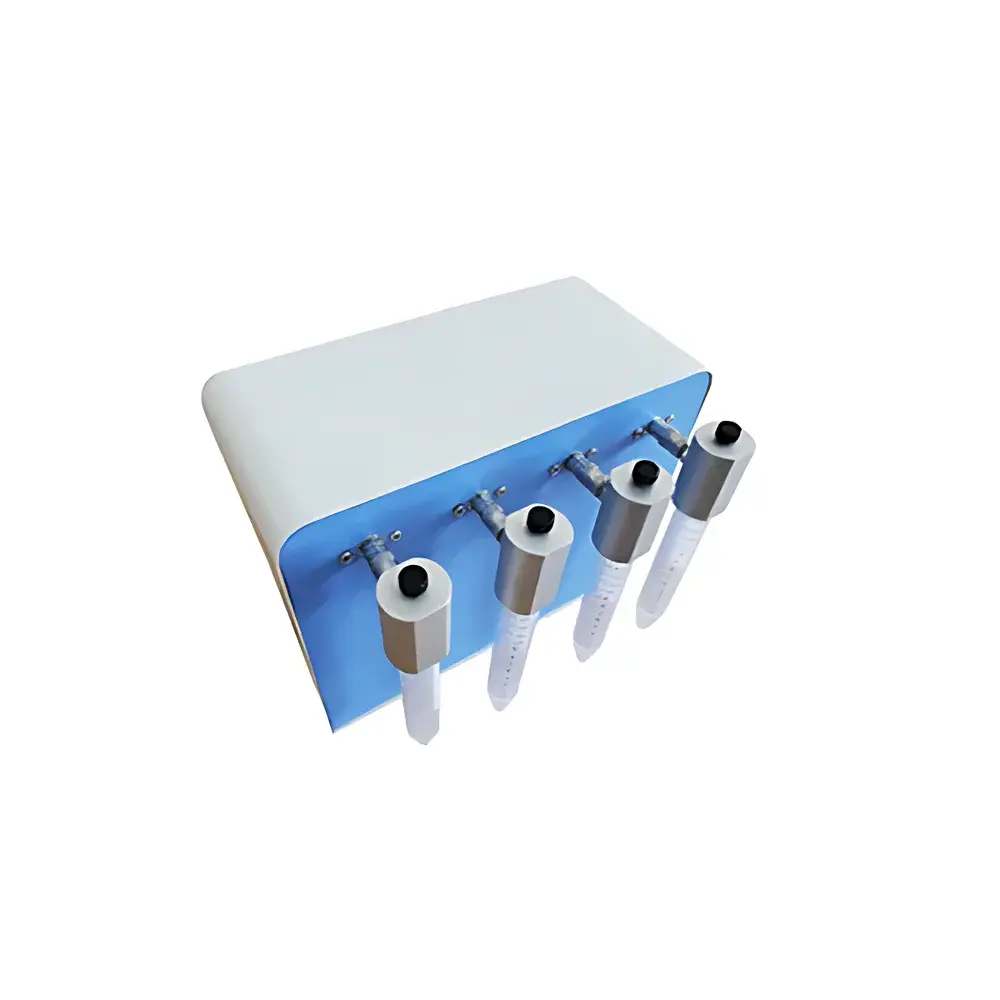
Fluigent P-OEM-ULTRA Quad-Channel High-Precision Microfluidic Pressure Controller
| Brand | Fluigent |
|---|---|
| Origin | France |
| Model | P-OEM-ULTRA |
| Pressure Range | 0–2000 mbar |
| Pressure Resolution | 600 µbar |
| Pressure Stability | < 0.1% |
| Channels | 4 |
| System Response Time | < 60 ms |
| Stabilization Time | < 100 ms |
| Pressure Input Interface | 6 mm OD |
| Compatible Gases | Non-corrosive, non-explosive (e.g., N₂, CO₂) |
| Power Supply | 220 V / 50 Hz |
| Power Consumption | 18 W |
| Operating Temperature | 5–40 °C |
| Dimensions (L×W×H) | 220 × 100 × 177 mm |
| Software Support | AIO, MAT, SDK (C/C++, MATLAB, Python, LabVIEW, Java, VB) |
Overview
The Fluigent P-OEM-ULTRA is a quad-channel, high-precision pressure-driven microfluidic controller engineered for demanding applications requiring stable, pulse-free, and programmable fluid actuation at the microscale. Unlike syringe-based peristaltic or stepper-motor pumps—which inherently generate flow pulsations and exhibit limited dynamic response—the P-OEM-ULTRA operates on a closed-loop pneumatic pressure control principle. It regulates fluid movement by applying precisely modulated positive or zero-pressure (up to +2000 mbar gauge) to reservoirs connected via gas-tight tubing, thereby driving laminar flow through microchannels without mechanical displacement. This architecture eliminates mechanical backlash, dead volume, and flow intermittency, making it especially suitable for long-duration experiments in live-cell perfusion, droplet generation, and real-time biochemical assays where flow continuity and pressure fidelity are critical.
Key Features
- Quad-channel independent pressure control with synchronized or asynchronous operation
- Closed-loop regulation achieving pressure stability better than 0.1% of full scale and resolution down to 600 µbar
- Fast system response (<60 ms) and stabilization time (<100 ms), enabling dynamic flow profile execution
- Integrated 24 V DC power output for direct coupling with external air compressors—no additional power supplies required
- Compact benchtop footprint (220 × 100 × 177 mm) with modular reservoir mounting capability for up to four liquid reservoirs
- Gas compatibility limited to non-corrosive, non-explosive media (e.g., nitrogen, carbon dioxide, dry air), ensuring safe integration into biosafety-level 1/2 laboratories
- Compliance-ready architecture supporting audit trails, parameter logging, and user-access controls when used with Fluigent’s MAT or AIO software under GLP/GMP-aligned workflows
Sample Compatibility & Compliance
The P-OEM-ULTRA is designed for use with aqueous buffers, cell culture media, organic solvents (non-aggressive), and low-viscosity polymer solutions commonly employed in microfluidics. Its gas-driven mechanism avoids direct contact between actuation components and fluids—eliminating contamination risk and enabling rapid reconfiguration across experimental conditions. The device meets CE marking requirements for electromagnetic compatibility (EMC Directive 2014/30/EU) and low-voltage safety (LVD Directive 2014/35/EU). While not intrinsically rated for hazardous environments, its operational constraints (non-corrosive gas input, ambient temperature range 5–40 °C) align with ISO 13485 and ASTM F2099 guidelines for microfluidic instrumentation used in diagnostic development and preclinical research settings.
Software & Data Management
Fluigent provides three interoperable software layers: AIO (All-in-One), MAT (Microfluidic Automation Tool), and SDK (Software Development Kit). AIO delivers real-time pressure/flow visualization and manual parameter adjustment—ideal for method development and training. MAT supports sequence-based automation, including timed pressure ramps, conditional triggers, and multi-step protocols compliant with 21 CFR Part 11 when deployed with electronic signatures and audit trail configuration. The SDK offers native APIs for C/C++, MATLAB, Python, LabVIEW, Java, and VB, enabling seamless integration into custom instrument control frameworks or high-throughput screening platforms. All software modules log timestamped pressure setpoints, actual values, and error flags—facilitating traceability during regulatory submissions or peer-reviewed data replication.
Applications
- Continuous perfusion systems for live-cell imaging and electrophysiology
- Droplet generation and coalescence control in emulsion-based synthesis and single-cell encapsulation
- Pressure-driven loading and washing in micro-ELISA and affinity capture assays
- Flow calibration and sensor validation within Lab-on-a-Chip (LoC) and MicroTAS platforms
- Controlled reagent delivery in on-chip chemical synthesis and kinetic reaction monitoring
- Steady and transient shear stress application in microvascular or organ-on-chip models
- Fiber-optic microfluidic sensing, where optical path stability depends on vibration-free, constant-flow conditions
FAQ
What types of fluids can be driven using the P-OEM-ULTRA?
Aqueous solutions, cell culture media, ethanol/water mixtures, and other low-viscosity, non-particulate fluids compatible with standard fluoropolymer or stainless-steel microfluidic interconnects. Viscosities up to ~20 mPa·s are supported with appropriate channel sizing.
Can the P-OEM-ULTRA operate in vacuum or negative pressure mode?
No—it is configured for positive-pressure control only (0–2000 mbar gauge). For suction-based applications, an external vacuum source must be integrated upstream of the chip.
Is flow rate directly controlled, or only inferred via pressure?
Pressure is the primary controlled variable. Accurate volumetric flow requires pairing with Fluigent’s Flow Unit sensors, which provide real-time feedback for closed-loop flow regulation across all four channels.
How is calibration performed and maintained?
Factory calibration is traceable to national standards. End-users may perform verification checks using certified pressure test gauges; no field recalibration is required under normal operating conditions.
Does the device support remote monitoring over Ethernet or USB?
Yes—USB 2.0 interface enables plug-and-play connection. Ethernet connectivity is available via optional USB-to-Ethernet adapters or third-party industrial gateways compatible with Modbus TCP or HTTP REST APIs through the SDK.
Related Products



