
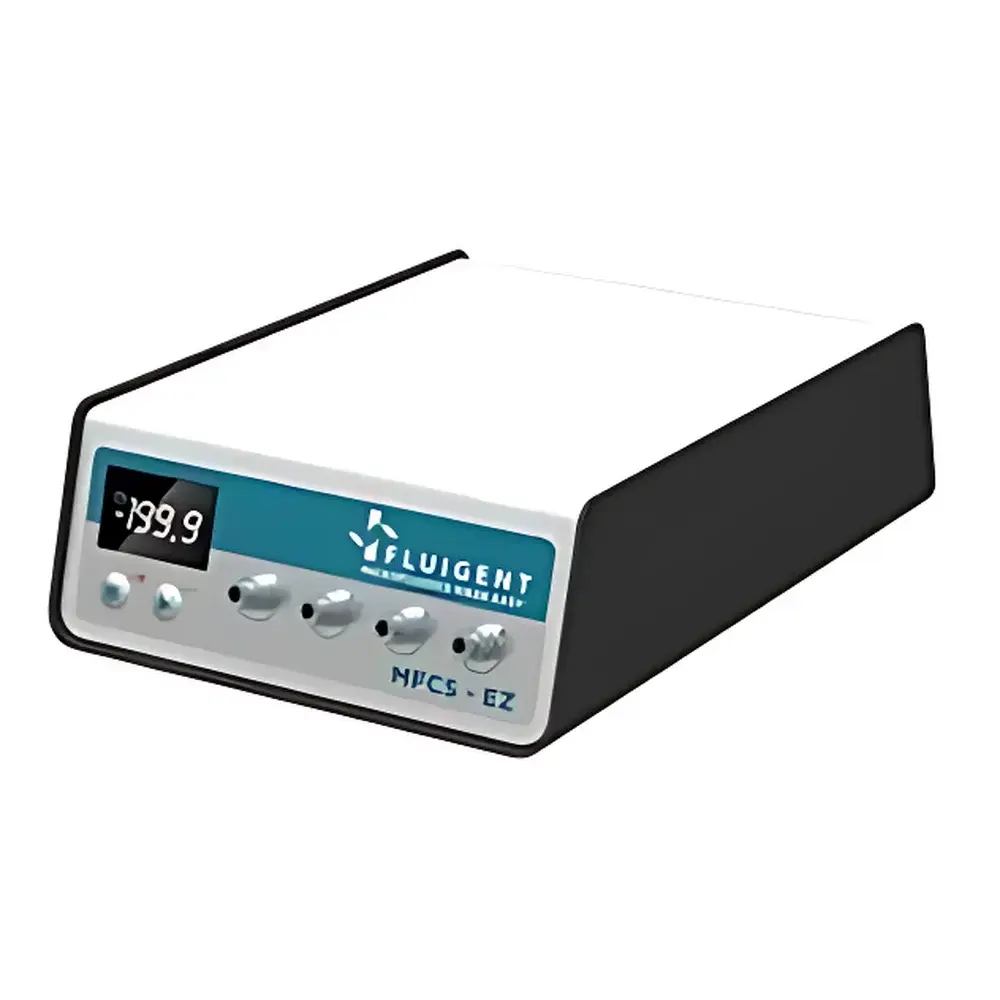
Fluigent p-pump Precision Pressure-Driven Microfluidic Pump
| Brand | Fluigent |
|---|---|
| Origin | France |
| Model | p-pump |
| Pump Type | Pressure-Driven Microfluidic Pump |
| Flow Rate Range | 7.5 nL/min – 5 mL/min |
| Rotational Speed | 1–100 rpm |
| Operating Pressure Range | −800 mbar to +7 bar (configurable ranges available) |
| Pressure Resolution | 0.03% of full scale |
| Pressure Stability | < 0.1% FS |
| Response Time | < 40 ms |
| Channels | 1–16 (modular) |
| Fluid Compatibility | Aqueous, organic, viscous, and particle-laden solutions |
| Compatible Gases | Air, N₂, CO₂, Ar |
| Power Supply | 24 V DC, 0.6 A |
| Power Consumption | 15 W |
| Operating Temperature | 5–40 °C |
| Compliance | CE, RoHS, compatible with GLP/GMP workflows via audit-trail-capable software integration |
Overview
The Fluigent p-pump is a high-precision, pressure-driven microfluidic pump engineered for stable, pulse-free, and programmable fluid delivery in demanding laboratory environments. Unlike conventional syringe pumps or peristaltic systems—whose mechanical actuation introduces compressibility artifacts, flow lag, and pulsatility—the p-pump operates on regulated gas pressure applied to reservoirs, enabling true laminar, inertia-free flow control across nanoliter-to-milliliter volumetric scales. Its core architecture leverages Fluigent’s proprietary FASTAB™ technology, which integrates real-time pressure feedback, adaptive PID control, and low-compliance fluidic pathways to achieve sub-second dynamic response and long-term baseline stability. Designed specifically for microfluidics, lab-on-a-chip (LoC), and microscale assay development, the p-pump eliminates the intrinsic limitations of displacement-based pumping (e.g., stepper motor backlash, seal wear, and syringe compliance), making it suitable for applications requiring ultra-low flow rates, multi-channel synchronization, and seamless integration into automated workflows.
Key Features
- Pressure-driven operation ensures zero pulsation, no mechanical wear, and full compatibility with fragile microchannels and soft lithography devices.
- Configurable pressure ranges: −800 mbar to +7 bar, selectable from nine standard spans (e.g., 0–25 mbar, −345 mbar to 0, 0–7000 mbar), supporting both vacuum-assisted aspiration and high-pressure perfusion.
- Modular design supports 1–16 independent channels on a single chassis; each channel features isolated pressure regulation and real-time monitoring without crosstalk.
- Sub-40 ms system response time enables rapid flow switching, transient waveform generation (e.g., square, ramp, sinusoidal), and closed-loop feedback protocols.
- Pressure resolution of 0.03% full scale and stability better than ±0.1% FS over 24 hours—validated under continuous operation at ambient temperature (20–25 °C).
- Compatible with standard 6 mm OD tubing and up to 16 reservoir positions; supports air, nitrogen, carbon dioxide, and argon as driving gases.
- 24 V DC input, low-power (15 W) design optimized for benchtop deployment and integration into enclosed instrumentation platforms.
Sample Compatibility & Compliance
The p-pump delivers consistent performance across diverse fluid classes—including aqueous buffers, glycerol-water mixtures (up to 80% v/v), cell suspensions, emulsions, and low-surface-tension solvents—without requiring recalibration or hardware modification. Its gas-driven mechanism avoids direct contact between moving parts and fluids, eliminating contamination risk and enabling sterile or solvent-resistant operation when paired with appropriate reservoirs and tubing. The system complies with CE marking requirements and RoHS directives. When operated with Fluigent’s M-Switch™ or MFCS-EZ controllers and connected to validated LabVIEW-based software, the p-pump supports 21 CFR Part 11-compliant data acquisition, electronic signatures, and audit trails—making it suitable for regulated QC/QA environments adhering to GLP or GMP standards.
Software & Data Management
Control is implemented via Fluigent’s intuitive, cross-platform software suite (compatible with Windows, macOS, and Linux), built on LabVIEW runtime architecture. Users define pressure profiles, flow sequences, and time-based triggers using graphical scripting or Python API (PyFluidics). All parameters—including actual pressure, estimated flow rate (calibrated per fluid viscosity and channel geometry), valve state, and timestamped events—are logged in CSV or HDF5 format with microsecond-level precision. The software supports hardware synchronization via TTL I/O, analog voltage inputs/outputs, and Ethernet-based communication (TCP/IP), enabling tight coupling with microscopes, spectrometers, or electrophysiology rigs. Firmware updates and channel reconfiguration are performed remotely without physical disassembly.
Applications
- Single-cell manipulation and microfluidic sorting using hydrodynamic focusing and dielectrophoretic traps.
- Continuous perfusion in organ-on-chip models requiring precise shear stress control (0.01–20 dyn/cm²).
- Microscale chemical synthesis and reaction kinetics studies on integrated LoC platforms.
- Droplet generation and stabilization in double-emulsion and Pickering systems.
- Micro-ELISA and digital immunoassays relying on reproducible reagent metering at sub-100 nL volumes.
- Rheological characterization of non-Newtonian biofluids using controlled pressure ramps and oscillatory waveforms.
- Fiber optic sensor calibration via calibrated refractive index gradient delivery.
FAQ
How does the p-pump differ from a conventional syringe pump in terms of flow accuracy and stability?
Unlike syringe pumps—which rely on mechanical displacement and suffer from compliance-related hysteresis, backslash, and nonlinear flow at low speeds—the p-pump uses regulated gas pressure to drive fluid, achieving full-scale accuracy of ±0.1% and stability better than 0.1% FS over extended periods.
Can the p-pump be used with viscous or particulate-laden samples?
Yes. Since there are no internal moving parts contacting the fluid, the p-pump handles viscosities up to ~1000 cP and suspensions containing particles ≤10 µm without clogging or performance degradation—provided appropriate reservoir filters and tubing are selected.
Is multi-channel coordination possible with independent pressure control per channel?
Yes. Each channel operates autonomously with dedicated pressure sensors and regulators. Synchronization across all active channels is achievable within ±10 ms timing jitter using master-clock triggering.
Does the system support regulatory-compliant data handling for pharmaceutical or clinical labs?
When deployed with Fluigent’s certified software modules and configured with user access controls, electronic signatures, and immutable audit logs, the p-pump meets foundational requirements for 21 CFR Part 11 and ISO 13485-aligned workflows.
What maintenance is required during routine operation?
No scheduled maintenance is required. Gas filters should be replaced every 6–12 months depending on ambient air quality; tubing and reservoirs follow standard lab consumable replacement protocols.



