
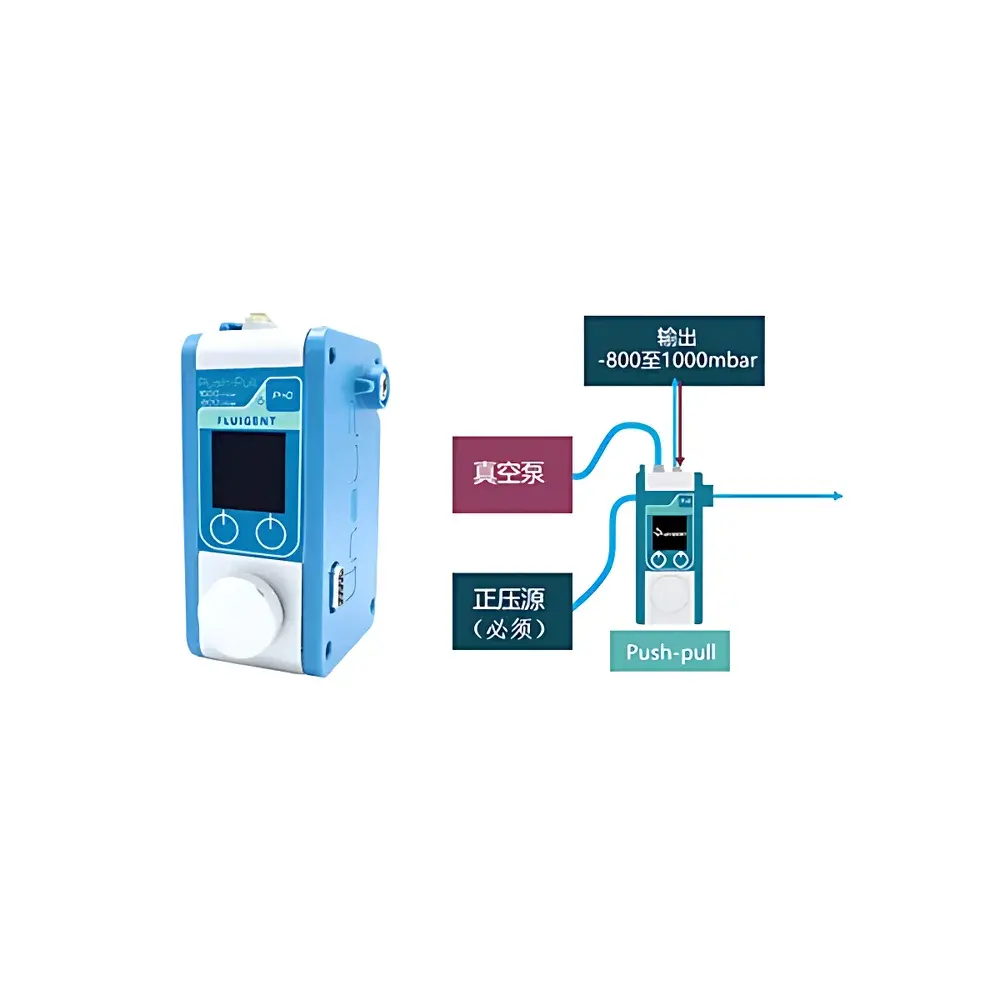
Fluigent Push-Pull Dual-Mode High-Precision Microfluidic Pressure Pump
| Brand | Fluigent |
|---|---|
| Origin | France |
| Model | Push-Pull |
| Flow Rate Range | 1.5 µL/min – 5 mL/min |
| Pressure Range | −800 mbar to +1000 mbar |
Overview
The Fluigent Push-Pull Dual-Mode High-Precision Microfluidic Pressure Pump is an engineered solution for bidirectional, high-stability pressure control in microfluidic systems. Operating on the principle of regulated pneumatic actuation, it delivers precise, programmable positive and negative pressure—enabling accurate fluid propulsion, aspiration, and recirculation at the microliter-to-milliliter scale. Unlike conventional single-mode pressure controllers, the Push-Pull integrates two independent pressure channels within a compact, thermally stable architecture: one optimized for positive pressure up to +1000 mbar (14.5 psi), and another for vacuum generation down to −800 mbar (−13.05 psi). Its design eliminates mechanical valves and moving parts in the fluid path, ensuring long-term repeatability and minimizing dead volume. As a core component of Fluigent’s LINE UP ecosystem, it interoperates natively with Flow EZ, Adapt, and LINK modules—allowing modular expansion of flow control capability without hardware reconfiguration. The system is calibrated for use with non-corrosive, non-explosive gases (e.g., dry air, N₂, O₂, CO₂) and compatible with aqueous solutions, oils, organic solvents, and biological samples—including cell suspensions and protein-containing media.
Key Features
- Dual-mode operation: Simultaneous or independent control of positive (+1000 mbar) and negative (−800 mbar) pressure outputs
- High-pressure stability: ≤0.015% CV in the 500–950 mbar range; ≤0.050% CV under deep vacuum (−400 to −750 mbar)
- Rapid dynamic response: <30 ms for 50% step transitions (e.g., −500 → +500 mbar or vice versa)
- Compact footprint: 91.9 × 71.8 × 131 mm; mass: 636 g; power consumption: 6 W
- No internal wetted moving parts—ensures contamination-free operation and >10⁶ cycle durability
- Gas inlet specification: Dry, oil-free, non-corrosive, non-explosive gases only
- Fully compatible with Fluigent Flow Unit sensors for closed-loop constant-flow regulation
Sample Compatibility & Compliance
The Push-Pull supports broad fluid compatibility—including deionized water, glycerol-water mixtures, ethanol, DMSO, PBS, cell culture media, and serum-containing solutions—provided they are non-aggressive toward fluoropolymer (FEP, PTFE) and stainless-steel wetted materials. It meets CE marking requirements and conforms to IEC 61326-1 (EMC for laboratory equipment) and IEC 61010-1 (safety for electrical equipment). While not certified for ISO 13485 or FDA 21 CFR Part 11 out-of-the-box, its deterministic pressure output, audit-trail-capable software interfaces (via SDK), and deterministic firmware behavior support integration into GLP/GMP-compliant workflows when deployed with appropriate validation protocols. All pressure transducers are traceably calibrated against NIST-traceable standards.
Software & Data Management
Fluigent provides three tiers of software integration: (1) All-in-One (AIO) — a GUI-based application for real-time monitoring of pressure setpoints, actual values, and optional Flow Unit-derived flow rates; (2) Microfluidic Automation Tool (MAT) — a script-driven environment supporting timed sequences, conditional logic, and multi-device synchronization across LINE UP modules; and (3) Software Development Kit (SDK) — offering native C/C++, Python, MATLAB, and LabVIEW APIs with full access to low-level pressure control registers, event callbacks, and error logging. All software layers support timestamped data export in CSV/JSON format, enabling traceable experimental records suitable for regulatory review. Firmware updates are delivered via signed binary packages with SHA-256 verification.
Applications
- Organ-on-a-chip platforms requiring bidirectional perfusion and shear stress modulation
- Automated sample preparation workflows involving sequential aspiration, dilution, and injection
- Long-term cell culture under physiologically relevant flow conditions (e.g., endothelial monolayer maintenance)
- Fluorescence-based assays with synchronized reagent delivery and wash cycles
- High-throughput drug screening using microfluidic multi-well interface manifolds
- Closed-loop fluid recirculation in analytical microsystems (e.g., coupled LC-microchip setups)
- OEM integration into diagnostic instruments where space-constrained, low-power, dual-mode pressure actuation is required
FAQ
Can the Push-Pull be used alongside existing Flow EZ units?
Yes. When configured for positive pressure output only, the Push-Pull functions as a direct replacement for Flow EZ (0–1000 mbar range); when operated in negative mode, it serves as a vacuum-compatible counterpart (−800–0 mbar). Interoperation requires shared bus communication via LINK module and synchronized firmware versions.
How is backflow prevented during vacuum operation?
Two mitigation strategies are recommended: (1) Install an inline hydrophobic gas-permeable filter between the reservoir and exhaust line—though this may increase pressure response latency by ~5–15 ms; or (2) Introduce a secondary sealed buffer reservoir upstream of the pump inlet to absorb overflow volume without exposing the pump to liquid ingress.
Is constant-flow control possible without external sensors?
No. Closed-loop constant-flow operation requires integration with a Fluigent Flow Unit sensor. The Push-Pull itself regulates pressure only; flow rate is inferred indirectly and must be measured optically or calorimetrically for true feedback control.
What gas supply specifications are mandatory?
Input gas must be filtered to ≤0.01 µm, dew point ≤−40 °C, and oil-free per ISO 8573-1 Class 1:2:1. Nitrogen is preferred for inert applications; compressed dry air is acceptable if oil and moisture removal is verified.
Does the device support remote triggering via TTL or analog input?
Yes. The rear-panel BNC connector accepts 0–5 V analog setpoint signals and TTL-compatible start/stop triggers, enabling synchronization with external instruments such as cameras, syringe pumps, or electrophysiology rigs.



