
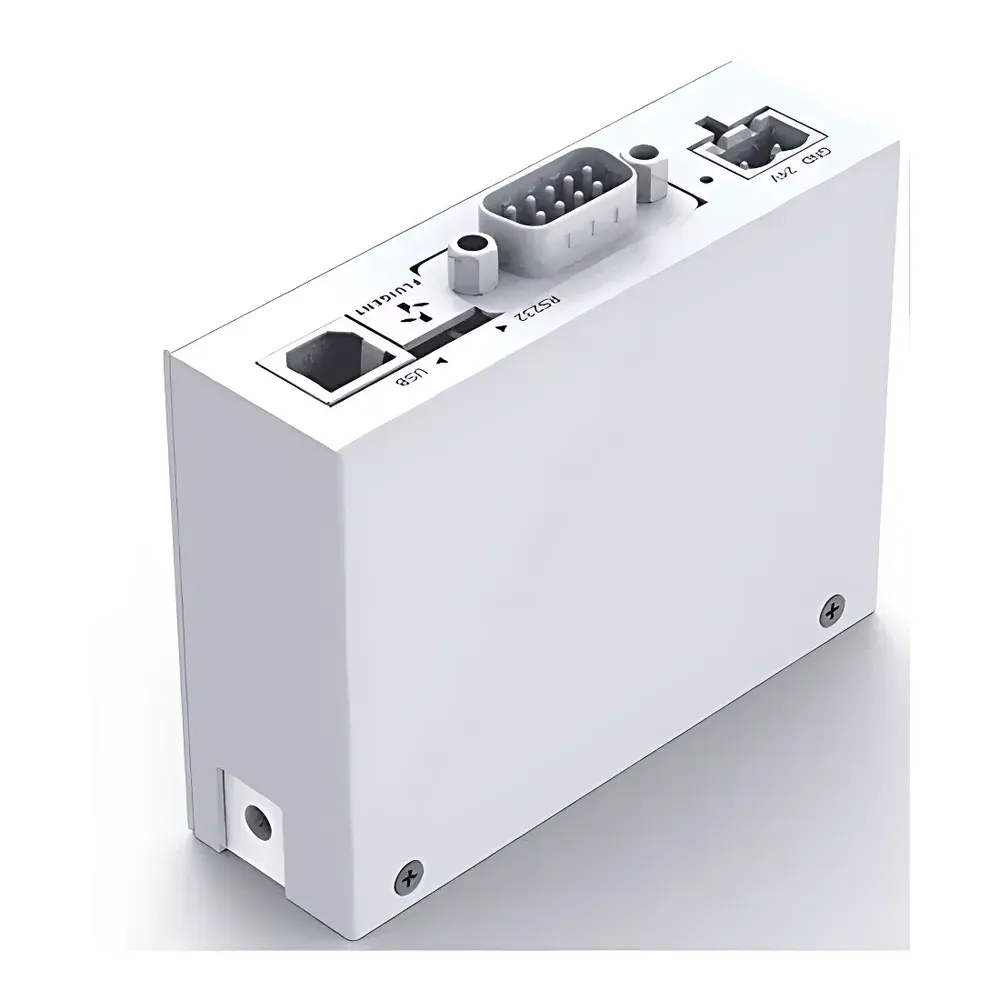
Fluigent PX Series High-Precision Microfluidic Pressure Pump
| Brand | Fluigent |
|---|---|
| Origin | France |
| Model | PX |
| Pressure Ranges | 0–1000 mbar |
| Stability (Std. Dev.) | ±0.06% of full scale |
| Operating Temperature | 4–37 °C |
| Storage Temperature | 0–50 °C |
| Dimensions | 82.4 × 25.7 × 67.9 mm |
| Weight | 192 g |
| Power Supply | 24 VDC |
| Max. Power | 2 W |
| Max. Current | 80 mA |
| Interfaces | RS232, USB |
Overview
The Fluigent PX Series High-Precision Microfluidic Pressure Pump is an industrial-grade, OEM-optimized pressure controller engineered for robust, drift-free fluid actuation in demanding microfluidic environments. Based on Fluigent’s proprietary FASTAB™ pressure regulation technology, the PX pump delivers continuous, pulseless pressure output—eliminating flow oscillations inherent in syringe-based displacement pumps. Unlike volumetric actuators, the PX operates on a closed-loop pneumatic principle: it dynamically modulates upstream gas pressure against a compliant diaphragm or reservoir, enabling true analog control of liquid flow rates via backpressure modulation. This architecture ensures exceptional long-term stability, sub-second response times, and intrinsic compatibility with low-volume, high-sensitivity assays where mechanical pulsation or thermal drift would compromise data integrity. Designed explicitly for integration into automated instrumentation—including diagnostic platforms, point-of-care devices, and lab-on-chip analyzers—the PX meets the mechanical, electrical, and software interoperability requirements of ISO 13485-aligned medical device manufacturing and GLP-compliant analytical workflows.
Key Features
- FASTAB™-enabled pressure regulation delivering <0.06% full-scale standard deviation over extended operation
- OEM-optimized form factor (82.4 × 25.7 × 67.9 mm, 192 g) with industrial-grade aluminum housing and EMI-shielded electronics
- Triple configurable pressure range option: 0–1000 mbar, 0–2000 mbar, or differential −800 to 0 mbar for vacuum-assisted applications
- Dual communication interfaces: isolated RS232 (for noise-immune serial control in electromagnetically harsh environments) and USB 2.0 (for rapid prototyping and host PC integration)
- Wide operational temperature envelope (4–37 °C), validated for use inside incubators, laminar flow hoods, and enclosed analytical instruments
- Low-power architecture: 24 VDC input, ≤2 W max power draw, suitable for battery-backed or portable systems
Sample Compatibility & Compliance
The PX pump is chemically inert across standard microfluidic media—including aqueous buffers (PBS, Tris-HCl), organic solvents (ethanol, isopropanol), and low-concentration surfactant solutions—when used with Fluigent-certified fluidic tubing and connectors (e.g., PTFE, FEP, or fluorinated ethylene propylene). It supports both positive-pressure-driven flow (e.g., perfusion, droplet generation) and negative-pressure (vacuum) modes for gentle cell aspiration or chip priming. The device complies with CE marking directives (2014/30/EU EMC, 2014/35/EU LVD), RoHS 2011/65/EU, and carries IEC 61000-4-2/3/4/6 immunity certification. While not FDA-cleared as a standalone medical device, its design adheres to principles outlined in ISO 14971 (risk management) and supports traceable operation under 21 CFR Part 11 when deployed with validated software configurations and audit-log-enabled host applications.
Software & Data Management
Fluigent provides three tiers of software support for seamless system integration: (1) AIO (All-in-One Software) — a Windows-native GUI offering real-time pressure monitoring, stepwise protocol scripting, and live waveform visualization; (2) MAT (Microfluidic Automation Tool) — a deterministic sequencer enabling synchronized multi-channel pressure control across multiple PX units, with event-triggered logic and error-handling routines; and (3) SDK — a cross-platform development toolkit supporting C/C++, MATLAB, Python (via PySerial or native DLL bindings), and LabVIEW, with full API documentation and example scripts for CI/CD pipeline integration. All software layers implement timestamped parameter logging, checksum-verified command transmission, and configurable data export (CSV, HDF5) compatible with LIMS and ELN systems.
Applications
- Cell manipulation and sorting platforms requiring laminar, non-shearing perfusion (e.g., microfluidic FACS pre-concentration stages)
- Organ-on-chip and tissue-engineered model perfusion systems operating under physiologically relevant shear stresses (0.1–20 dyn/cm²)
- Droplet microfluidics for monodisperse emulsion generation (CV < 2%) in pharmaceutical formulation and CRISPR screening workflows
- Micro-ELISA and digital immunoassays relying on precise reagent metering and washing cycle reproducibility
- Fiber-optic sensor calibration rigs requiring stable hydrostatic head control for refractive index validation
- Rheological characterization of non-Newtonian biofluids using pressure-driven capillary viscometry with integrated pressure–flow rate correlation
FAQ
Can the PX pump be used in sterile or biosafety-level 2 (BSL-2) environments?
Yes—its sealed enclosure, absence of moving parts in contact with fluid paths, and compatibility with autoclavable external manifolds make it suitable for integration behind secondary containment barriers.
Is remote firmware update supported?
Firmware updates are performed via USB using Fluigent’s certified updater tool; RS232 does not support field upgrades.
Does the PX support analog voltage input for external pressure setpoint modulation?
No—setpoints are exclusively digital (RS232/USB); however, real-time pressure feedback is available as analog 0–5 V output (±0.1% linearity) for external PID loop integration.
What is the maximum recommended tubing inner diameter for optimal dynamic response?
For sub-100 ms pressure step response, use tubing with ID ≤ 500 µm and total path length < 1.5 m; larger IDs increase system compliance and dampen transient fidelity.
How is long-term calibration stability maintained?
PX units undergo factory calibration against NIST-traceable deadweight testers; end users may perform zero-offset verification at ambient pressure but full recalibration requires return to Fluigent-authorized service centers.



