
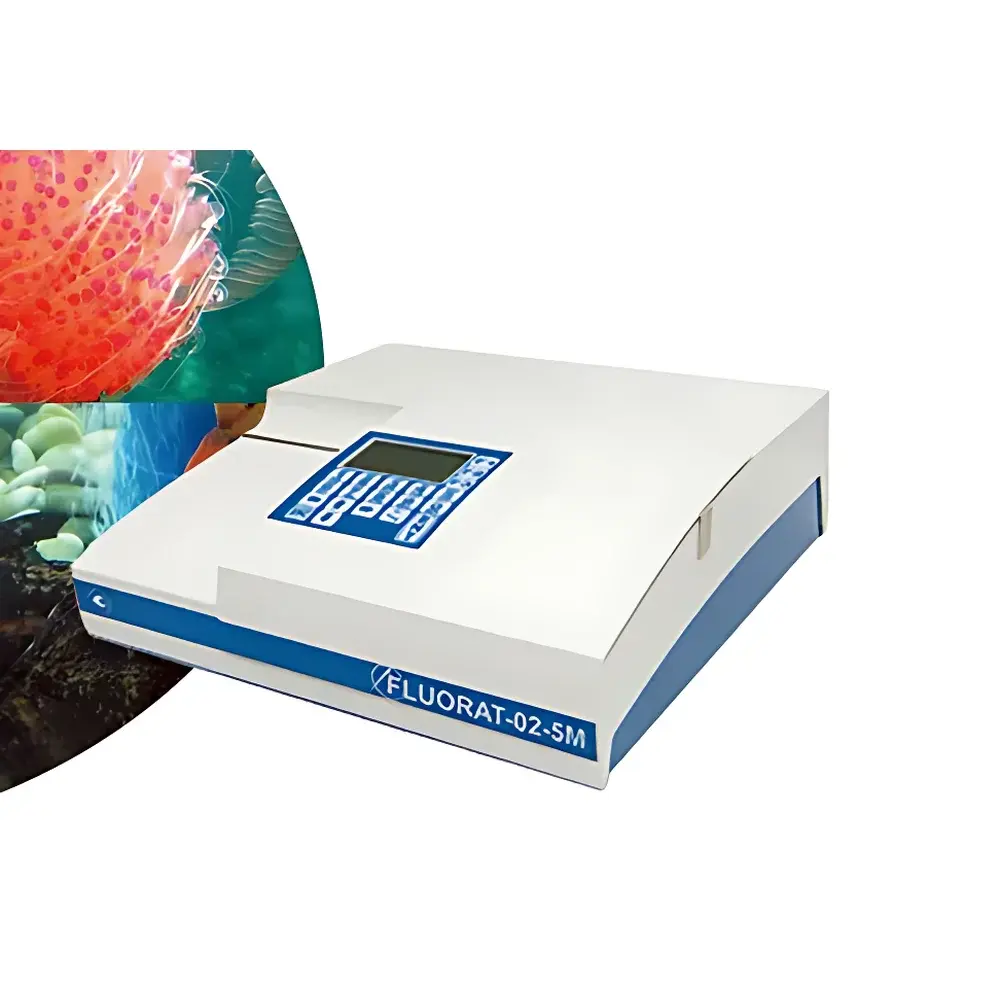
Fluorat-02-5M High-Precision Oil-in-Water Analyzer
| Brand | — |
|---|---|
| Origin | Beijing, China |
| Manufacturer Type | Authorized Distributor |
| Origin Category | Domestic |
| Model | Fluorat-02-5M |
| Pricing | Upon Request |
Overview
The Fluorat-02-5M High-Precision Oil-in-Water Analyzer is a multi-modal optical detection platform engineered for quantitative analysis of hydrocarbon-based contaminants and a broad spectrum of priority pollutants in environmental and industrial matrices. It operates on the fundamental principle of photoluminescence spectroscopy—specifically ultraviolet-induced fluorescence (UV-FL), absorbance photometry, phosphorescence, and chemiluminescence—enabling trace-level quantification based on emission intensity, transmittance, or luminescent decay kinetics. Designed to meet stringent regulatory measurement requirements, the instrument complies with key national and international standard methods including GB/T 16488.1–1996 (fluorescence method for petroleum hydrocarbons in water), GB/T 16488.2–1996 (UV spectrophotometric method), SL 366–2006 (water quality monitoring for hydropower projects), GB 17378.4–2007 (marine sediment analysis), EPA Method 1664A (n-hexane extractable material), and PND F 14.1:2:4.128–98 (Russian Federation sanitary standards). Its core architecture integrates pulsed xenon lamp excitation, optimized optical path design with triple reference channels, and temperature-stabilized detection electronics to ensure long-term signal stability and minimal drift.
Key Features
- Multi-technique detection capability: simultaneous support for UV-fluorescence, absorbance photometry, phosphorescence, and chemiluminescence measurements
- Pulsed high-intensity xenon lamp source delivering stable spectral output across 200–700 nm, with extended service life (>10⁹ pulses) and minimal thermal load
- Single-channel wide-dynamic-range optical design eliminating manual range switching; accommodates petroleum hydrocarbon concentrations from 0.001 to 100 mg/L without dilution or hardware reconfiguration
- Proprietary triple-reference optical path architecture minimizing stray light, detector saturation, and baseline fluctuation—enhancing signal-to-noise ratio and reproducibility (RSD < 2.5% at 0.05 mg/L oil)
- Integrated touchscreen interface with embedded firmware; optional PC-based software for advanced data handling, audit trail logging, and method validation
- Non-volatile memory storage for calibration curves, instrument configuration, and QC records—retained after power cycling
- Low-toxicity reagent compatibility and minimal consumption (< 2 mL per test); supports regeneration protocols aligned with Montreal Protocol compliance objectives
- Robust mechanical design suitable for both fixed-lab deployment and field-portable operation—including integrated sample pretreatment modules and battery-powered operation mode
Sample Compatibility & Compliance
The Fluorat-02-5M accepts liquid, semi-solid, and extracted organic-phase samples across diverse environmental media. Validated applications include surface water, drinking water, wastewater, marine sediments, soil extracts, food homogenates, air particulate filters (after solvent elution), and industrial effluents. It meets analytical performance criteria specified in ISO/IEC 17025:2017 for testing laboratories, supports GLP-compliant workflows via timestamped electronic records, and enables 21 CFR Part 11–ready data integrity features when used with validated software configurations. All measurement protocols adhere to documented uncertainty budgets per GUM (JCGM 100:2008) and are traceable to NIST SRMs where applicable.
Software & Data Management
Instrument control and data acquisition are managed through dual-mode operation: an onboard 7-inch capacitive touchscreen with intuitive graphical workflow navigation, or a Windows-compatible desktop application supporting method development, multi-point calibration, statistical outlier detection, and report generation in PDF/XLSX formats. The software implements full audit trail functionality—including user login history, parameter change logs, calibration event timestamps, and raw-data immutability flags—to satisfy regulatory review requirements. Calibration curves may be archived, recalled, or transferred between instruments using encrypted USB export. Firmware updates are delivered via signed binary packages with SHA-256 verification.
Applications
- Water analysis: Petroleum hydrocarbons (TPH), phenols (including volatile phenol), anionic surfactants (MBAS), COD (via dichromate oxidation endpoint detection), turbidity (NTU), cyanide (pyridine-barbituric acid method), uranium, vanadium, molybdenum, nickel, manganese, chromium(VI)
- Sediment & solid waste: Total petroleum hydrocarbons (TPH), benzo[a]pyrene (BaP) in Soxhlet extracts
- Food safety: Selenium, aflatoxins, vitamins A/E/B1/B2/C, BaP in edible oils and processed foods
- Air monitoring: BaP, formaldehyde, H₂S, HF, Cu/Zn/Se in filter-collected particulates
- Emissions testing: Formaldehyde and BaP in stack gas condensates and scrubber solutions
FAQ
Does the Fluorat-02-5M require daily recalibration?
No—calibration curves remain stable for up to 30 days under controlled lab conditions; field use recommends single-point verification before each sampling session.
Can it measure petroleum hydrocarbons in the presence of methanol or suspended solids?
Yes—the optical system is insensitive to common polar solvents and particulate interference due to its dual-wavelength referencing and background subtraction algorithm.
Is the instrument compliant with EPA Method 1664A?
It supports the extraction and quantification steps outlined in EPA 1664A; final reporting must follow laboratory-specific SOPs validated per 40 CFR Part 136.
What sample preparation is required for sediment analysis?
Soxhlet or ultrasonic extraction using n-hexane or Freon替代溶剂 (e.g., cyclohexane) is recommended; extracts are then concentrated and reconstituted in isooctane prior to analysis.
Is remote diagnostics supported?
Yes—when connected to a local network, the instrument permits secure remote firmware updates and diagnostic log retrieval via TLS-encrypted SSH tunneling.





