FMS Human Energy Metabolism Laboratory System
| Brand | FMS |
|---|---|
| Origin | USA |
| Manufacturer Type | Authorized Distributor |
| Import Status | Imported |
| Model | Human Energy Metabolism Laboratory System |
| Price Range | USD 28,000 – 70,000 |
Overview
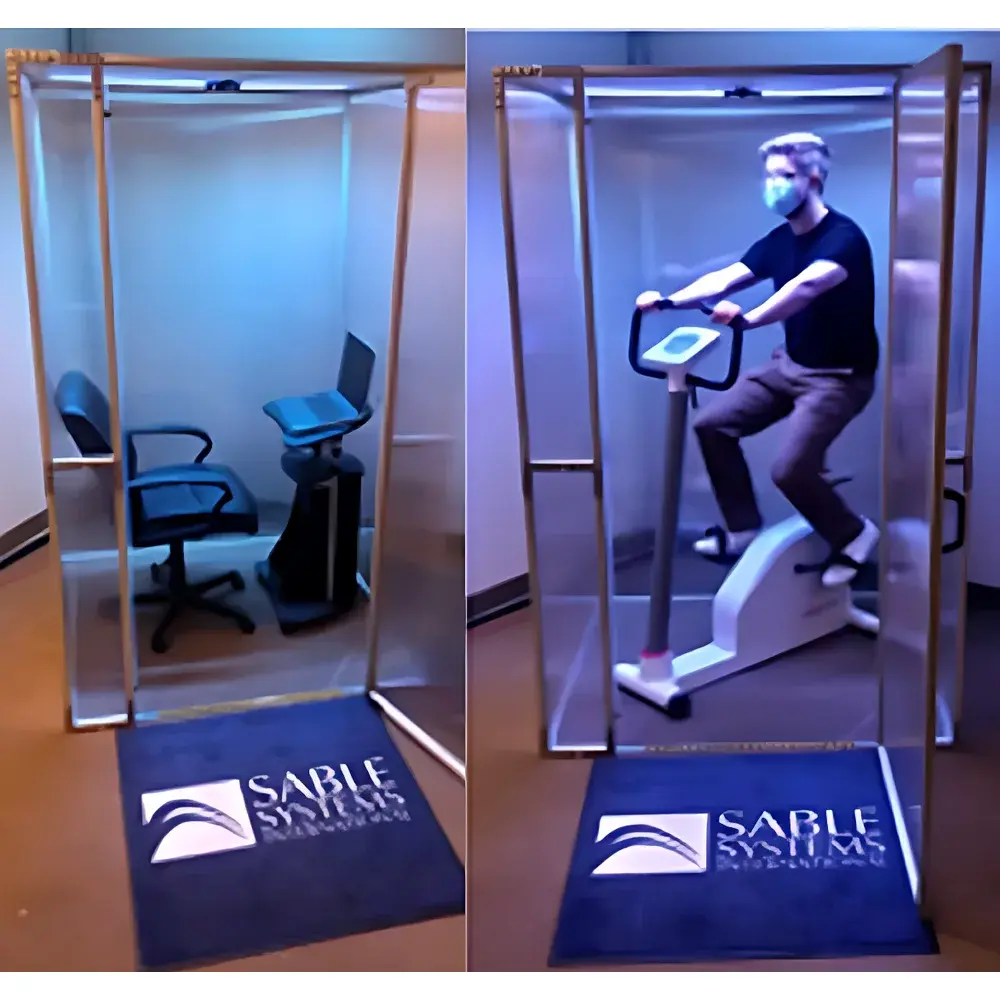
The FMS Human Energy Metabolism Laboratory System is a research-grade indirect calorimetry platform engineered for high-fidelity, real-time quantification of whole-body energy expenditure (EE), substrate oxidation, and respiratory gas exchange kinetics in human subjects under ecologically valid conditions. It implements the gold-standard open-circuit indirect calorimetry principle—measuring volumetric O₂ consumption (VO₂) and CO₂ production (VCO₂) to calculate resting metabolic rate (RMR), total daily energy expenditure (TDEE), and respiratory exchange ratio (RER)—in accordance with ASTM E2536-22 and ISO 8596:2018 guidelines for metabolic measurement systems. The system supports two primary operational configurations: (1) a fully instrumented, walk-in metabolic chamber enabling unrestricted ambulatory activity over extended durations (up to 72 h), and (2) a portable mask- or hood-based setup for acute or field-deployable assessments. Integrated environmental monitoring—including concurrent infrared thermography, cutaneous thermal flux, hygrometric profiling, and triaxial accelerometry—enables multivariate analysis of thermoregulatory coupling, behavioral energetics, and physiological adaptation to environmental stressors such as circadian misalignment, hypobaric exposure, thermal extremes, and nutritional interventions.
Key Features
- Modular, scalable architecture supporting seamless reconfiguration for human, non-human primate, and rodent metabolism studies—compliant with NIH Guide for the Care and Use of Laboratory Animals (8th ed.)
- Real-time, flow-through respirometry with <1 s response time for CO₂ and <7 s for O₂, enabling breath-by-breath resolution of transient metabolic shifts during exercise, feeding, or sleep transitions
- Differential gas analysis modules: fuel-cell O₂ sensor (0–100% range, ±0.1% accuracy, 24-h drift <0.01%), dual-wavelength NDIR CO₂ analyzer (0–5% / 0–15% dual-range, ±1% accuracy, 1 ppm resolution), and thin-film capacitive H₂O vapor sensor (0–100% RH, ±1% accuracy, 0.001% RH resolution)
- Simultaneous environmental and physiological telemetry: integrated thermistor array (−5–60°C, ±0.2°C), barometric pressure sensor (30–110 kPa, 0.0001 kPa resolution), and programmable mass-flow controller (75–500 L/min, ±2% FS)
- Wearable physiological data logger: triaxial accelerometer (±15 g, ±0.15 g precision), skin temperature/humidity probe (−40–125°C, ±0.2°C; 0–100% RH, ±1.8% RH), OLED display, Bluetooth 5.0 interface, and onboard memory for >72 h continuous logging
- Optional infrared thermographic module (640 × 480 pixel uncooled microbolometer, NETD <50 mK) for spatial mapping of cutaneous heat flux and environmental thermal gradient correlation
- Fully digitized signal chain: 24-bit A/D conversion, 16-bit analog outputs, 10 Hz sampling frequency, digital noise filtering (0.2–50 s adjustable), and hardware-level temperature/pressure compensation
Sample Compatibility & Compliance
The system accommodates diverse subject cohorts—including clinical populations (obese, diabetic, cardiovascular-compromised), athletes, shift workers, and aging cohorts—while maintaining strict adherence to Good Clinical Practice (GCP) and GLP-compliant data integrity standards. All gas analyzers are calibrated traceable to NIST-certified reference gases (SRM 1678c, SRM 1969). Data acquisition firmware supports FDA 21 CFR Part 11-compliant audit trails, electronic signatures, and role-based access control. Hardware design conforms to IEC 61000-6-3 (EMC emissions) and IEC 61000-6-2 (immunity), with CE marking for in vitro diagnostic use under IVDR Annex XVI. Chamber construction meets ISO 7211-2 Class 5 cleanroom particulate requirements for long-duration metabolic isolation.
Software & Data Management
The proprietary FMS MetabSoft Suite (v5.3+) provides synchronized visualization, real-time spectral analysis, and automated calculation of EE (kcal/day), RQ, fat/carbohydrate oxidation rates (g/min), and ventilatory thresholds. Raw signals are stored in HDF5 format with embedded metadata (subject ID, protocol timestamp, calibration history, sensor serial numbers). Export modules support CSV, MATLAB (.mat), and EDIFACT-compliant HL7 CDA for integration into REDCap, OpenMRS, or institutional EHR platforms. Batch processing includes artifact rejection (e.g., cough-induced VO₂ spikes), rolling-window averaging (1–60 min), and circadian phase alignment using cosine-fitting algorithms per Bingham et al. (J Biol Rhythms, 1989). Audit logs record all parameter modifications, user logins, and data export events with SHA-256 hashing.
Applications
- Clinical nutrition research: quantifying diet-induced thermogenesis (DIT), postprandial energy partitioning, and macronutrient-specific metabolic flexibility
- Environmental physiology: assessing metabolic cost of locomotion across altitudes, ambient temperatures, and transportation microenvironments (e.g., railcar cabins, EV interiors)
- Chronobiology: characterizing misalignment-induced reductions in non-exercise activity thermogenesis (NEAT) and nocturnal glucose intolerance
- Translational obesity research: evaluating adaptive thermogenesis suppression following weight loss and its modulation by pharmacologic agents
- Sports science: determining ventilatory thresholds, critical power, and fatigue-related substrate switching during graded exercise protocols
- Gerontology: tracking age-associated declines in basal metabolic rate and mitochondrial coupling efficiency via longitudinal RMR monitoring
FAQ
What regulatory standards does the system comply with for clinical research use?
The system meets ISO 8596:2018 for metabolic measurement accuracy, ASTM E2536-22 for respirometry validation, and supports 21 CFR Part 11 compliance through encrypted audit trails and electronic signature workflows.
Can the metabolic chamber be customized for pediatric or bariatric subjects?
Yes—FMS offers configurable chamber volumes (2.5–12 m³), reinforced structural framing (up to 300 kg load capacity), and pediatric airflow optimization kits with low-turbulence inlet manifolds.
Is remote monitoring supported for multi-site trials?
MetabSoft includes secure TLS 1.3-enabled remote access, live dashboard sharing, and automated daily QC report generation with email/SFTP delivery.
How is cross-sensor calibration maintained during long-term deployments?
Each gas module performs automatic zero/span verification every 24 h using internal reference valves and certified span gases; drift correction coefficients are applied in real time via embedded polynomial compensation algorithms.
Does the system integrate with third-party actigraphy or polysomnography platforms?
Yes—via HL7 v2.5.1 and IEEE 11073-10201 device specialization profiles; native drivers exist for ActiGraph GT9X, Philips Alice PDx, and Compumedics Somte PSG systems.
Related Products