
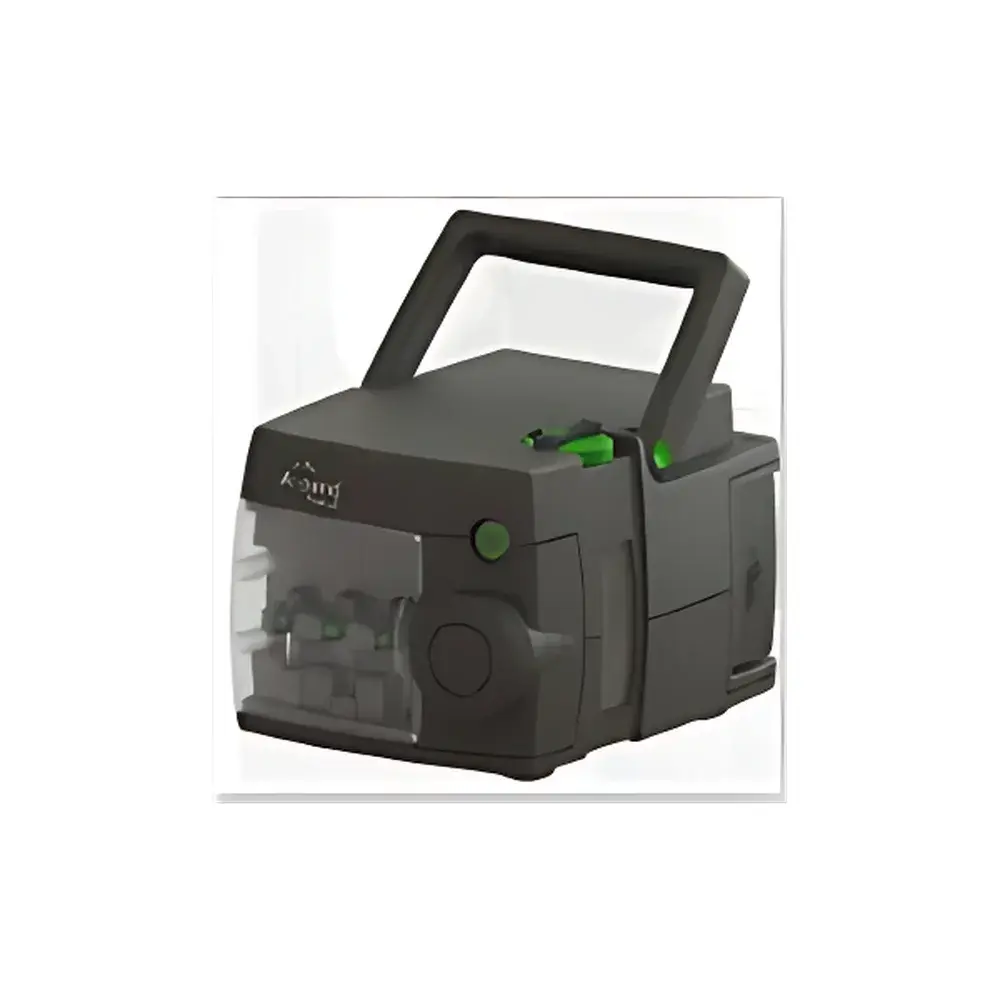
Focus LC Portable Capillary High-Performance Liquid Chromatograph by Axcend
| Brand | Axcend |
|---|---|
| Origin | USA |
| Model | Focus LC |
| Instrument Type | Portable Capillary HPLC |
| Detection Principle | UV Absorbance (254 nm standard) |
| Max Operating Pressure | 10,000 psi |
| Power Input | AC 100–240 V, 50/60 Hz, 1.4 A |
| Battery | 12 V DC, 126 Wh LiFePO₄ |
| Runtime | >10 hours per charge |
| Cycle Life | >2,000 charge/discharge cycles |
| Solvent Consumption | <10 mL/week (typical operational use) |
| Cartridge-Based System | Tool-free, modular hardware reconfiguration |
Overview
The Focus LC Portable Capillary High-Performance Liquid Chromatograph, engineered and manufactured by Axcend (USA), redefines field-deployable chromatographic analysis. Unlike conventional benchtop HPLC systems, the Focus LC employs capillary-scale separation channels (inner diameter ≤ 300 µm) coupled with low-volume UV absorbance detection to deliver high-resolution, quantitative separations in a footprint smaller than a standard shoebox (24 × 18 × 12 cm). Its core architecture is based on isocratic or gradient elution via precision micro-pumping, with flow rates ranging from 0.1 to 5 µL/min — optimized for minimal solvent consumption and maximal column efficiency. The system operates under pressures up to 10,000 psi, enabling the use of sub-2-µm particle-packed capillary columns for enhanced peak capacity and resolution. Designed for deployment beyond centralized laboratories — including environmental monitoring sites, pharmaceutical manufacturing floors, forensic mobile units, and academic field stations — the Focus LC meets the technical requirements of method transfer, routine QC screening, and rapid method development without compromising analytical integrity.
Key Features
- Ultra-compact form factor (shoebox-sized): Enables transport in carry-on luggage and operation on unstable or space-constrained surfaces.
- Capillary-scale HPLC platform: Reduces solvent consumption to <10 mL per week under typical usage, minimizing hazardous waste generation and disposal costs.
- Modular cartridge architecture: All critical fluidic and optical components — including pump module, column heater, UV flow cell, and detector — are integrated into interchangeable, tool-free cartridges. Hardware reconfiguration requires <90 seconds and no calibration recalibration.
- Dual-power operation: Supports continuous AC operation or battery-powered autonomous use for >10 hours. The integrated 126 Wh LiFePO₄ battery offers superior thermal stability, extended cycle life (>2,000 full charge/discharge cycles), and compliance with IATA air transport regulations for lithium batteries.
- Robust pressure control: Precision piezoelectric micropump delivers stable flow with <0.2% RSD over 24-hour runs; pressure feedback loop maintains setpoint accuracy within ±50 psi across the full 100–10,000 psi range.
Sample Compatibility & Compliance
The Focus LC accommodates liquid samples compatible with reversed-phase, normal-phase, and hydrophilic interaction liquid chromatography (HILIC) modalities. Sample introduction is achieved via 10–100 µL loop injection using a manually actuated or optional motorized syringe-based autosampler. It supports standard capillary column chemistries (C18, C8, phenyl-hexyl, amino, silica) with lengths from 15 to 100 cm and internal diameters of 150–300 µm. The system conforms to key regulatory expectations for data integrity: all acquisition parameters, method files, and raw chromatograms are timestamped and stored with immutable metadata. Audit trails comply with ALCOA+ principles and support GLP/GMP environments when paired with validated software configurations. While not pre-certified for FDA 21 CFR Part 11 out-of-the-box, the architecture supports electronic signatures and user access controls through optional enterprise software licensing.
Software & Data Management
Control and data acquisition are managed via the Axcend ChromaView™ desktop application (Windows 10/11, 64-bit), which provides real-time chromatogram visualization, peak integration using tangent skim and Gaussian deconvolution algorithms, and customizable reporting templates. Raw data are saved in vendor-neutral .cdf (NetCDF) format, ensuring long-term readability and compatibility with third-party processing tools such as OpenChrom or MATLAB. Method files include complete instrument state definitions (flow rate, gradient profile, detection wavelength, temperature setpoints), enabling full reproducibility across instruments. Data export supports CSV, PDF, and XML formats; batch processing allows automated report generation for multi-sample sequences. Remote monitoring is supported via Ethernet or Wi-Fi (optional module), with TLS-encrypted data transmission for secure network deployment.
Applications
- On-site environmental testing: Rapid quantification of pesticides, PAHs, and pharmaceutical residues in surface water or soil extracts.
- Pharmaceutical manufacturing: In-process checks for API purity, excipient compatibility, and cleaning validation swab extracts.
- Academic research: Teaching chromatography fundamentals with reduced infrastructure dependency; method scouting for novel stationary phases.
- Food safety screening: Detection of mycotoxins, preservatives, and adulterants directly at distribution hubs or border inspection points.
- Forensic toxicology: Preliminary identification of controlled substances in biological matrices prior to confirmatory GC-MS analysis.
FAQ
Is the Focus LC compliant with ISO/IEC 17025 requirements for accredited testing laboratories?
Yes — when operated with documented SOPs, calibrated reference standards, and traceable maintenance records, the Focus LC satisfies the technical competence criteria outlined in ISO/IEC 17025:2017 Clause 6.4 (Equipment) and Clause 7.2 (Method Validation). Full accreditation requires laboratory-specific validation per intended use.
Can the system be used with mass spectrometry detectors?
Not natively — the Focus LC is configured for UV detection only. However, its capillary flow output (≤5 µL/min) is compatible with nanospray ESI interfaces for coupling to benchtop or portable MS systems, subject to external flow splitting and interface optimization.
What column dimensions and chemistries are validated by Axcend?
Axcend provides full performance validation for 15–50 cm × 150–250 µm ID columns packed with C18, C8, and HILIC phases. Third-party columns may be used but require independent method qualification.
Does the battery support hot-swapping during operation?
No — battery replacement requires system shutdown. However, the dual-power design allows seamless transition from AC to battery mode without interruption if AC is disconnected while battery is charged above 20%.
How is baseline noise and drift managed in field conditions?
The UV detector incorporates temperature-stabilized LED source optics and dual-beam referencing with real-time background subtraction. Baseline drift remains <0.5 mAU/hour under ambient temperature fluctuations of ±5 °C, verified per ASTM E260-18 Annex A1.





