
Focuslight Environmental Intelligence Solution
| Origin | Zhejiang, China |
|---|---|
| Manufacturer Type | Authorized Distributor |
| Product Origin | Domestic (China) |
| Model | Environmental Intelligence Solution |
| Pricing | Available Upon Request |
Overview
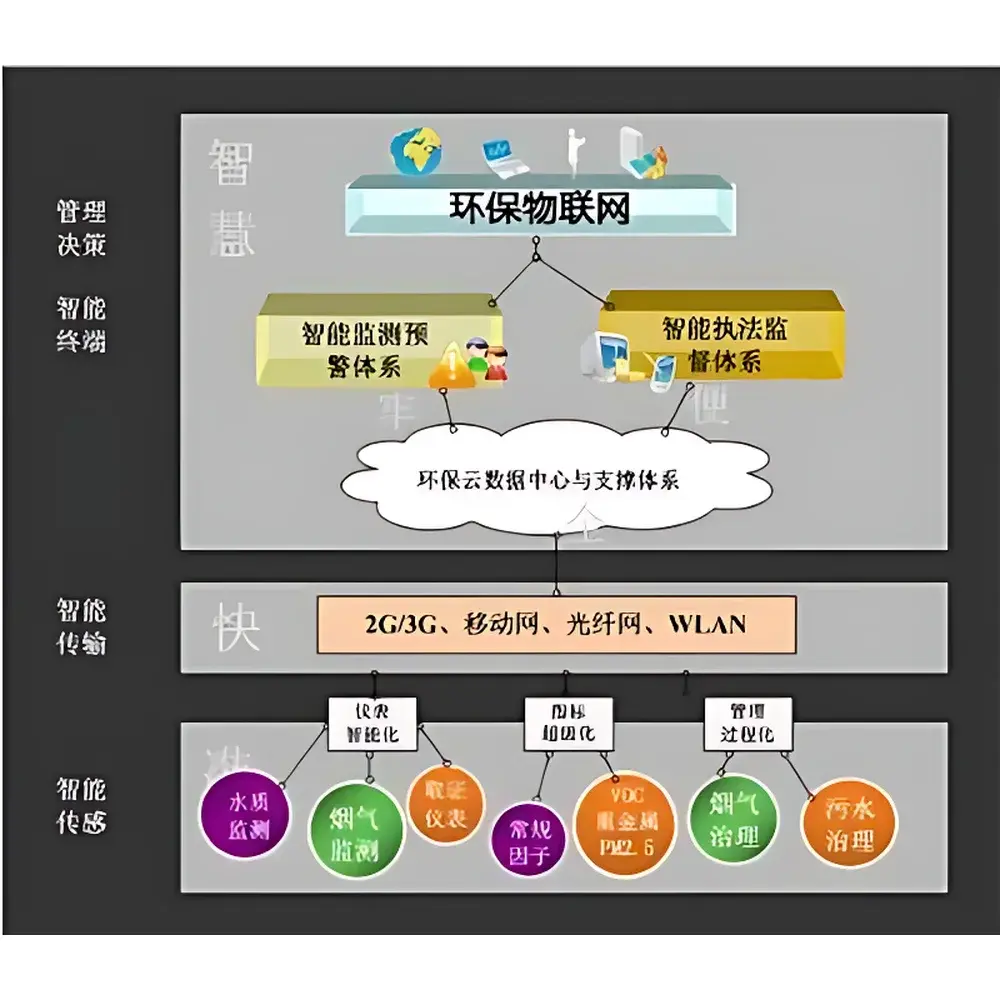
The Focuslight Environmental Intelligence Solution is an integrated IoT-based environmental monitoring and management platform engineered for regulatory agencies, municipal ecological bureaus, and industrial park authorities. It implements a multi-layered sensing architecture grounded in real-time data acquisition, edge intelligence, and cloud-enabled analytics to support evidence-based environmental governance. Unlike legacy point-source monitoring systems, this solution applies distributed sensor networks—deployed across air, water, noise, and soil domains—to capture dynamic emission profiles, process-level pollution behavior, and cross-media contaminant migration. Its core measurement methodology integrates calibrated electrochemical, optical (NDIR, DOAS, PID), and gravimetric sensing modalities, synchronized with automated calibration verification and remote diagnostics. Designed for continuous operation under varying climatic and industrial conditions, the system adheres to fundamental principles of metrological traceability and data integrity required by national environmental monitoring standards (e.g., HJ 817–2018, HJ 654–2013) and aligns with international frameworks such as ISO 14001 and the EU’s INSPIRE Directive for spatial environmental data interoperability.
Key Features
- Multi-parameter intelligent sensing layer: Simultaneous detection of SO₂, NOₓ, PM₂.₅/PM₁₀, VOCs (via PID/FID), HCl, HF, heavy metals (via XRF or ICP-MS–compatible sampling interfaces), noise (Leq, Lmax), and water quality indicators (COD, NH₃-N, TP, heavy metals)
- Process-integrated monitoring architecture: Real-time linkage between emission source control systems (e.g., scrubbers, thermal oxidizers) and online analyzers to enable closed-loop compliance verification
- Edge-to-cloud data pipeline: On-device preprocessing, TLS 1.2–secured transmission, automatic metadata tagging (location, timestamp, instrument ID, calibration status), and dual redundancy storage (local SD + cloud archive)
- Adaptive alerting engine: Configurable thresholds based on regulatory limits (e.g., GB 3095–2012, GB 16297–1996), trend-based anomaly detection, and geofenced incident escalation workflows
- Unified dashboard with GIS integration: Web-based interface supporting real-time map overlays, historical trend analysis, source attribution modeling, and exportable audit-ready reports compliant with GLP documentation requirements
Sample Compatibility & Compliance
The solution supports heterogeneous sample matrices including ambient air (gaseous and particulate phases), surface/groundwater, industrial stack emissions, and urban noise environments. All field-deployed sensors undergo factory calibration against NIST-traceable reference standards and are validated per CNAS-CL01:2018 requirements. Data acquisition firmware complies with HJ 212–2017 communication protocols for environmental monitoring equipment, ensuring seamless integration with provincial and national environmental information platforms (e.g., China’s National Environmental Monitoring Network). System architecture supports audit trails, user role-based access control (RBAC), and electronic signature functionality aligned with FDA 21 CFR Part 11 expectations for regulated data handling.
Software & Data Management
The proprietary Environmental Intelligence Platform (EIP) provides browser-accessible software with role-specific dashboards for operators, inspectors, and policy analysts. It features time-series database indexing optimized for high-frequency sensor streams (up to 1 Hz resolution), automated QA/QC flagging (e.g., zero/span drift >5%, signal saturation, communication timeout), and configurable report templates meeting HJ 972–2018 reporting specifications. Data exports support CSV, PDF, and XML formats with embedded digital signatures; raw data archives retain full sensor-level granularity for retrospective reprocessing. The platform supports API-based integration with third-party GIS engines (ArcGIS, QGIS), ERP systems (SAP, Oracle), and mobile enforcement tools used in China’s “Blue Sky Protection Campaign” mobile inspection workflows.
Applications
- Regional air quality forecasting and source apportionment in urban agglomerations
- Real-time compliance monitoring for key polluting enterprises (e.g., steel, cement, chemical manufacturing)
- Industrial park environmental risk assessment and early warning for VOC leakage events
- Mobile monitoring deployment for construction site dust, road traffic noise, and roadside exhaust profiling
- Supporting environmental impact assessments (EIAs) and post-implementation monitoring (PIM) under China’s EIA Law and the “Dual Carbon” policy framework
FAQ
Does the system support integration with existing provincial environmental monitoring platforms?
Yes—it implements HJ 212–2017 protocol natively and has been certified for interoperability with over 12 provincial data centers across China.
How is data authenticity and tamper resistance ensured?
Each data packet includes cryptographic hash signatures, device-unique keys, and immutable timestamps; all modifications trigger versioned audit logs stored separately from operational databases.
What maintenance model does Focuslight provide for long-term deployment?
A tiered service model is available: remote diagnostics (Level 1), on-site preventive maintenance (Level 2), and full lifecycle support including sensor recalibration, firmware updates, and regulatory adaptation services (Level 3).
Related Products







