
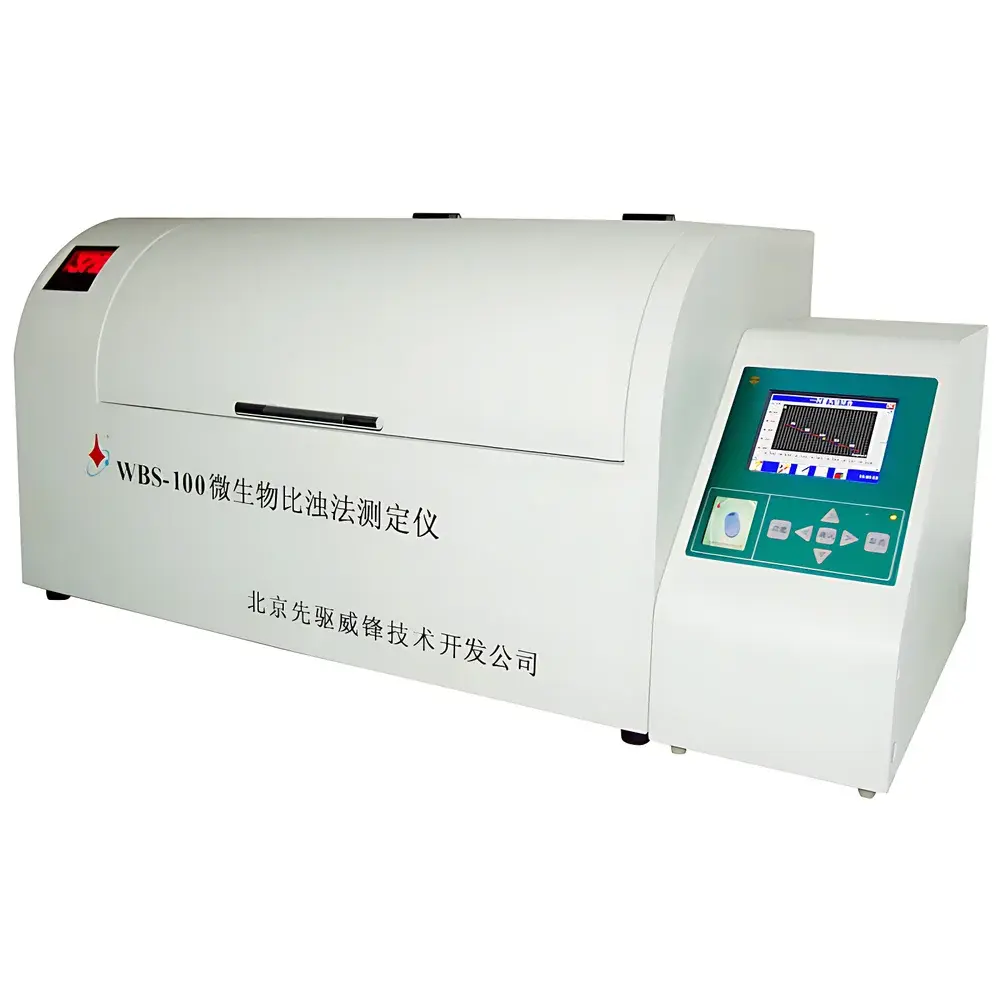
Forerunner WBS-100 Microbial Turbidimetric Assay Instrument
| Brand | Forerunner |
|---|---|
| Model | WBS-100 |
| Origin | Beijing, China |
| Temperature Control Range | Room Temp to 60 °C |
| Temp. Accuracy | ±0.1 °C |
| Temp. Uniformity | ±0.3 °C |
| Heating Rate | 1.5 °C/min |
| Detection Cycle | 25 s per 40 cuvettes |
| Potency Calculation Time | <0.1 s |
| Absorbance Detection Precision | 0.001 A |
| Absorbance Repeatability | ±0.001 A |
| Potency Reproducibility | ≤0.5% |
| Multi-wavelength Light Source | Optional |
| UV Sterilization Lamp | Integrated |
| Audit Trail | Yes |
| User Access Control | Role-based authentication with password and RFID key |
Overview
The Forerunner WBS-100 Microbial Turbidimetric Assay Instrument is a dedicated pharmaceutical analytical system engineered for quantitative determination of antimicrobial potency via turbidimetric bioassay—principally in accordance with the Chinese Pharmacopoeia (ChP) 2020 Edition, while maintaining full alignment with international pharmacopoeial standards including USP 〈81〉 Antimicrobial Effectiveness Testing, EP 2.6.12 Microbiological Assays, and JP 6.07 Microbiological Assay. It implements the classical microbial growth inhibition principle: antibiotic-containing samples are incubated with standardized suspensions of susceptible test organisms (e.g., Bacillus subtilis, Staphylococcus aureus, Candida albicans); optical density (OD) changes at defined wavelengths (typically 580–650 nm) are monitored in real time to quantify bacterial proliferation suppression. The instrument supports all three standard dose-response methodologies—single-dose (one-point), two-dose (parallel-line), and three-dose (slope-ratio)—enabling robust potency estimation with statistical validation per ICH Q5C and ISO/IEC 17025 requirements.
Key Features
- Five-channel high-speed scanning photometer capable of simultaneous measurement of up to 40 cuvettes in 25 seconds, with optional multi-wavelength LED sources (580 nm, 620 nm, 650 nm) for optimized microorganism-specific absorbance detection.
- Patented real-time online scanning technology with automatic optical calibration prior to each assay cycle, eliminating drift-induced baseline error.
- Integrated precision incubation module featuring PID-controlled temperature regulation (±0.1 °C accuracy, ±0.3 °C uniformity across chamber), programmable ramp rate (1.5 °C/min), and electronic orbital shaking for homogeneous suspension maintenance during incubation (20–300 rpm, adjustable).
- Latin-square cuvette arrangement configuration compliant with USP 〈81〉 and EP 2.6.12, minimizing positional bias and systematic inter-assay variability.
- Dual-layer security architecture: RFID-enabled electronic key authentication + role-based user access control (administrator, analyst, reviewer) with encrypted password management and session timeout.
- Onboard UV-C germicidal lamp (254 nm) for post-assay chamber decontamination, validated to achieve ≥3-log reduction of residual vegetative bacteria.
- Distributed network topology supporting up to 10 independent incubation units controlled by a single workstation—enabling concurrent execution of up to 20 parallel assays under identical or divergent protocols.
Sample Compatibility & Compliance
The WBS-100 accommodates standard 12 × 75 mm or 16 × 100 mm sterile glass or polystyrene cuvettes, compatible with both liquid broth-based and agar-diffusion-derived test systems. It meets critical regulatory expectations for data integrity and process traceability: full 21 CFR Part 11-compliant audit trail (immutable timestamped records of all user actions, parameter modifications, and result exports), electronic signatures, and ALCOA+ principles adherence (Attributable, Legible, Contemporaneous, Original, Accurate). System validation documentation—including IQ/OQ/PQ templates, risk assessments (ICH Q9), and method verification protocols aligned with USP 〈1225〉—is provided to support GMP/GLP laboratory implementation.
Software & Data Management
- Windows-based workstation software with multilingual UI (English, Spanish, French, German, Japanese, Simplified Chinese) and intuitive graphical workflow navigation.
- Real-time OD curve visualization with automatic lag-phase, exponential-phase, and stationary-phase identification; kinetic parameters (doubling time, maximum growth rate µmax) are computed and exportable.
- Integrated potency calculation engine applying weighted least-squares regression, parallel-line analysis (PLA), and slope-ratio models—with confidence interval estimation and validity checks per EP 2.6.12 Annex.
- LIS/HIS connectivity via HL7 v2.5 and ASTM E1384 interfaces; raw data export in CSV, PDF, XML, and proprietary .WBS binary formats.
- Secure cloud-sync capability for remote monitoring, historical trend analysis, and centralized report generation across multi-site operations.
- Firmware and software updates delivered via authenticated HTTPS channel with SHA-256 signature verification.
Applications
The WBS-100 serves as a core platform in pharmaceutical quality control laboratories for: antibiotic potency release testing of bulk APIs and finished dosage forms (tablets, injectables, ointments); preservative efficacy testing (PET) of multidose formulations per USP 〈51〉; stability-indicating assay development; microbiological method validation; and academic research in antimicrobial resistance profiling. Its reproducibility (≤0.5% RSD for replicate potency determinations) and traceable calibration chain make it suitable for regulatory submissions to NMPA, FDA, EMA, and PMDA.
FAQ
Does the WBS-100 comply with 21 CFR Part 11 requirements for electronic records and signatures?
Yes—full audit trail logging, electronic signature capture with biometric or token-based second-factor authentication, and system-generated validation reports are embedded in firmware and software.
Can the instrument perform assays using non-standard microorganisms or custom media?
Yes—the software allows user-defined organism-specific growth curves, wavelength selection, incubation profiles, and acceptance criteria; method templates may be saved and version-controlled.
Is external calibration required, and how often?
The system performs self-calibration before each run using built-in neutral-density reference filters; annual third-party metrological verification against NIST-traceable photometric standards is recommended.
What level of IT infrastructure is needed for network deployment?
A standard Gigabit Ethernet LAN with static IP assignment and firewall port configuration (TCP 8080, 443) suffices; no domain controller or Active Directory integration is mandatory.
How is data backup and disaster recovery handled?
Automated daily encrypted backups to local NAS or cloud storage (AWS S3, Azure Blob) are configurable; full system image restoration is supported from USB recovery drive.





