
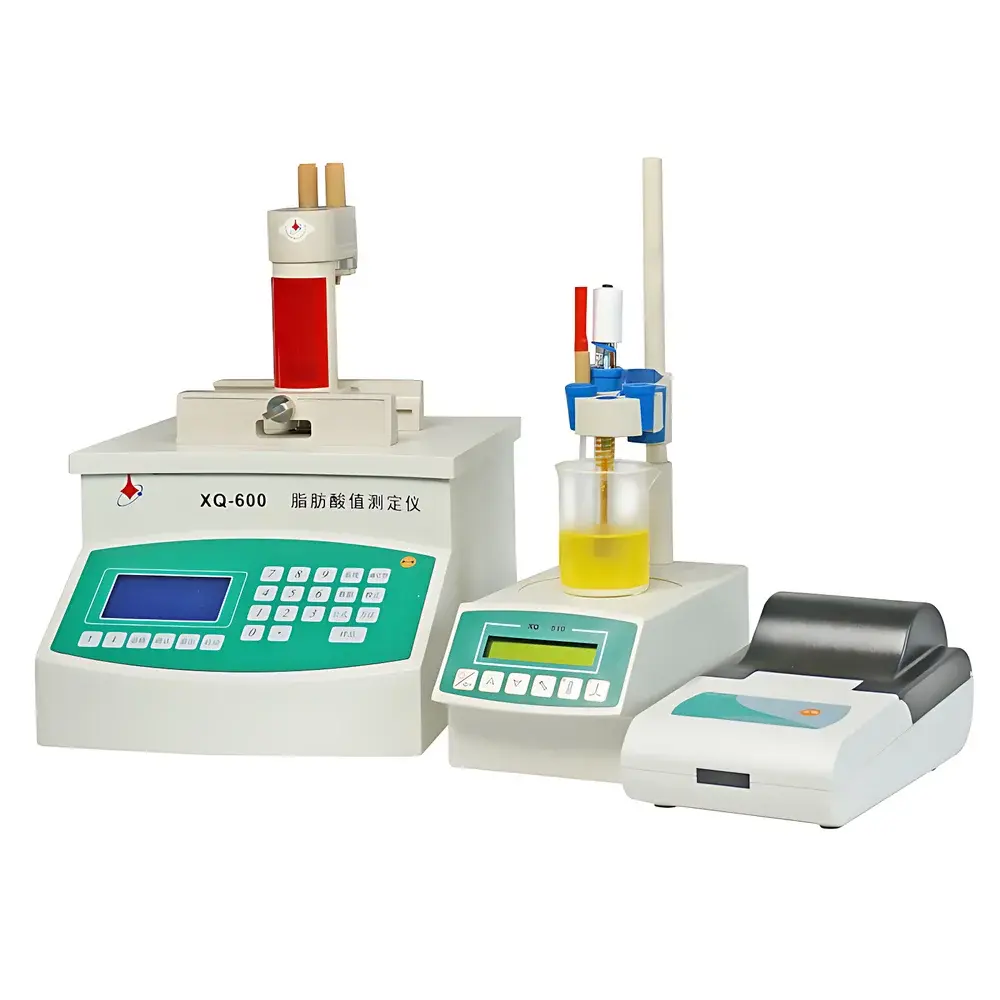
Forerunner XQ-600 Fatty Acid Value Analyzer
| Brand | Forerunner |
|---|---|
| Origin | Beijing, China |
| Manufacturer Type | Authorized Distributor |
| Country of Origin | China |
| Model | XQ-600 |
| Price | Upon Request |
| Measurement Range | 0–300 mg KOH/100 g dry matter |
| Resolution | 0.01 mg KOH/100 g dry matter |
| Repeatability | RSD ≤ 0.3% |
| Minimum Dispensing Volume | 0.625 µL |
| Titration Modes | Rapid Titration, Precise Titration |
| Preloaded Methods | Corn, Rice (Paddy), Wheat (100 method slots) |
| Compliance | GB/T 15684–1995, GB 5510–1985, GB/T 20569–2006, GB/T 20570–2006, GB/T 20571–2006 |
| Interfaces | RS232C, Parallel Printer Port |
| Software | Embedded real-time monitoring & PC-based data management suite |
Overview
The Forerunner XQ-600 Fatty Acid Value Analyzer is an automated potentiometric titration system engineered for precise, standardized quantification of free fatty acid content in cereal grains and oilseed products. It operates on the principle of acid-base titration using standardized potassium hydroxide (KOH) solution, with endpoint detection performed via a high-stability ion-selective electrode coupled with adaptive artificial neural network (ANN) algorithm processing. Unlike conventional visual endpoint detection relying on phenolphthalein indicator — which suffers from subjectivity, low contrast in turbid extracts, and inter-operator variability — the XQ-600 eliminates human judgment by dynamically modeling titration curve inflection points in real time. This architecture ensures traceable, objective, and statistically robust results aligned with national grain quality surveillance requirements. Designed specifically for grain storage quality assessment, it addresses the critical correlation between rising fatty acid value (FAV) and progressive lipolytic deterioration during post-harvest storage, enabling early intervention before rancidity compromises safety or marketability.
Key Features
- ANN-driven endpoint recognition: Trained on >10,000 titration curves from diverse grain matrices (corn, paddy rice, wheat), delivering superior robustness against extract coloration, suspended solids, and solvent volatility effects.
- Dual-solvent compatibility: Fully supports both anhydrous ethanol and benzene extraction protocols per GB/T 15684–1995 and GB 5510–1985, with automatic solvent-specific calibration and drift compensation.
- Integrated moisture input interface: Direct entry of sample moisture content (as % w/w) triggers automatic dry-matter normalization, eliminating manual calculation errors in final reporting (mg KOH / 100 g dry matter).
- Multi-tier titration strategy: Combines coarse rapid titration (≥80% of expected equivalence point) followed by fine-step precise titration (≤0.625 µL increments), optimizing throughput without sacrificing resolution (0.01 mg KOH/100 g).
- Regulatory-grade audit trail: All method parameters, raw titration data, endpoint decisions, operator ID, timestamp, and environmental metadata (ambient temperature, humidity) are logged in immutable binary format compliant with GLP documentation standards.
Sample Compatibility & Compliance
The XQ-600 is validated for use with milled or ground samples of maize (Zea mays), paddy rice (Oryza sativa), and common wheat (Triticum aestivum), as specified in GB/T 20569–2006 (rice), GB/T 20570–2006 (wheat), and GB/T 20571–2006 (maize). Extraction procedures follow AOAC Official Method 944.13 principles adapted to Chinese national standards. Instrument performance meets repeatability requirements (RSD ≤ 0.3% at n = 10, within-laboratory) and accuracy benchmarks defined in GB/T 15684–1995 Annex B. Data integrity conforms to the structural and retention requirements of GB/T 27404–2008 (Laboratory Quality Control Guidelines) and supports retrospective verification under CNAS-CL01:2018 accreditation audits.
Software & Data Management
The embedded firmware provides real-time graphical display of titration curves, pH vs. volume, derivative plots, and ANN confidence metrics. The optional Windows-based desktop application (XQ-Control Suite v3.2) enables remote instrument control, batch report generation (PDF/CSV/XLSX), statistical process control (SPC) charting, and trend analysis across multiple instruments. All exported files include digital signatures and cryptographic hashes to satisfy FDA 21 CFR Part 11 electronic record requirements where applicable. Method libraries support version-controlled updates and role-based access (administrator, analyst, reviewer) with full change history logging.
Applications
- Grain storage quality monitoring: Routine FAV screening at national grain reserves, provincial inspection centers, and port quarantine laboratories.
- Procurement quality gatekeeping: Objective acceptance/rejection criteria for incoming corn, rice, and wheat deliveries based on GB 2715–2016 (Food Safety Standard for Grain).
- Stability studies: Accelerated aging trials tracking lipid oxidation kinetics under controlled temperature/humidity conditions.
- Method validation support: Reference instrument for collaborative studies verifying alternative FAV protocols (e.g., FTIR, GC-FID).
- Training & proficiency testing: Standardized platform for inter-laboratory comparison programs administered by the National Grain and Oils Quality Supervision and Inspection Center.
FAQ
Does the XQ-600 require daily recalibration of the electrode?
No — the system performs automatic electrode health diagnostics before each assay and applies dynamic slope correction using dual-point buffer verification (pH 4.01 and 7.00) integrated into every method sequence.
Can the instrument store raw titration data for regulatory review?
Yes — all primary sensor readings (mV, volume, time), processed derivatives, ANN decision vectors, and metadata are retained in non-volatile memory for ≥12 months and exportable in forensic-ready format.
Is benzene extraction safe to perform on this platform?
The XQ-600 itself does not handle solvent hazards; however, its sealed titration cell design minimizes vapor exposure, and method templates enforce mandatory pause prompts for solvent transfer steps in accordance with GB/T 15684–1995 Section 6.2 safety provisions.
How is traceability ensured across multi-shift operations?
Each measurement is stamped with ISO 8601 timestamp, assigned unique 12-digit assay ID, and linked to operator credentials entered at login — all enforced via password-protected firmware-level access control.
What maintenance intervals are recommended for long-term reliability?
Electrode replacement every 18 months (or after 5,000 assays), syringe pump tubing replacement every 6 months, and annual factory calibration verification — documented in the onboard maintenance log with automated service reminders.





