
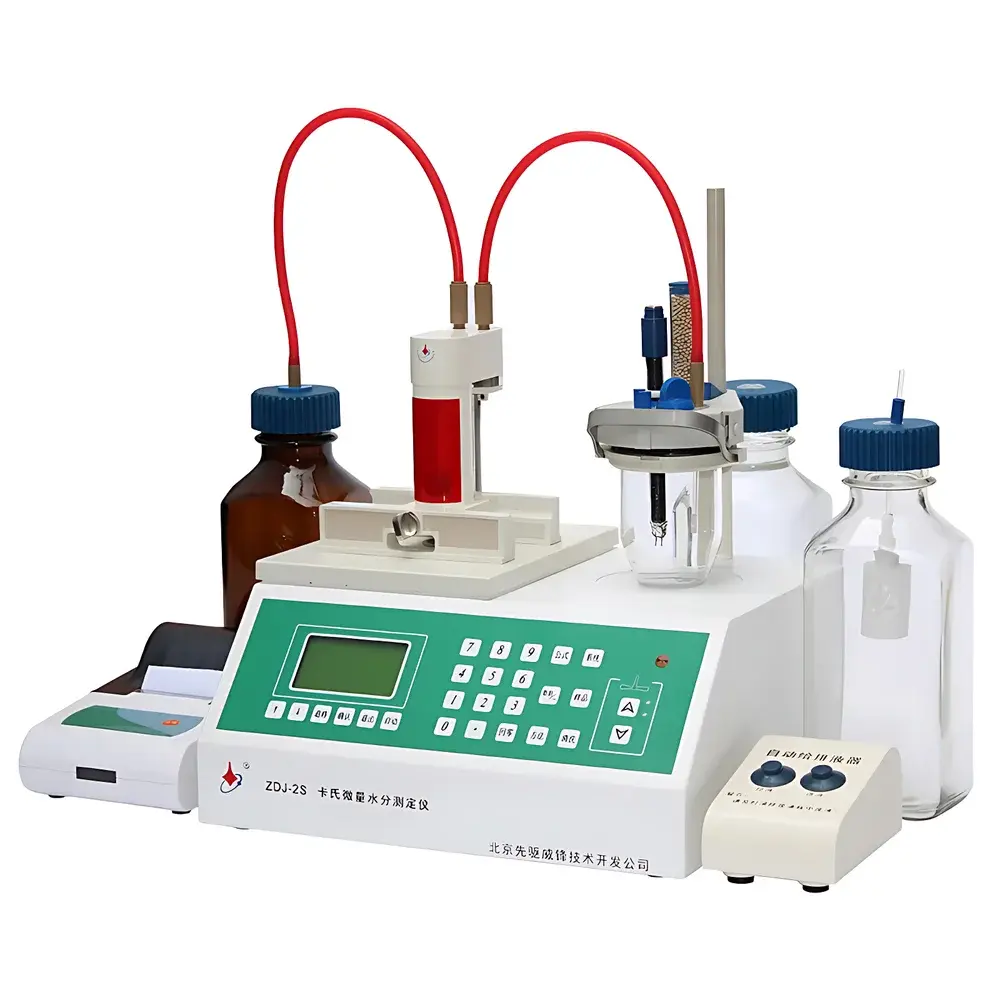
Forerunner ZDJ-2S Fully Automated Karl Fischer Coulometric & Volumetric Moisture Titrator
| Brand | Forerunner |
|---|---|
| Origin | Beijing, China |
| Model | ZDJ-2S |
| Titration Mode | Fully Automated |
| Method Type | Dual-Mode (Coulometric & Volumetric Karl Fischer) |
| Measurement Resolution | 0.01 μA |
| Water Content Range | 0.01 mg to 100% w/w |
| Accuracy | ≤0.3% RSD |
| Minimum Dispensing Increment | 1/2000 of burette volume |
| Titration Control Precision | 0.1 μA |
| Drift Compensation | Automatic background drift correction (drift <5 µg H₂O/min) |
| Detection Limit | 0.01 mg H₂O |
| Sample Forms | Liquids, solids, gases, pastes |
| Display & Interface | Bilingual (Chinese/English) LCD with real-time titration curve visualization |
| Data Output | GLP/GMP-compliant report formats (%, ppm, mg), statistical analysis capability |
| Software | Embedded titration monitoring software with firmware upgrade support |
| Compliance | Designed for ISO 8533, ASTM E203, USP <921>, and EP 2.5.12 environments |
Overview
The Forerunner ZDJ-2S is a dual-mode fully automated Karl Fischer moisture analyzer engineered for high-precision quantitative determination of trace water content in diverse sample matrices. It operates on both volumetric and coulometric principles—enabling flexible method selection based on expected water concentration: volumetric mode for samples containing ≥100 µg H₂O (e.g., solvents, oils, polymers), and coulometric mode for ultra-trace analysis down to 0.01 mg (e.g., pharmaceutical excipients, lithium battery electrolytes, electronic-grade chemicals). The instrument employs a microprocessor-controlled bipotentiometric endpoint detection system, ensuring robust and reproducible identification of the stoichiometric endpoint defined by the Karl Fischer reaction (I₂ + SO₂ + H₂O + 3RN + CH₃OH → 2RN·HI + RN·HSO₄CH₃). Its hermetically sealed titration cell and automated solvent handling module eliminate operator exposure to toxic reagents such as pyridine-free KF reagents (e.g., imidazole-based methanol solutions), aligning with OSHA and EU CLP occupational safety requirements.
Key Features
- Fully automated dual-method platform supporting both volumetric and coulometric Karl Fischer titration within a single instrument architecture
- Hermetically sealed titration station with motorized solvent exchange mechanism—no manual reagent handling required
- Real-time bipotentiometric endpoint detection with adaptive threshold algorithm, minimizing false endpoints from electrode polarization or sample conductivity shifts
- Drift-compensated measurement engine: configurable automatic or manual baseline drift subtraction; typical system drift <5 µg H₂O/min under controlled lab conditions (23 ±2°C, RH <60%)
- Bilingual (Chinese/English) graphical LCD interface with dynamic titration curve display, step-by-step protocol guidance, and parameter validation prompts
- High-resolution current sensing (0.01 µA resolution, 0.1 µA control precision) enabling accurate coulometric charge integration for sub-milligram water quantification
- GLP/GMP-ready data management: timestamped audit trail, user-access logging, electronic signature support, and exportable CSV/PDF reports compliant with 21 CFR Part 11 Annex 11 expectations
Sample Compatibility & Compliance
The ZDJ-2S accommodates heterogeneous sample types without modification: volatile liquids (e.g., acetone, THF), viscous oils (e.g., transformer oil, lubricants), hygroscopic solids (e.g., APIs, silica gels), gaseous streams (via gas-tight syringe injection or permeation tube coupling), and semi-solids (e.g., creams, adhesives). All sample introduction interfaces maintain inert atmosphere integrity during loading. The system meets essential metrological requirements of ISO 8533:2017 (Karl Fischer titration — General requirements), ASTM E203–22 (Standard Test Method for Water Using Volumetric Karl Fischer Titration), USP “Water Determination”, and European Pharmacopoeia 2.5.12. Its closed-system design satisfies ICH Q5C stability testing prerequisites for moisture-sensitive biologics and supports regulatory submissions requiring documented analytical control strategies.
Software & Data Management
Embedded firmware includes a dedicated titration monitoring suite that records raw current/time data, calculates water mass via Faraday’s law (coulometric) or standardized titer calibration (volumetric), and applies matrix-specific recovery corrections. Data files are stored with immutable metadata (operator ID, method version, environmental log, reagent lot numbers). Statistical functions include mean, SD, RSD, confidence intervals, and trend analysis across up to 1,000 stored results. Export options include GLP-formatted PDF reports (with header/footer branding), CSV for LIMS integration, and XML for ELN synchronization. Remote firmware updates are performed via USB or optional Ethernet interface—no proprietary dongles or cloud dependencies.
Applications
This analyzer serves critical QC/QA functions across regulated and industrial laboratories: residual moisture verification in lyophilized pharmaceuticals per FDA guidance; water content specification testing of lithium hexafluorophosphate (LiPF₆) electrolytes for EV batteries; hydrolytic stability assessment of polyamide resins in automotive engineering; quality release testing of ethanol fuel blends (ASTM D6304); and moisture mapping in food-grade starches and dairy powders (Codex Alimentarius STAN 204–1999). Its adaptability to non-aqueous and reactive matrices makes it suitable for catalyst characterization, semiconductor precursor purity screening, and forensic solvent analysis.
FAQ
Does the ZDJ-2S support both volumetric and coulometric titration in one instrument?
Yes—the system automatically detects and configures the appropriate method based on selected reagent type and user-defined water concentration range.
Can the instrument be validated for GMP environments?
Yes—it provides full 21 CFR Part 11 readiness including electronic signatures, audit trails, and role-based access control when used with validated procedures and qualified reagents.
What is the minimum detectable water mass in coulometric mode?
0.01 mg H₂O, verified using certified anhydrous standards traceable to NIST SRM 2890.
Is external computer connectivity required for routine operation?
No—all core functions—including method execution, result calculation, and report generation—are self-contained within the instrument’s embedded OS.
How is solvent contamination prevented during repeated analyses?
The sealed titration cell uses a dual-purge gas system (dry nitrogen or argon) and integrated molecular sieve traps to maintain <1 ppm ambient moisture ingress during solvent exchange cycles.




