
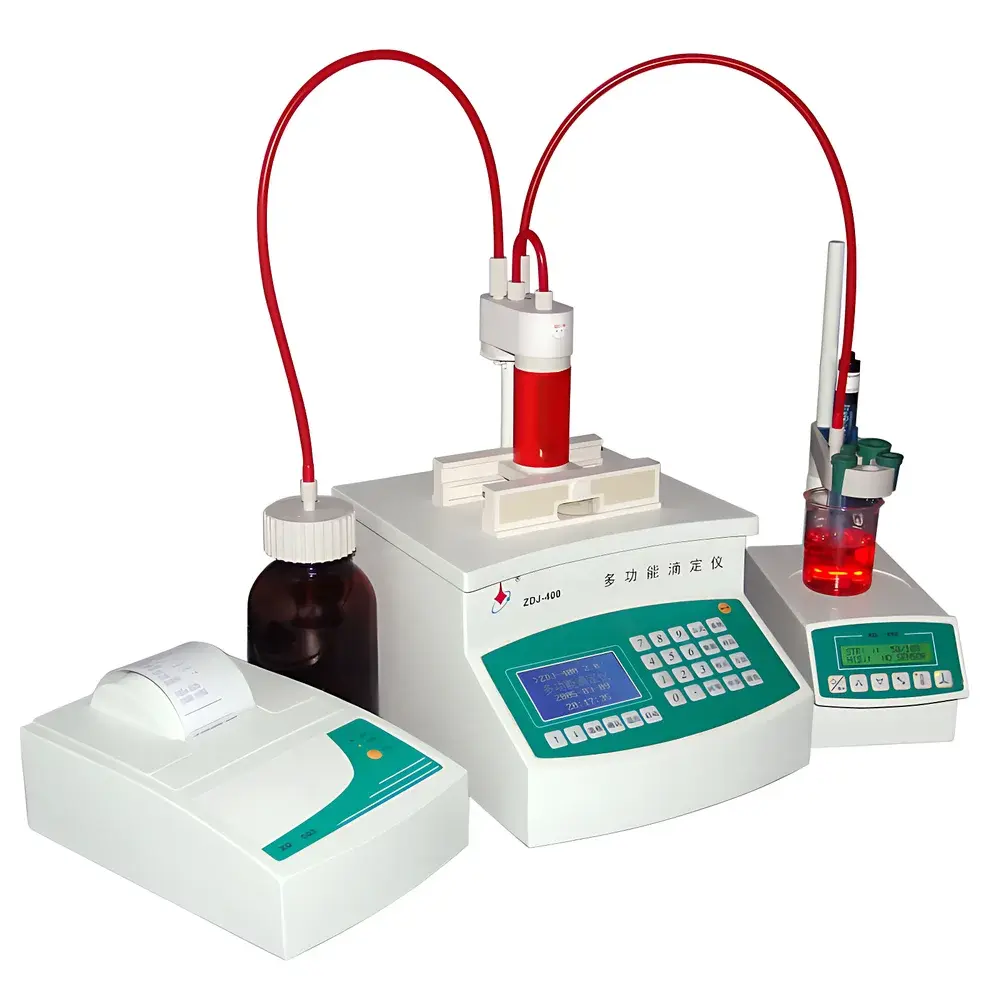
Forerunner ZDJ-400 Advanced Automatic Potentiometric Titrator
| Brand | Forerunner |
|---|---|
| Origin | Beijing, China |
| Model | ZDJ-400 |
| Instrument Type | General-purpose Potentiometric Titrator |
| Application Scope | Universal |
| Measuring Range | mV: −2000 to +2000 mV |
| pH | 0.00 to 20.00 |
| Temperature | 0.0 to 125.0 °C |
| Resolution | pH: 0.01 |
| mV | 0.1 mV |
| Temperature | 0.1 °C |
| Input Current (Typical) | −3 × 10⁻¹⁵ A |
| Accuracy (mV) | ±0.5 mV |
| Minimum Dispensing Volume | 0.0625 µL |
| Titration Modes | Dynamic, Equivalence-point, Fixed-volume, pH-stat, and Direct pH Measurement |
| Method Storage Capacity | 30 pre-programmed titration methods |
| Result Storage Capacity | 100 titration records |
| Display & Interface | Dual-language (Chinese/English) LCD interface |
| Software | Embedded titration monitoring software with firmware update capability |
| Compliance Support | GLP/GMP-compliant data output and audit trail generation |
| Titration Precision | ±0.01 pH over 3 h |
| Titration Resolution | 1/20000 |
Overview
The Forerunner ZDJ-400 Advanced Automatic Potentiometric Titrator is an engineered solution for precise, reproducible electrochemical endpoint detection in routine and regulated laboratory environments. Based on the fundamental principle of potentiometric measurement—monitoring potential difference between a reference electrode and an indicator electrode as a function of titrant addition—the ZDJ-400 delivers high-fidelity response across acid-base, redox, complexometric, precipitation, and ion-selective titrations. Its wide operational range (pH 0.00–20.00, mV −2000 to +2000, temperature 0.0–125.0 °C) accommodates non-aqueous, high-ionic-strength, and elevated-temperature applications commonly encountered in pharmaceutical development, quality control of active pharmaceutical ingredients (APIs), polymer synthesis, and environmental water analysis. The instrument employs a low-input-current amplifier (typical input current <3 fA), minimizing electrode polarization errors and ensuring stability during prolonged measurements—a critical requirement for trace-level ion quantification and weak-acid titrations.
Key Features
- High-resolution electrochemical sensing: 0.01 pH unit and 0.1 mV resolution, enabling detection of subtle inflection points in titration curves.
- Ultra-fine burette drive mechanism with 1/20000 step resolution and minimum dispensing volume of 0.0625 µL—optimized for micro-titration and low-volume sample workflows.
- Multi-mode titration engine supporting dynamic (curve-based), equivalence-point (first-derivative), fixed-volume, pH-stat (controlled-pH addition), and direct pH measurement protocols.
- Dual-language (English/Chinese) graphical LCD interface with intuitive navigation, real-time titration curve visualization, and on-screen method editing.
- Robust hardware architecture featuring isolated analog signal paths, electromagnetic interference (EMI)-hardened circuitry, and thermally stabilized reference junction design.
- Integrated GLP/GMP-ready functionality including user access levels, electronic signature support, timestamped audit trails, and tamper-evident result archiving.
Sample Compatibility & Compliance
The ZDJ-400 interfaces seamlessly with standard ASTM- and ISO-compliant electrodes—including glass pH, Ag/AgCl, Pt, and ion-selective electrodes—enabling method transfer across laboratories. It supports pharmacopeial procedures per USP , EP 2.2.22, and ChP IV for Karl Fischer coulometric and volumetric water determination (with optional KF accessory kit), as well as amperometric end-point detection for diazotization and iodometric assays (via optional bipotentiometric or dead-stop module). All stored results include full metadata: operator ID, method version, electrode calibration history, ambient temperature/humidity logs (when connected to external sensors), and raw potential vs. volume data arrays. Data export conforms to CSV and XML formats compatible with LIMS integration and FDA 21 CFR Part 11–compliant review workflows.
Software & Data Management
The embedded titration monitoring software provides real-time graphical overlay of E/V, dE/dV, and d²E/dV² curves, with adjustable smoothing filters and automatic inflection point interpolation. Methods are structured using hierarchical templates—defining electrode type, stirring speed, dosing rate profiles, stop conditions (e.g., ΔE < 1 mV/10 s), and post-titration rinse sequences. Up to 30 user-defined methods can be saved with version control and change logs. Result archives retain raw sensor signals, calculated concentrations, confidence intervals (based on replicate precision), and statistical summaries (mean, SD, RSD, % recovery). Firmware updates are delivered via RS232C without requiring external PCs—ensuring continuity in validated environments.
Applications
- Pharmaceutical QC: Assay of organic bases/acids (e.g., ibuprofen, ascorbic acid), chloride content in saline formulations, and residual catalyst quantification in API synthesis.
- Food & Beverage: Total acidity (TA) in wines and juices, salt content in processed meats, and preservative (sorbate/benzoate) titration via back-titration.
- Chemical Manufacturing: Saponification value of fats/oils, free fatty acid (FFA) content, and neutralization number of lubricants per ASTM D974 and D664.
- Environmental Testing: Alkalinity and hardness profiling in wastewater per APHA 2320B and ISO 9963-1; cyanide determination via pyridine-barbituric acid spectrophotometric coupling.
- Academic Research: pKa determination of weak electrolytes, stoichiometry validation in coordination chemistry, and kinetic endpoint modeling in slow-reacting systems.
FAQ
Does the ZDJ-400 support compliance with FDA 21 CFR Part 11?
Yes—the system supports role-based user authentication, electronic signatures, immutable audit trails, and secure data export. Full Part 11 readiness requires configuration of networked storage and time-server synchronization, detailed in the Validation Support Package.
Can I use non-Forerunner electrodes with this titrator?
Yes—any electrode conforming to standard BNC or DIN connectors and operating within the specified impedance (<10¹² Ω) and mV range is compatible. Calibration verification against NIST-traceable buffers is recommended prior to regulated use.
What is the maximum allowable sample temperature during titration?
The instrument’s temperature probe and electrode input stage are rated for continuous operation up to 125.0 °C; however, thermal expansion effects on burette accuracy require gravimetric recalibration above 60 °C.
How does the system handle drift compensation during long-duration titrations?
The ZDJ-400 applies real-time baseline correction using a dual-reference algorithm that monitors open-circuit potential between successive additions and adjusts endpoint calculation accordingly—critical for redox titrations exceeding 20 minutes.
Is method validation documentation available?
Forerunner provides IQ/OQ protocol templates, performance qualification test scripts, and uncertainty budget worksheets aligned with ISO/IEC 17025 and ICH Q2(R2) guidelines—available under NDA upon request.




