
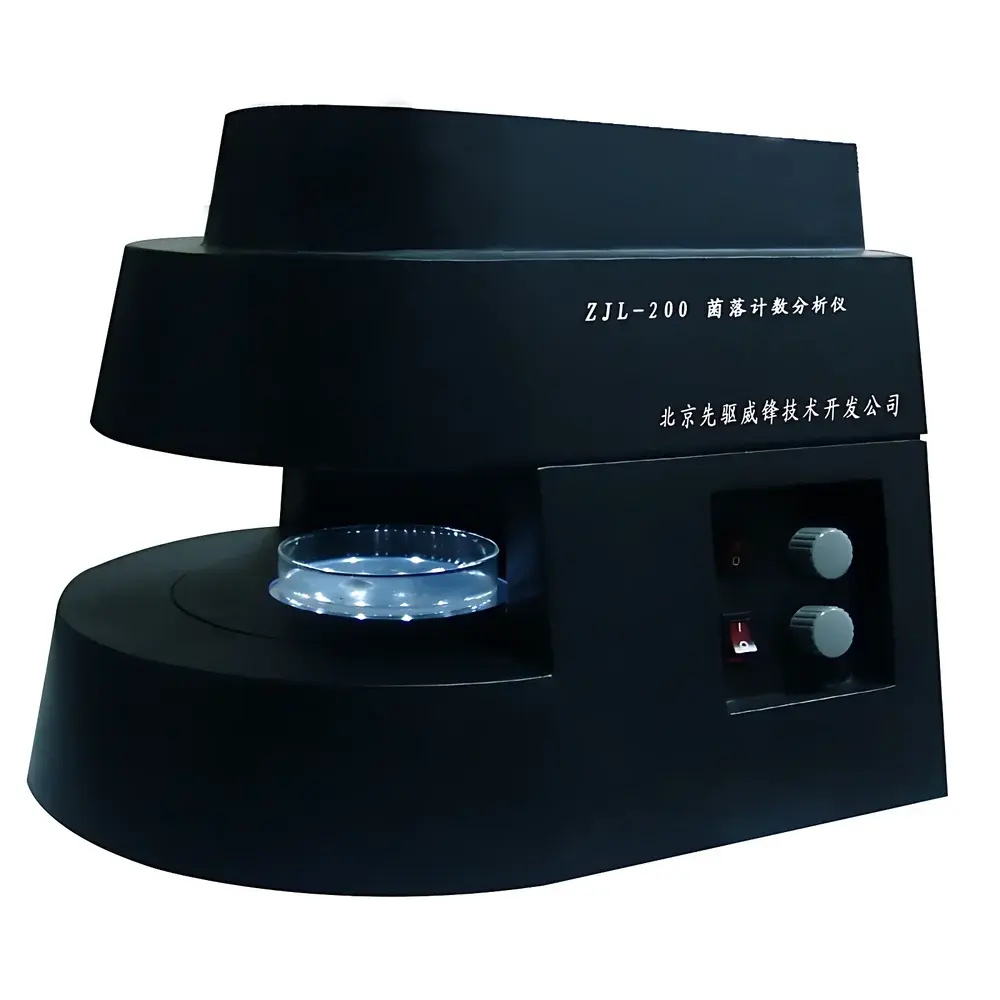
Forerunner ZJL-200 Automated Colony Counter
| Brand | Forerunner |
|---|---|
| Origin | Beijing, China |
| Manufacturer Type | Authorized Distributor |
| Country of Origin | China |
| Model | ZJL-200 |
| Instrument Type | Fully Automated Colony Counter |
| Petri Dish Compatibility | ≤150 mm diameter |
| Counting Speed | <1 second for ≤500 colonies |
| Colony Size Detection Range | 0.08–100 mm |
| Counting Modes | Fully Automatic, Manual, Spiral Plate Mode |
| Image Resolution | 1080×720 to 2160×1440 pixels |
| Custom Dilution Series Support | Yes |
| Illumination | Dual-mode cold LED source (top and bottom transillumination) |
| Operating Environment | 10–40 °C, ≤80% RH |
| Reporting | Exportable electronic reports (PDF, CSV, Excel), printable hardcopy |
| Software Interface | LIS-compatible (HL7, ASTM E1384 compliant) |
| Hardware Interface | USB 2.0 |
Overview
The Forerunner ZJL-200 Automated Colony Counter is an image-based microbiological enumeration system engineered for precision, reproducibility, and regulatory compliance in modern quality control and research laboratories. It operates on the principle of high-resolution digital imaging combined with adaptive threshold segmentation and morphological feature extraction algorithms to distinguish individual microbial colonies from agar-based culture media. Unlike manual or semi-automated counters reliant on subjective visual assessment, the ZJL-200 employs dual-axis illumination—simultaneous top and bottom cold LED lighting—to maximize contrast across diverse colony morphologies (opaque, translucent, pigmented, mucoid, or filamentous) and agar formulations (e.g., PCA, TSA, VRBA, mFC, Sabouraud). Its optical architecture supports consistent detection of colonies as small as 0.08 mm in diameter while maintaining robust discrimination against debris, condensation droplets, and agar imperfections. Designed for integration into routine microbiological workflows, the instrument delivers quantitative colony-forming unit (CFU) data aligned with internationally recognized standard methods.
Key Features
- Fully automated counting with three operational modes: automatic batch processing, interactive manual correction, and spiral plate analysis (compatible with standard 10-fold dilution series)
- User-definable ROI (Region of Interest) functionality—enables selective enumeration within irregularly shaped or partially obscured areas of the petri dish
- Adjustable colony size and contrast thresholds—supports optimization for low-contrast colonies (e.g., Clostridium on reinforced clostridial medium) or high-density plates (>1000 CFU/plate)
- Integrated cold LED illumination system—eliminates thermal drift and agar drying during acquisition; minimizes spectral interference with chromogenic media
- GMP/GLP-compliant software architecture—with full audit trail, user access levels, electronic signatures, and 21 CFR Part 11–ready reporting capabilities
- Native support for common microbiological standards—including GB/T 4789.2–2003 (aerobic plate count), GB/T 4789.32–2002 (coliform enumeration), ISO 4833-1:2013, ISO 7218:2017, and AOAC Official Methods®
Sample Compatibility & Compliance
The ZJL-200 accommodates standard petri dishes up to 150 mm in diameter, including polystyrene, polypropylene, and glass-bottom variants. It reliably enumerates colonies grown on non-selective (e.g., Plate Count Agar), selective (e.g., MacConkey Agar), differential (e.g., XLD Agar), and chromogenic media (e.g., CHROMagar™ Candida, RAPID’E. coli 2). The system has been validated for use with aerobic mesophiles, coliforms, yeasts, molds, and thermotolerant E. coli. All firmware and software modules comply with ISO/IEC 17025:2017 requirements for testing laboratories, and raw image archives—including timestamped metadata, illumination settings, and operator ID—are retained in immutable format to satisfy GLP audit requirements. Data integrity is ensured via SHA-256 hashing of exported reports and internal database encryption.
Software & Data Management
The proprietary ColonyCount Pro v3.2 software provides a modular, workflow-driven interface optimized for regulated environments. It supports HL7 and ASTM E1384 message protocols for bidirectional LIS/HIS integration, enabling automatic patient/sample ID injection and result auto-population. All analyses generate traceable digital records containing original TIFF/JPEG images, segmented binary masks, centroid coordinates, area/perimeter measurements, and CFU/mL calculations—including dilution factor propagation and statistical uncertainty estimation (95% CI). Reports are exportable in PDF/A-1b (archival), CSV (for statistical packages), and Excel (for QA review). Audit logs record every action—including parameter modification, ROI adjustment, and manual override—with ISO 8601 timestamps and authenticated user credentials.
Applications
- Food & beverage safety testing: total viable count, coliform screening, pathogen confirmation (post-enrichment plating)
- Clinical microbiology: urine culture quantification, wound swab analysis, blood culture subculture enumeration
- Pharmaceutical QC: environmental monitoring (EM) settle plate analysis, sterility test membrane filtration counts
- Water & wastewater: heterotrophic plate count (HPC), coliform and E. coli enumeration per ISO 9308-1
- Cosmetic product challenge testing: preservative efficacy evaluation (ISO 11930)
- Academic & contract research: high-throughput strain isolation, antimicrobial susceptibility assay colony scoring
FAQ
Does the ZJL-200 support spiral plating quantification according to ISO 7218 and FDA BAM Chapter 3?
Yes—the instrument implements the linear regression algorithm specified in ISO 7218:2017 Annex D for spiral plate analysis, automatically calculating CFU/mL based on calibrated deposition volume and radial position.
Can raw images be archived in a format compliant with 21 CFR Part 11?
Yes—original images are stored in lossless TIFF format with embedded EXIF metadata (including instrument ID, date/time, operator, and acquisition parameters); the database enforces write-once-read-many (WORM) retention policies.
Is validation documentation available for IQ/OQ/PQ protocols?
Yes—Forerunner provides a comprehensive Validation Support Package including URS, FDS, test scripts, and blank protocol templates aligned with EU GMP Annex 11 and USP Analytical Instrument Qualification.
What training and technical support options are offered?
On-site installation qualification, operator certification workshops, remote troubleshooting, and annual software maintenance with regulatory update notifications are included in the extended service agreement.
Related Products





