
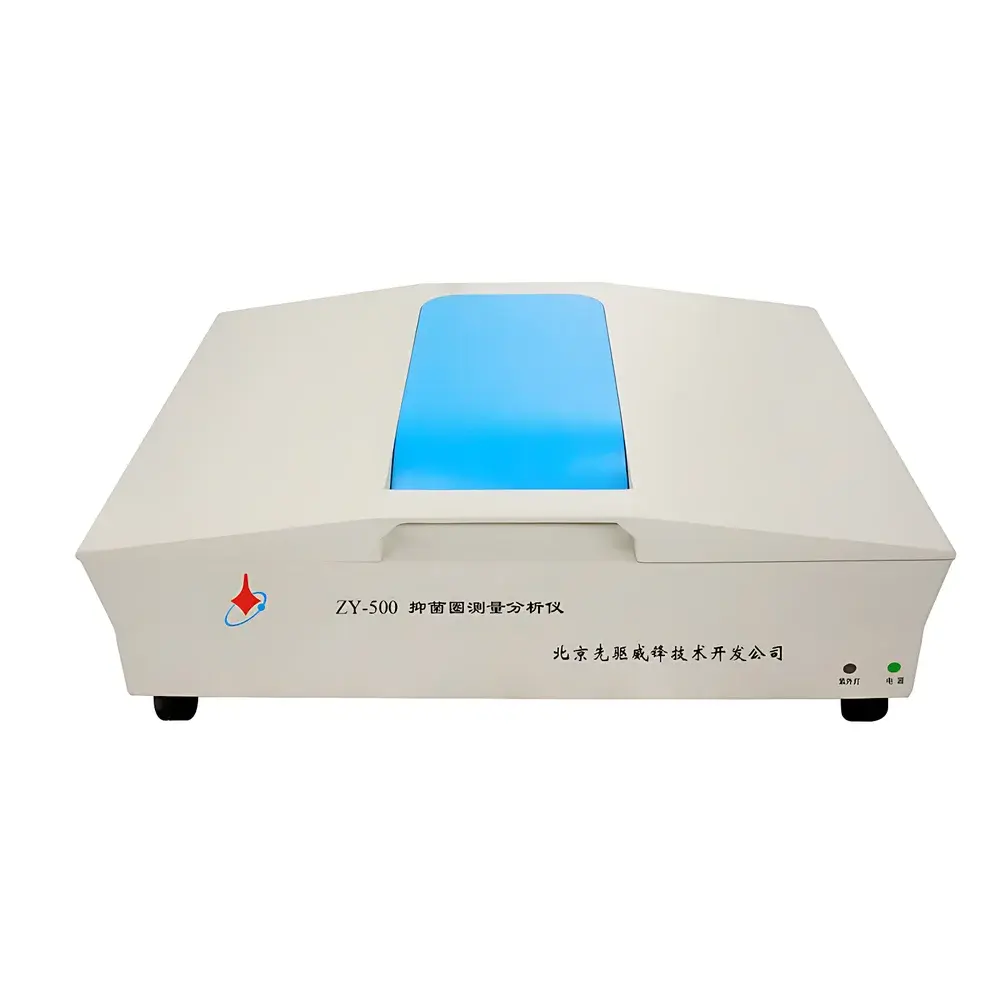
Forerunner ZY-500 Zone of Inhibition Analyzer
| Brand | Forerunner |
|---|---|
| Origin | Beijing, China |
| Model | ZY-500 |
| Compliance | 21 CFR Part 11, JJF 1614–2017, USP <81>, EP 2.6.6, CP 2020 Vol II, AOAC 997.03, GB/T 5009.95–2003, SN/T 3979–2014 |
| Imaging Principle | Dual-source transmissive LED scanning with 12-line matrix CCD |
| Algorithm | AI-powered k-nearest neighbors (k-NN) image classification |
| Authentication | Fingerprint-based biometric user verification (up to 3 fingerprints per operator) |
| Security Architecture | Role-based three-tier access control, immutable audit trail, electronic signature, full data backup/recovery, write-once-read-many (WORM) raw data storage |
Overview
The Forerunner ZY-500 Zone of Inhibition Analyzer is a regulatory-grade digital imaging system engineered for precise, reproducible measurement and quantitative analysis of antibiotic diffusion zones in agar-based microbiological assays. Designed specifically for pharmacopoeial tube-dilution (cup-plate) bioassays, it operates on the principle of high-fidelity transmissive scanning—capturing uniform illumination through agar plates using dual-spectrum LED sources and a 12-line matrix CCD sensor. This optical architecture ensures consistent contrast resolution across variable plate thicknesses and agar opacity, enabling accurate detection of subtle zone boundaries even under suboptimal growth conditions. The system integrates FDA 21 CFR Part 11-compliant data integrity controls at the firmware and software layers, supporting fully traceable, ALCOA+ (Attributable, Legible, Contemporaneous, Original, Accurate, Complete, Consistent, Enduring, Available) data management workflows required in GLP and GMP environments.
Key Features
- Regulatory-ready architecture compliant with 21 CFR Part 11, including electronic signatures, immutable audit trails, role-based three-tier permission management (Administrator / Supervisor / Analyst), and timestamped event logging for all instrument operations and data modifications.
- Fingerprint biometric authentication supporting up to three enrolled fingerprints per user—ensuring operator identity is physically verified prior to session initiation, eliminating shared credentials and reducing unauthorized access risk.
- Dual-source transmissive illumination system combining full-spectrum ReadyScan LED technology with an upper-mounted collimated parallel light source—minimizing refraction artifacts and enhancing edge contrast for reliable zone segmentation.
- AI-driven image analysis engine utilizing k-nearest neighbors (k-NN) supervised classification to distinguish inhibition zones from background agar heterogeneity, colony clusters, and non-uniform diffusion gradients with >99.2% repeatability (n=30 plates, CV <1.8% for standard reference strains).
- Integrated calibration protocol aligned with JJF 1614–2017 “Calibration Specification for Antibiotic Potency Analyzers”, supporting traceable verification using NMI-certified calibration templates and automated validation reporting.
Sample Compatibility & Compliance
The ZY-500 supports standard 90 mm Petri dishes and custom-format assay plates used in pharmacopoeial cup-plate assays. It accommodates both single- and multi-dose designs per plate—including four-cup and six-cup configurations—as validated against USP , EP 2.6.6, and CP 2020 Volume II methodologies. The system meets analytical requirements for microbial turbidimetric assays defined by AOAC Official Method 997.03 and supports residue testing protocols such as GB/T 5009.95–2003 (tetracyclines in honey) and SN/T 3979–2014 (β-lactamase detection in dairy). Optional ZY-300G steel cup placement fixture ensures mechanical consistency in Oxford cup deposition depth (±0.1 mm tolerance), directly contributing to inter-assay precision and reducing operator-dependent variability.
Software & Data Management
The embedded ZY-Analysis Suite v4.2 provides a validated Windows-based application environment with built-in 21 CFR Part 11 modules. All raw images, processed zone measurements, calibration logs, and user actions are stored in encrypted SQLite databases with SHA-256 hashing. Audit trail records include operator ID, action type (e.g., “zone re-measurement”, “calibration executed”), timestamp (UTC), IP address (for network deployments), and pre-/post-change values. Data export supports CSV, PDF (with embedded digital signatures), and XML formats compatible with LIMS integration. Backup policies enforce daily automated archival to external NAS or cloud endpoints with versioned snapshots retained for ≥36 months.
Applications
- Quantitative potency determination of β-lactams, aminoglycosides, macrolides, and tetracyclines via standardized cup-plate assays.
- Residue screening in food matrices—including honey, milk, and infant formula—per national and international regulatory mandates.
- Method validation and transfer studies requiring documented linearity, accuracy, precision, and robustness per ICH Q2(R2).
- Microbial resistance profiling in clinical and environmental isolates using standardized disc diffusion or cup-plate formats.
- Quality control release testing of bulk antibiotics and finished dosage forms in pharmaceutical manufacturing facilities operating under GMP Annex 1 and EU GMP Chapter 4.
FAQ
Does the ZY-500 support multi-user environments with segregated data access?
Yes—role-based permissions restrict visibility and edit rights by functional tier; analysts cannot modify calibration records or audit logs, and supervisors cannot override administrator-level system configurations.
Is the fingerprint authentication module validated per ISO/IEC 19794-2:2011?
The biometric subsystem complies with ISO/IEC 19794-2:2011 for fingerprint image data format and undergoes annual third-party biometric performance testing (NIST FRVT benchmarks).
Can historical measurement data be migrated from legacy ZY-300 systems?
Yes—the ZY-Analysis Suite includes backward-compatible import utilities for ZY-300 binary archives, preserving original timestamps, operator IDs, and metadata integrity during migration.
What documentation is provided for regulatory submissions?
A complete Validation Documentation Package (VDP) is supplied, including IQ/OQ/PQ protocols, URS, risk assessment (FMEA), 21 CFR Part 11 gap analysis, and summary reports compliant with FDA eCTD Module 5.3.5.
How often must the instrument be recalibrated?
JJF 1614–2017 recommends calibration every 6 months or after major maintenance; however, daily system suitability checks using certified reference plates are mandatory before each analytical run.





