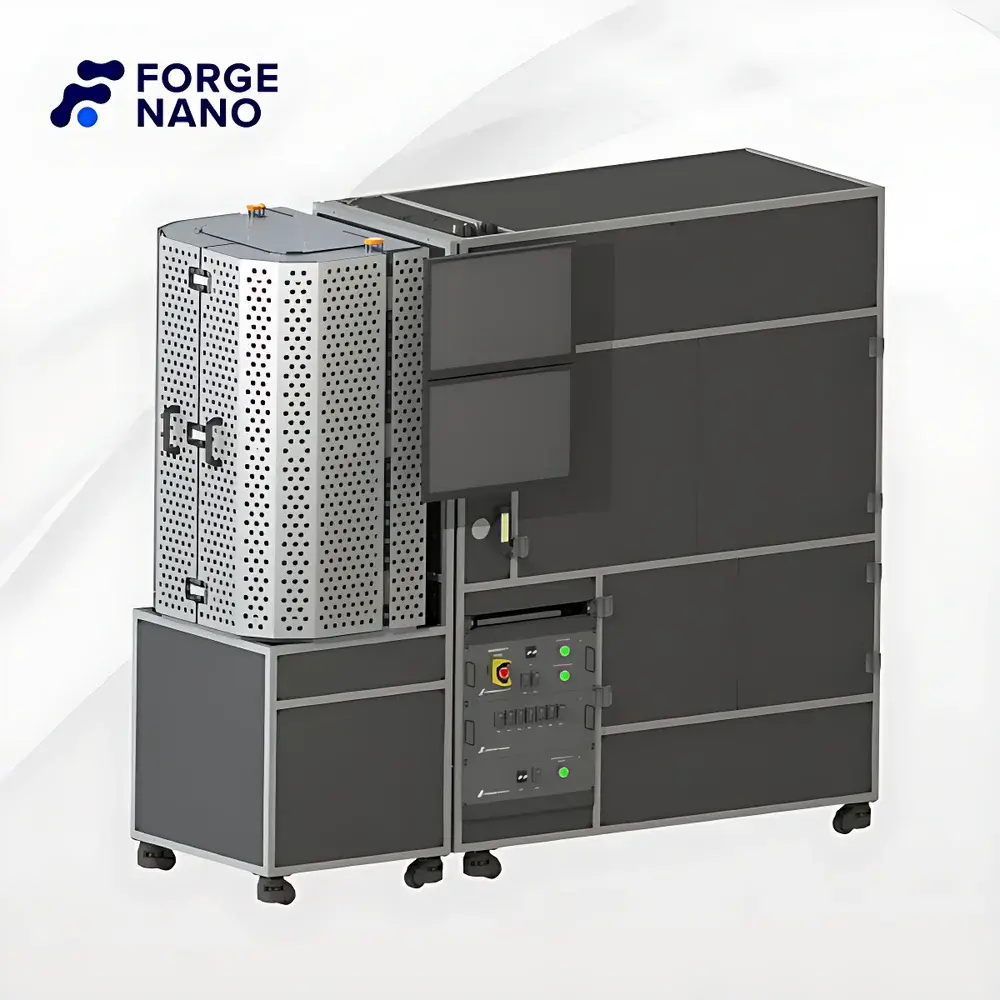
Forge Nano PROMETHEUS Fluidized-Bed Atomic Layer Deposition System
| Brand | Forge Nano |
|---|---|
| Origin | USA |
| Manufacturer Type | Authorized Distributor |
| Origin Category | Imported |
| Model | PROMETHEUS |
| Quotation | Upon Request |
| Substrate Capacity | 5–5000 g powder |
| Process Temperature | Up to 200 °C |
| Precursor Channels | 2–8 |
| Weight | >200 kg |
| Footprint | Floor-Standing |
| Uniformity | Conformal atomic-layer coating across entire powder surface |
Overview
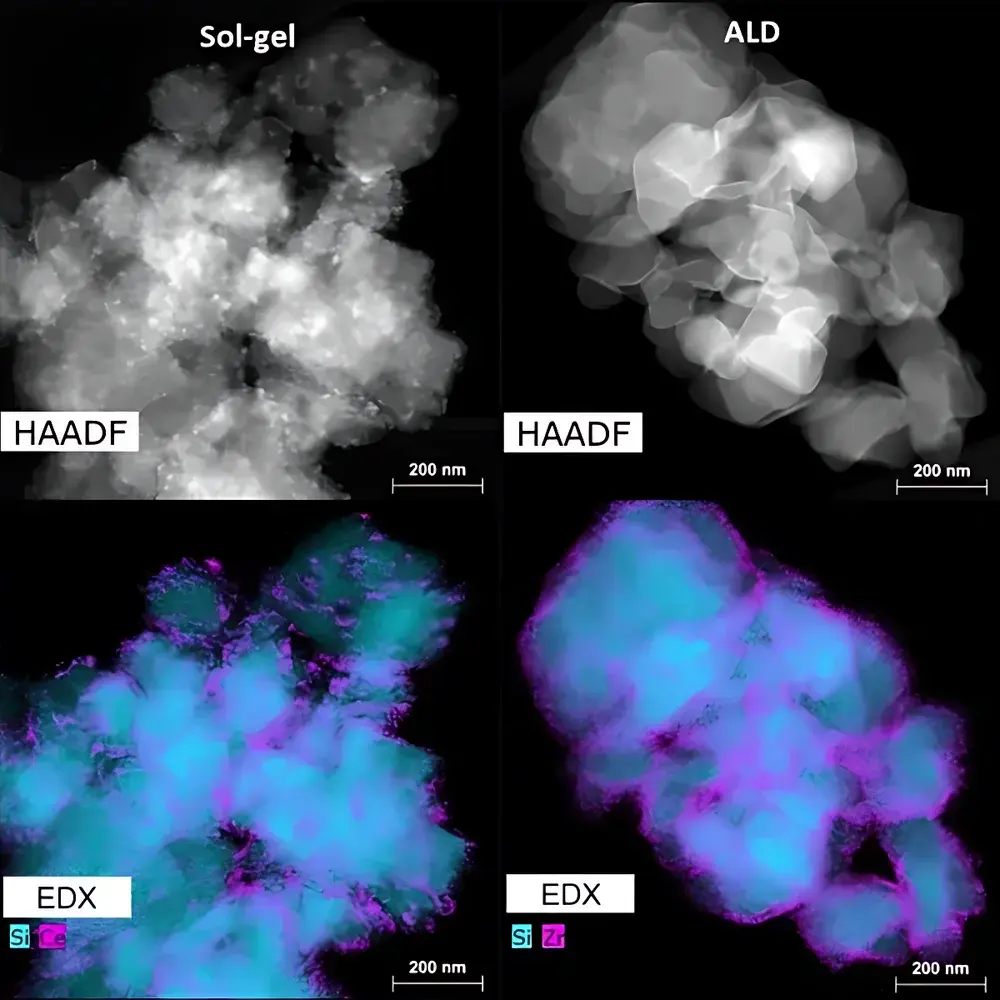
The Forge Nano PROMETHEUS Fluidized-Bed Atomic Layer Deposition (FB-ALD) System is an engineered platform for scalable, conformal surface functionalization of high-surface-area particulate materials. Unlike conventional batch ALD reactors designed for planar wafers or static powders, the PROMETHEUS leverages gas-solid fluidization dynamics to achieve molecular-level precursor exposure across every particle interface—enabling true monolayer control on irregular, micron-scale powders. Its core architecture integrates a vibration-assisted fluidized-bed reactor with precisely timed, self-limiting surface reactions governed by Langmuir-type adsorption and sequential pulse-purge cycles. This principle ensures stoichiometric, pinhole-free coatings—including Al2O3, TiO2, SiO2, and ZnO—with sub-nanometer thickness resolution and exceptional run-to-run reproducibility. Designed explicitly for R&D-to-pilot transition, the system bridges the gap between lab-scale ALD feasibility studies and industrial-scale surface engineering requirements in battery, catalysis, and additive manufacturing applications.
Key Features
- Vibration-Assisted Fluidized-Bed Reactor: Combines high-shear gas flow with mechanical vibration to disrupt particle agglomeration, enabling stable fluidization of cohesive, low-density, or moisture-sensitive powders (e.g., NCM622, LiFePO4, metal-organic frameworks).
- Modular Precursor Delivery Architecture: Supports 2–8 independently heated precursor sources (up to 450 °C), accommodating low-vapor-pressure organometallics (e.g., TMA, DEZ) and thermally labile precursors without decomposition.
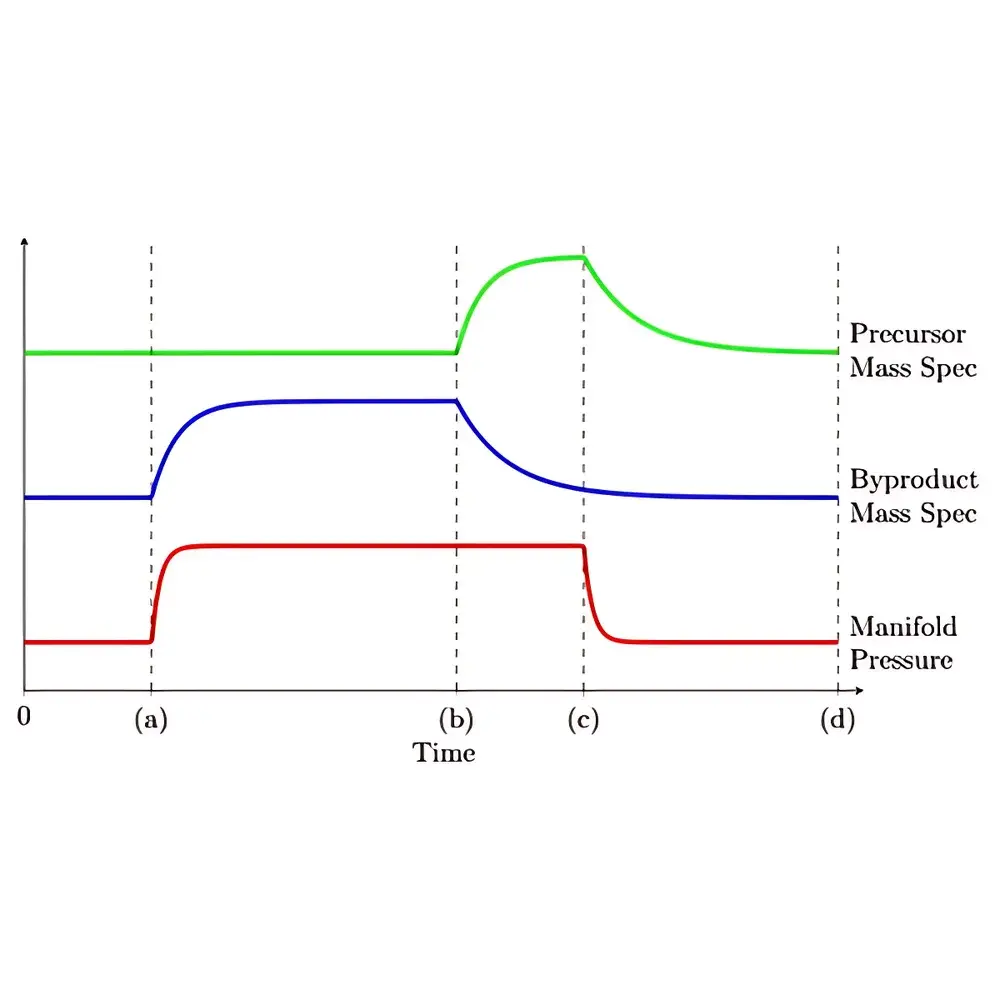
- Integrated Real-Time Gas Analysis: Optional quadrupole mass spectrometer (QMS) monitors precursor depletion and reaction byproduct evolution, providing quantitative endpoint detection for each ALD cycle—critical for process validation and DOE optimization.
- Expandable Auxiliary Modules: Factory-integrated interfaces for ozone generation, plasma enhancement (RF or microwave), and inline humidity/temperature sensors support advanced chemistries including oxidant-assisted ALD and low-temperature plasma-enhanced ALD.
- Robust Thermal Management: Zone-controlled heating (reactor wall, precursor lines, manifold) maintains thermal gradients <±1 °C, minimizing condensation and ensuring consistent precursor transport kinetics across all channels.
- Automated Valve Sequencing: High-cycle-life pneumatic valves with <10 ms actuation latency enable precise temporal control over purge durations, pulse widths, and multi-step co-injection protocols—essential for complex bilayer or gradient film synthesis.
Sample Compatibility & Compliance
The PROMETHEUS accommodates powder samples ranging from 5 g (R&D screening) to 5 kg (pilot-scale batch validation), with particle size distributions spanning 50 nm to 200 µm. It supports ceramic oxides, transition-metal phosphates, conductive carbons, polymer microspheres, and reactive metal powders (e.g., Al, Mg). All wetted surfaces are electropolished 316L stainless steel or quartz-lined; O-rings comply with ASTM F104 Class A (FFKM) for chemical resistance. The system meets CE machinery directive (2006/42/EC), conforms to UL 61010-1 for laboratory equipment safety, and supports audit-ready documentation packages aligned with ISO 9001:2015 and GLP principles. Optional 21 CFR Part 11-compliant software modules provide electronic signatures, audit trails, and secure user role management for regulated environments.
Software & Data Management
Control is executed via Forge Nano’s proprietary ALD-Suite™ v4.2—a Windows-based application supporting recipe-driven operation, real-time parameter logging (T, P, flow, valve status, QMS signals), and automated cycle counting. All process data—including timestamped gas-phase spectra, temperature ramp profiles, and valve timing logs—are stored in structured SQLite databases with configurable export (CSV, HDF5, MATLAB .mat). Remote monitoring via encrypted HTTPS API enables integration into centralized MES or LIMS platforms. For quality-critical deployments, optional validation packages include IQ/OQ documentation, calibration certificates traceable to NIST standards, and SOP templates compliant with ASTM E2917-22 (Standard Practice for Validation of Analytical Methods).
Applications
- Lithium-Ion Battery Materials: Atomic-layer Al2O3 coating on NCM cathodes suppresses interfacial side reactions with electrolyte, reducing impedance growth and improving capacity retention (>92% after 500 cycles at 1C). Surface passivation of silicon anode powders mitigates SEI overgrowth and pulverization.
- Additive Manufacturing Powders: Conformal SiO2 or AlN layers on Ti-6Al-4V or Inconel 718 powders inhibit high-temperature oxidation during laser sintering, reducing porosity and improving tensile strength uniformity across printed builds.
- Heterogeneous Catalysts: Sub-2 nm Pt or CoOx overlayers on porous carbon or alumina supports enhance active site density while preventing sintering at >400 °C operating temperatures—validated via in situ XRD and CO chemisorption.
- Pharmaceutical Excipients: Hydrophobic SiO2 coatings on lactose or microcrystalline cellulose improve flowability and reduce hygroscopicity—critical for direct compression tablet manufacturing per USP <1058> guidelines.
FAQ
What powder types are compatible with the PROMETHEUS system?
The system processes free-flowing and cohesive powders—including metal oxides, nitrides, carbides, polymers, and reactive metals—provided they remain mechanically stable under fluidization conditions (typical minimum fluidization velocity: 0.1–0.5 cm/s). Agglomerated or fibrous materials may require pre-treatment or auxiliary dispersion aids.
Can the system operate under inert or reducing atmospheres?
Yes. The reactor is rated for vacuum (10−3 mbar) and positive pressure (up to 3 bar gauge) with full compatibility for Ar, N2, H2, NH3, and forming gas mixtures. All gas lines feature dual-stage purification and residual oxygen/moisture monitoring.
Is remote diagnostics and software update support available?
Forge Nano provides Tier-2 remote access (with customer consent) via TLS-encrypted VNC for troubleshooting, firmware updates, and preventive maintenance alerts. On-site service contracts include quarterly calibration verification and annual PQ testing.
How is film thickness uniformity verified across kg-scale batches?
Uniformity is validated using cross-sectional TEM imaging of representative particles, XPS depth profiling, and batch-averaged BET surface area reduction. Typical coating non-uniformity is ≤±3% across 95% of sampled particles (n ≥ 50), as confirmed per ISO 13007-2:2021 Annex D protocols.
Does the system support precursor recycling or abatement?
Exhaust streams are routed through optional liquid nitrogen cold traps and base- or acid-scrubbed abatement units compliant with EPA 40 CFR Part 63 Subpart HHHHHH. Precursor recovery is not implemented due to cross-contamination risks in multi-channel configurations.