
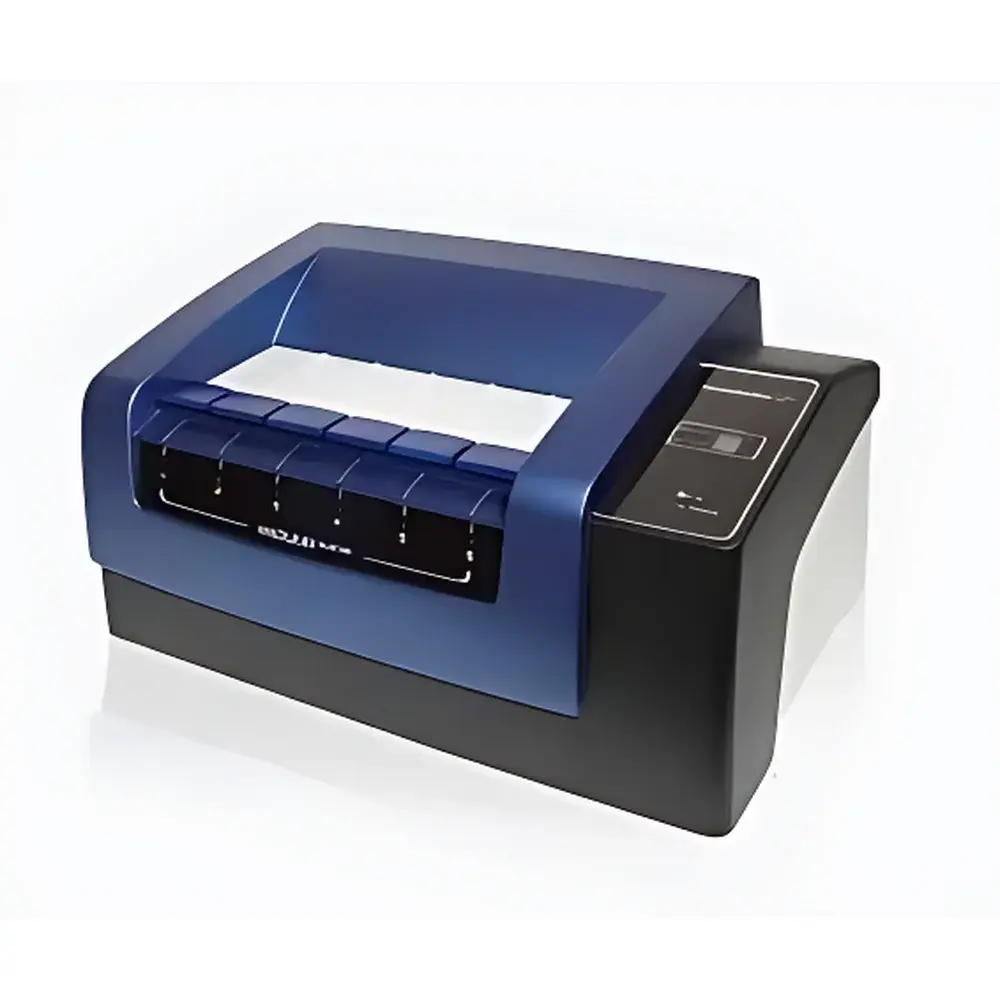
Formulaction RHEOLASER MASTER Optical Micro-Rheometer
| Brand | Formulaction (Microtrac Group) |
|---|---|
| Origin | France |
| Model | RHEOLASER MASTER |
| Light Source | 650 nm laser |
| Detection Principle | Multi-Speckle Diffusing Wave Spectroscopy (MS-DWS) |
| Detection Mode | Backscattered light |
| Detector | Dedicated CCD camera |
| Sample Cell | 20 mL standard glass vial (optional 4 mL) |
| Sample Capacity | 6-position automated sample tray |
| Temperature Control Range | +5 °C to 90 °C above ambient (optional up to 150 °C) |
| Temperature Stability | ±0.1 °C |
| Frequency Range (Viscoelastic Spectrum) | 10⁻⁴ Hz to 50 Hz (sample-dependent) |
| Measured Particle RMS Displacement Range | 0.1 nm – 100 nm |
| Compliance | Designed for GLP/GMP environments |
Overview
The Formulaction RHEOLASER MASTER is a high-precision optical micro-rheometer engineered for non-invasive, label-free characterization of soft matter viscoelasticity at the micrometer scale. Unlike conventional rotational or oscillatory rheometers that apply macroscopic mechanical stress, the RHEOLASER MASTER operates on the principle of Multi-Speckle Diffusing Wave Spectroscopy (MS-DWS). It quantifies thermally driven Brownian motion of embedded tracer particles (naturally present or optionally added) within complex fluids and soft solids—such as hydrogels, polymer solutions, emulsions, colloidal dispersions, and food matrices—by analyzing temporal fluctuations in backscattered laser speckle patterns. This passive, zero-shear methodology yields intrinsic linear viscoelastic moduli (G′ and G″) without perturbing delicate microstructures, making it uniquely suited for fragile systems where traditional deformation-based measurement would induce yielding, syneresis, or irreversible structural breakdown.
Key Features
- True non-contact, non-destructive measurement: No moving parts, no shear geometry, no sample preparation beyond loading into standard vials.
- Patented MS-DWS detection architecture: Combines a stable 650 nm diode laser with a high-sensitivity CCD detector optimized for backscattered speckle dynamics.
- Automated 6-position sample tray: Enables unattended sequential analysis of multiple formulations or time-point stability studies.
- Precise thermostatic control: Integrated Peltier-based temperature module maintains setpoints from +5 °C to 90 °C (±0.1 °C stability); high-temperature option extends range to 150 °C for thermal transition profiling.
- Flexible sample formats: Compatible with standard 20 mL glass vials; optional 4 mL micro-vials reduce material consumption for precious or highly concentrated samples.
- Full frequency-domain viscoelastic spectrum: Extracts G′(ω) and G″(ω) across 10⁻⁴–50 Hz via Laplace inversion of particle mean-square displacement (MSD) data—no assumptions about material model required.
Sample Compatibility & Compliance
The RHEOLASER MASTER accommodates opaque, turbid, and highly scattering media—including dairy gels, protein aggregates, cosmetic creams, pharmaceutical suspensions, and cementitious pastes—without dilution or centrifugation. Its optical design eliminates path-length limitations inherent in transmission-based techniques. The instrument meets fundamental requirements for regulated environments: raw data files are timestamped and immutable; software supports user access levels, electronic signatures, and full audit trails. When deployed with validated SOPs and configured per organizational data governance policies, it satisfies traceability expectations aligned with ISO/IEC 17025, USP , and FDA 21 CFR Part 11 for electronic records and signatures in QC/QA laboratories.
Software & Data Management
Acquisition and analysis are performed using Formulaction’s proprietary RheoLab software, which provides real-time speckle correlation decay visualization, automated MSD curve fitting, and direct conversion to viscoelastic parameters—including elastic factor (EF), viscous factor (VF), gel point (tgel), solid–liquid balance (SLB), and time-resolved modulus evolution. All processing steps are scriptable and reproducible; project files embed metadata (temperature, timestamp, operator ID, instrument serial number). Export options include CSV, Excel, and XML formats compatible with LIMS integration. Raw speckle movies (.avi) and correlation functions (.txt) are retained for reprocessing and method verification—ensuring full analytical transparency and regulatory defensibility.
Applications
- Stability assessment of emulsions and suspensions: Quantify aggregation onset, phase separation kinetics, and network reinforcement over days or weeks.
- Gelation monitoring: Detect sol–gel transitions in thermo-responsive polymers, pectin, or κ-carrageenan systems with minute temperature resolution.
- Yield stress proxy evaluation: Correlate EF/VF crossover with macroscopic yield behavior in weak gels and spreadable foods (e.g., yogurts, margarines).
- Protein formulation development: Track conformational changes and early-stage aggregation under thermal or pH stress without labeling.
- Quality-by-Design (QbD) support: Map critical material attributes (CMAs) to rheological fingerprints for robust process control in biopharmaceutical and nutraceutical manufacturing.
FAQ
Does the RHEOLASER MASTER require tracer particles to be added to the sample?
No—endogenous particles (e.g., casein micelles, silica nanoparticles, polymer aggregates) are sufficient if they scatter light effectively. Exogenous tracers are optional and only recommended for optically transparent or low-scattering systems.
Can it measure samples with very high viscosity or solid-like behavior?
Yes—the technique is insensitive to bulk viscosity; it detects nanoscale particle displacements regardless of macroscopic flow resistance, enabling characterization of stiff gels and even lightly crosslinked elastomers.
How does temperature control affect measurement accuracy?
The ±0.1 °C stability ensures minimal thermal drift during long-term monitoring (e.g., 72-h aging studies), preserving spectral fidelity in MSD-derived moduli and enabling precise Arrhenius modeling of relaxation kinetics.
Is calibration required before each measurement?
No routine calibration is needed—the system uses self-referencing speckle dynamics; however, periodic verification with NIST-traceable polystyrene latex standards is recommended for lab-wide consistency.
Can data be exported for third-party statistical analysis?
Yes—time-series modulus values, EF/VF curves, and gelation times export directly to CSV or MATLAB-compatible formats, supporting multivariate analysis, PCA, and DoE modeling workflows.



