
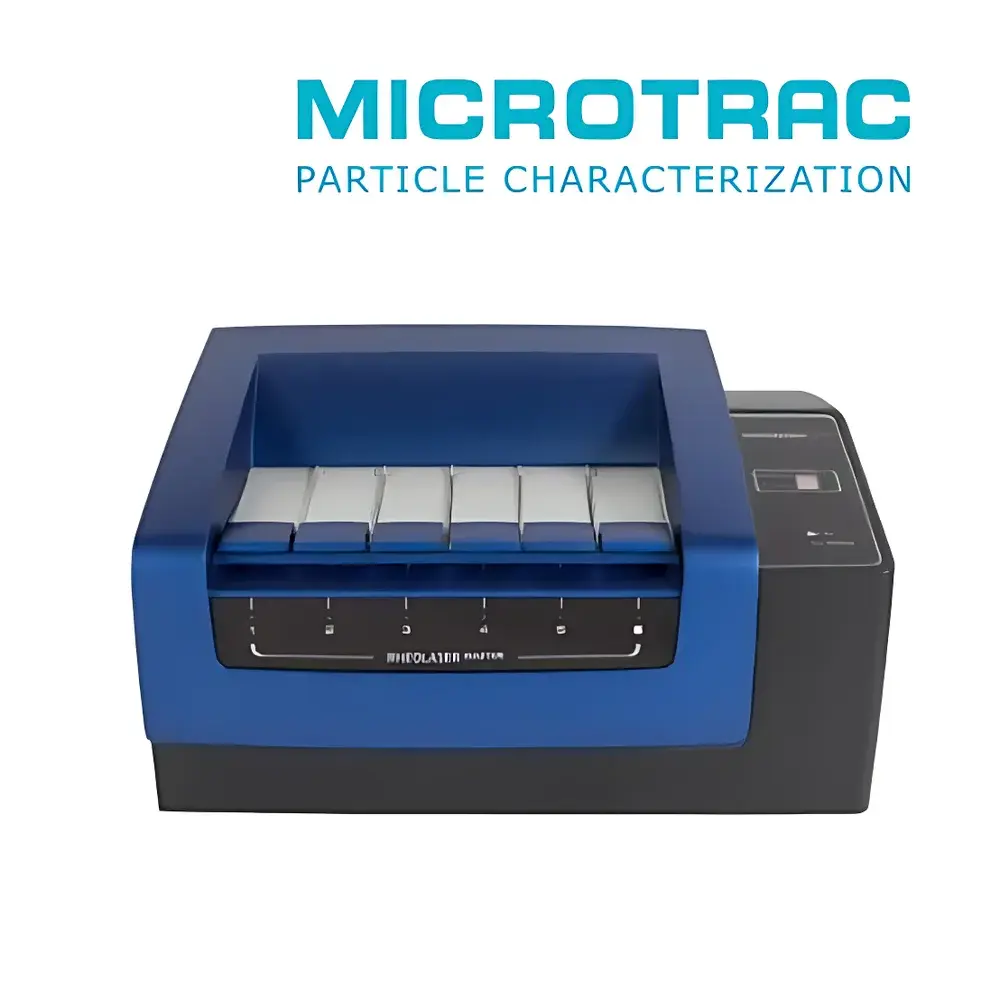
Formulaction Rheolaser Master Optical Microrheometer
| Brand | Formulaction (Microtrac) |
|---|---|
| Origin | France |
| Model | Rheolaser Master |
| Instrument Type | Optical Microrheometer |
| Sample State | Liquid |
| Measurement Principle | Multi-Speckle Diffusing Wave Spectroscopy (MS-DWS) |
| Temperature Range | +5°C above ambient to 90°C (optional up to 150°C) |
| Frequency Range | 10⁻⁴ Hz to 10² Hz |
| RMS Particle Displacement Range | 0.1 nm – 100 nm |
| Minimum Detectable Particle Size | 50 nm |
| Maximum Solid Volume Concentration | 90% v/v |
| Torque Specifications | Not applicable (non-mechanical, optical measurement) |
| Data Acquisition | High-resolution CMOS camera-based speckle image analysis |
| Sample Holder | 20 mL borosilicate glass cuvette with 6-position sample carousel |
Overview
The Formulaction Rheolaser Master is a high-precision optical microrheometer engineered for label-free, non-invasive characterization of soft matter viscoelasticity at the microscale. Unlike conventional rotational or oscillatory rheometers that apply macroscopic shear stress, the Rheolaser Master operates on the physical principle of Multi-Speckle Diffusing Wave Spectroscopy (MS-DWS). It quantifies thermally driven Brownian motion of embedded tracer particles (≥50 nm) within colloidal dispersions, gels, emulsions, polymer solutions, and other complex fluids. By analyzing temporal fluctuations in laser backscattered speckle patterns—captured via a high-sensitivity CMOS camera—the instrument reconstructs mean-squared displacement (MSD) curves over timescales spanning 10⁻⁴ to 10² seconds. From these MSD profiles, linear viscoelastic moduli—including storage modulus G′(ω), loss modulus G″(ω), relaxation time distribution, and elastic network mesh size—are derived without mechanical contact or sample perturbation. This makes the Rheolaser Master uniquely suited for studying fragile, aging-sensitive, or low-yield-stress systems where traditional rheometry induces structural damage or yield artifacts.
Key Features
- True static measurement: Zero mechanical stress applied—ideal for weak gels, yogurt, creams, and biopolymer networks that deform under even minimal torque.
- Non-contact, non-destructive analysis: Samples remain undisturbed in standard 20 mL borosilicate glass cuvettes; repeated measurements on identical aliquots enable longitudinal stability and recovery tracking.
- Microstructural resolution: Extracts nanoscale structural parameters—including gel mesh size, heterogeneity index, and local mobility gradients—from particle-level dynamics.
- Integrated thermal control: Precision Peltier stage maintains temperature from +5°C above ambient to 90°C (upgradeable to 150°C), with stability ±0.1°C—critical for temperature-ramped aging or transition studies.
- High-throughput capability: Six-position sample carousel allows automated sequential analysis of multiple formulations or time points under identical environmental conditions.
- Multi-parameter output: Simultaneous derivation of G′, G″, tan δ, relaxation time τR, MSD slope, and elasticity factor—all traceable to fundamental diffusion physics and ISO/ASTM-compliant data reduction protocols.
Sample Compatibility & Compliance
The Rheolaser Master accommodates liquid-phase samples across a broad compositional range: aqueous and organic dispersions, hydrogels, microemulsions, protein solutions, nanoparticle suspensions, and high-concentration pastes (up to 90% v/v solids). Its optical design eliminates wall-slip, edge effects, and gap calibration dependencies inherent in cone-and-plate or parallel-plate geometries. The system complies with principles outlined in ISO 17972:2020 (Colloidal systems — Characterization of rheological behavior by microrheology) and supports GLP/GMP workflows through audit-trail-enabled software logging. All raw speckle image sequences and intermediate MSD datasets are stored in vendor-neutral HDF5 format, ensuring long-term reproducibility and third-party validation readiness.
Software & Data Management
Rheolaser Master is operated via Formulaction’s proprietary RheoSoft platform—a Windows-based application designed for scientific rigor and regulatory compliance. The software provides guided experimental setup, real-time speckle intensity monitoring, automatic baseline correction, and batch-processing pipelines for time-resolved or frequency-sweep analyses. Critical features include: Time-resolved viscoelastic mapping (e.g., recovery after thermal shock), stability fingerprinting (MSD slope vs. aging time), and microstructural classification (mesh size vs. crosslink density). Data export supports CSV, Excel, and MATLAB-compatible formats. For regulated environments, optional 21 CFR Part 11 compliance packages include electronic signatures, role-based access control, and immutable audit trails for all parameter modifications and report generations.
Applications
- Stability assessment of pharmaceutical suspensions and injectables during shelf-life simulation
- Real-time monitoring of sol-gel transitions in silica or chitosan hydrogels
- Quantification of thixotropic recovery kinetics in cosmetic creams and paints
- Structure-property correlation in food matrices (e.g., whey protein gels, starch pastes)
- Early-stage detection of aggregation onset in monoclonal antibody formulations
- Characterization of self-healing polymers and stimuli-responsive nanocomposites
- Validation of computational rheology models using experimentally resolved MSD spectra
FAQ
Does the Rheolaser Master require tracer particles to be added to the sample?
No—endogenous scatterers (e.g., emulsion droplets, protein aggregates, or nanoparticles) serve as intrinsic tracers. Exogenous tracers are only needed for optically transparent systems lacking sufficient scattering contrast.
Can it measure samples with very high viscosity or yield stress?
Yes—since it measures thermal motion rather than imposed deformation, it characterizes systems ranging from Newtonian liquids to solid-like gels without requiring flow initiation.
How does MS-DWS differ from Dynamic Light Scattering (DLS)?
DLS reports average diffusion coefficients under dilute, non-interacting assumptions; MS-DWS resolves sub-diffusive dynamics in concentrated, heterogeneous media by statistically averaging over thousands of speckles, enabling robust microrheology in opaque or turbid samples.
Is calibration required before each measurement?
No—system calibration is factory-performed and verified via NIST-traceable reference standards; routine verification uses built-in thermal noise diagnostics and reference latex suspensions.
What is the minimum sample volume per test?
Each 20 mL glass cuvette holds sufficient volume for full kinetic profiling; smaller volumes (≥5 mL) may be used with custom holders, though signal-to-noise ratio decreases proportionally.



