
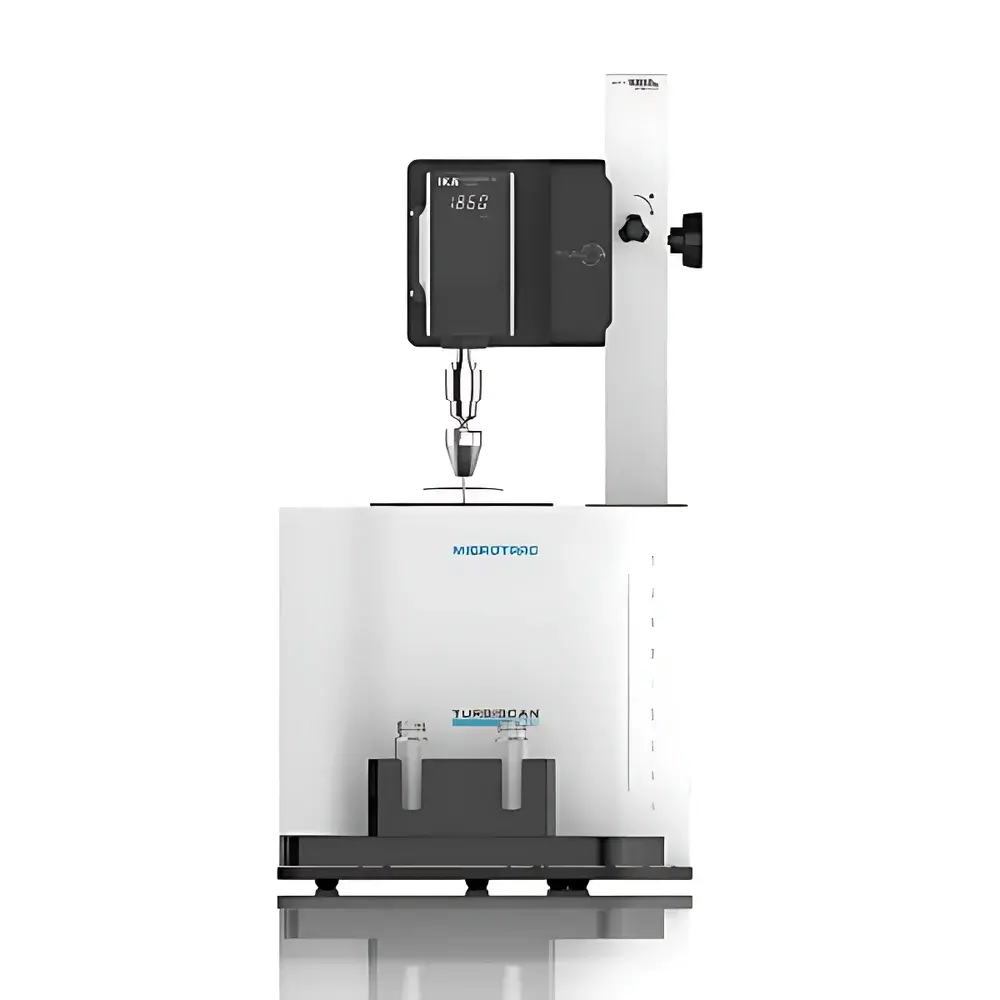
Formulaction Turbiscan TMIX Foam Analyzer
| Brand | Formulaction (Microtrac) |
|---|---|
| Origin | France |
| Model | TMIX |
| Light Source | 880 nm NIR LED |
| Measurement Principle | Multiple Light Scattering (MLS) |
| Particle Size Range | 0.05–1000 µm |
| Max. Volume Concentration | 95% v/v |
| Temperature Control Range | RT + 5 °C to 60 °C |
| Scan Height | 55 mm |
| Spatial Resolution | 40 µm |
| Dimensions (W × D × H) | 38 × 42 × 32 cm |
| Sample Capacity | 1 tube per run |
| Data Acquisition Interval | 20 s |
| Compliance | Designed for GLP-compliant stability assessment |
Overview
The Formulaction Turbiscan TMIX Foam Analyzer is a dedicated, non-invasive optical instrument engineered for quantitative, time-resolved characterization of foam structure and evolution. Based on patented Multiple Light Scattering (MLS) technology, it employs an 880 nm near-infrared light source to simultaneously detect both backscattering and transmission signals across the full sample height (55 mm) with 40 µm spatial resolution. Unlike single-point or imaging-based methods, MLS enables depth-resolved detection of local changes in particle/bubble concentration and size distribution—critical for capturing heterogeneous phenomena such as drainage, coalescence, Ostwald ripening, and collapse. The system operates under controlled temperature conditions (RT + 5 °C to 60 °C), ensuring reproducible thermal environments essential for comparative stability studies. Its design prioritizes metrological traceability and experimental repeatability, making it suitable for method development, formulation screening, and regulatory documentation in industrial R&D and quality control laboratories.
Key Features
- Real-time, full-height foam profiling with 20-second acquisition intervals—enabling high-temporal-resolution monitoring from initial foaming through complete destabilization.
- Quantitative derivation of six core foam parameters: total foam height, liquid phase height, bubble size distribution (0.05–1000 µm), half-life (t1/2), expansion ratio, and stability index—all calculated directly from raw scattering profiles without user-defined thresholds.
- Integrated temperature-controlled sample chamber for isothermal or ramped thermal protocols, supporting Arrhenius-based shelf-life prediction and surfactant performance evaluation under process-relevant conditions.
- Optimized optical path geometry minimizing multiple-scattering artifacts in highly concentrated foams (up to 95% v/v gas phase), validated against reference gravimetric and rheological benchmarks.
- Modular hardware architecture compatible with standardized 10–25 mm diameter cylindrical tubes, enabling rapid method transfer between development and production-scale testing.
Sample Compatibility & Compliance
The Turbiscan TMIX accommodates a broad range of foam-forming systems—including aqueous surfactant solutions, protein-stabilized dairy foams, polymer-laden oilfield foams, and low-surface-tension mineral flotation froths. It requires no dilution, labeling, or centrifugation, preserving native interfacial structure. The system supports compliance with internationally recognized stability assessment frameworks: data output formats align with ASTM D7421 (Standard Test Method for Foaming Tendency and Stability of Aqueous Solutions), ISO 697 (Foam Testing of Detergents), and USP (Stability Testing of Pharmaceutical Emulsions and Foams). Audit trails, electronic signatures, and version-controlled method files are available via optional software modules compliant with FDA 21 CFR Part 11 and EU Annex 11 requirements.
Software & Data Management
Turbiscan Analysis Software (v4.x) provides automated, scriptable workflows for foam parameter extraction, kinetic modeling (e.g., exponential decay fitting for t1/2), and multivariate comparison across formulation libraries. Raw MLS profiles are stored in HDF5 format for long-term archival and third-party analysis. Export options include CSV, Excel, and PDF reports with embedded metadata (operator ID, timestamp, environmental conditions, calibration status). Batch processing supports statistical evaluation (ANOVA, PCA) of stability metrics across >100 formulations, facilitating DOE-driven optimization. All software modules undergo annual verification per ICH Q2(R2) guidelines for analytical procedure validation.
Applications
- Food & Beverage: Quantifying foam persistence in craft beers, latte art stability in plant-based milks, and CO2 retention kinetics in carbonated soft drinks.
- Oilfield Chemistry: Evaluating surfactant efficiency in foam-assisted EOR, assessing thermal degradation resistance of foaming agents in steam flood applications, and benchmarking viscoelastic response during foam fracturing fluid design.
- Mineral Processing: Screening collector/frother combinations for selective bubble generation in sulfide ore flotation circuits.
- Coatings & Ceramics: Monitoring air entrainment dynamics in waterborne paints and slip casting slurries to prevent defect formation.
- Pharmaceuticals: Characterizing aerated topical gels and pulmonary foam delivery systems per USP and Ph. Eur. 2.9.40.
FAQ
How does the TMIX differentiate between foam drainage and coalescence?
It resolves vertical concentration gradients over time: drainage manifests as progressive liquid accumulation at the bottom (increasing transmission at base), while coalescence produces localized increases in backscattering intensity at intermediate heights due to bubble size growth.
Can the TMIX analyze opaque or colored foams?
Yes—the 880 nm NIR wavelength minimizes absorption interference from pigments, dyes, and turbid matrices, enabling robust measurements in chocolate mousse, coffee crema, and dyed drilling foams.
Is calibration required before each test?
A one-time optical alignment and reference tube validation are performed during installation; routine daily verification uses a certified polystyrene microsphere suspension traceable to NIST SRM 1980.
Does the system support custom protocol scripting?
Yes—via Python API integration, users can define dynamic temperature ramps, variable scan intervals, and conditional stop criteria based on real-time stability thresholds.
What sample volume is needed?
Standard testing uses 8–15 mL in 16-mm-diameter glass tubes; low-volume kits (3–5 mL) are available for precious or hazardous formulations.



