
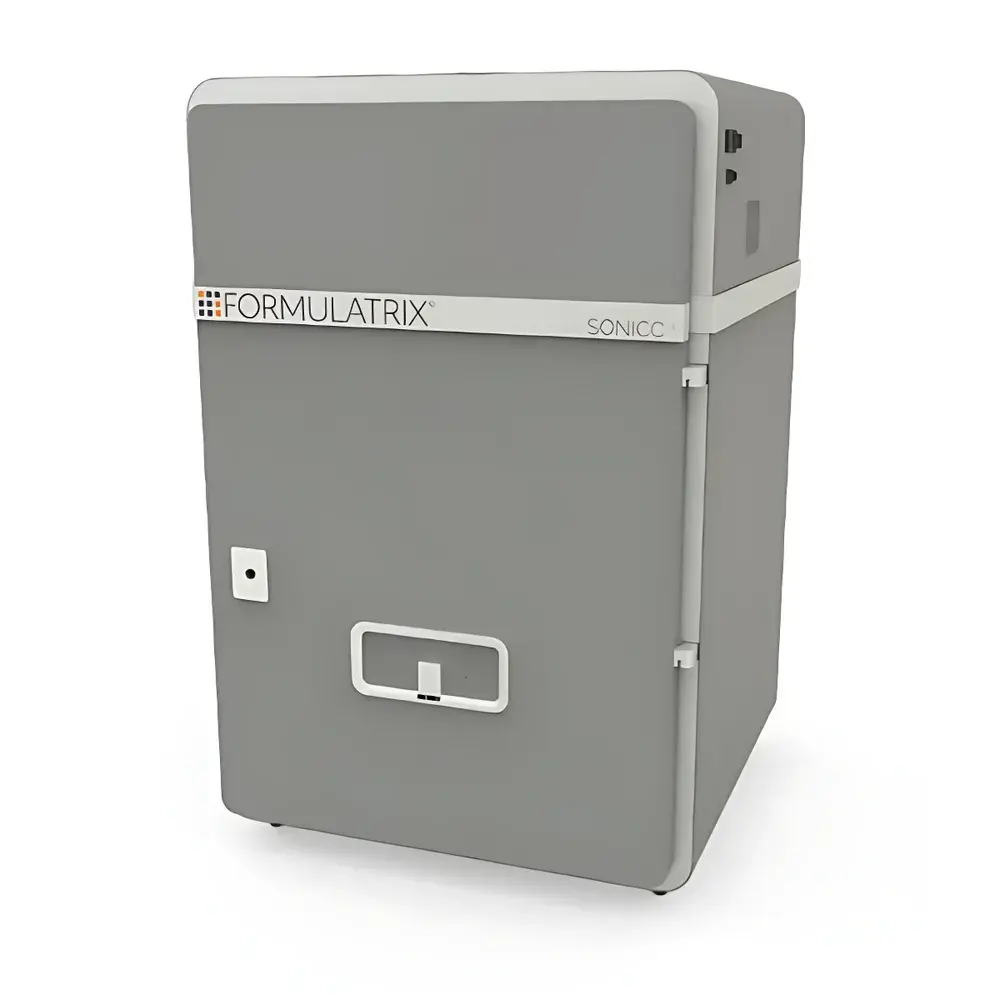
Formulatrix SONICC® Second-Order Nonlinear Imaging System for Asymmetric Crystals
| Brand | Formulatrix |
|---|---|
| Origin | USA |
| Manufacturer Type | Original Equipment Manufacturer (OEM) |
| Import Status | Imported |
| Model | SONICC® |
| Price | Upon Request |
| Field of View (mm) | 2.2 × 2.2 to 0.65 × 0.65 |
| Optical Resolution (µm) | 4.0 to 1.1 |
Overview
The Formulatrix SONICC® Second-Order Nonlinear Imaging System is a purpose-built optical platform engineered for label-free, high-contrast detection and discrimination of protein crystals in complex crystallization screens. It leverages two complementary nonlinear optical modalities: Second Harmonic Generation (SHG) imaging and Ultraviolet Two-Photon Excited Fluorescence (UV-TPEF). SHG arises exclusively from non-centrosymmetric (i.e., chiral or asymmetric) crystalline lattices—making it inherently selective for protein crystals while remaining silent on centrosymmetric salt crystals and amorphous precipitates. UV-TPEF complements SHG by exploiting intrinsic tryptophan and tyrosine fluorescence under 266 nm excitation, enabling differentiation between protein-rich microcrystals and non-proteinaceous aggregates. Unlike conventional brightfield or UV-transmission imaging, SONICC® provides unambiguous physical-structural contrast rooted in crystal symmetry and molecular electronic structure—eliminating subjective interpretation and significantly reducing false positives during hit identification.
Key Features
- Simultaneous dual-modality acquisition: SHG and UV-TPEF channels are optically co-registered and acquired in parallel without mechanical repositioning or wavelength switching delays.
- Variable-resolution imaging: Motorized objective turret supports interchangeable high-NA objectives (e.g., 10×, 20×, 40×), enabling field-of-view scaling from 2.2 × 2.2 mm down to 0.65 × 0.65 mm with optical resolution ranging from 4.0 µm to 1.1 µm (lateral, diffraction-limited).
- Integrated environmental control: Stable operation across 4 °C to 30 °C ambient; active thermal regulation maintains sample temperature within ±5 °C below or +7 °C above ambient—critical for preserving metastable crystal integrity during extended imaging sessions.
- Flexible deployment architecture: Available as a standalone benchtop unit for single-plate screening or as a fully integrated subsystem within the Formulatrix RI1000 robotic crystallization platform.
- Automated plate handling compatibility: When deployed with RI1000, SONICC® performs SHG/UV-TPEF imaging across up to 1,000 microplates per day, with concurrent visible-light imaging performed in parallel—enabling throughput of 40 plates (96-well) for nonlinear imaging and 200 plates for visible-light imaging per 24-hour cycle.
Sample Compatibility & Compliance
SONICC® is optimized for standard crystallization formats including 96-well sitting-drop and hanging-drop plates (e.g., CrystalQuick™, EasyXtal™), as well as specialized low-volume formats such as nanodrop slides and microfluidic chips. All optical paths comply with ISO 10110-7 (laser safety) and IEC 60825-1 standards. The system’s non-invasive, non-destructive nature ensures full compatibility with downstream analysis—including X-ray diffraction, cryo-cooling, and serial crystallography workflows. Data acquisition adheres to GLP-compliant metadata tagging (timestamp, objective ID, laser power, exposure time, plate position), supporting audit-ready documentation for regulated environments.
Software & Data Management
Acquisition and analysis are managed via Formulatrix’s proprietary CrystalScore™ software, which provides real-time SHG/UV-TPEF overlay visualization, automated crystal scoring based on intensity gradient, spatial coherence, and spectral signature correlation, and batch export in TIFF/FITS format with embedded EXIF-like metadata. The software supports integration with LIMS platforms via RESTful API and meets FDA 21 CFR Part 11 requirements for electronic records and signatures—including role-based access control, full audit trail logging, and secure user authentication.
Applications
- High-throughput identification of microcrystals obscured within amorphous precipitate or phase-separation zones.
- Discrimination of protein crystals from salt crystals (e.g., ammonium sulfate, sodium chloride) and polymeric contaminants without staining or labeling.
- Crystallization condition optimization through quantitative assessment of crystal nucleation density, size distribution, and morphology evolution across gradient screens.
- Validation of crystal quality prior to synchrotron or XFEL beamtime allocation—reducing wasted beamtime on non-diffracting samples.
- Support for fragment-based drug discovery (FBDD) where small-molecule co-crystals require unambiguous structural confirmation at sub-10 µm scale.
FAQ
Does SONICC® require fluorescent labeling of proteins?
No. SONICC® relies entirely on intrinsic nonlinear optical responses—SHG from non-centrosymmetric crystal lattices and UV-TPEF from native aromatic amino acids—eliminating the need for exogenous dyes or genetic fusion tags.
Can SONICC® be used with opaque or silicone-oil-sealed plates?
Yes. The system utilizes reflective-mode imaging geometry and near-infrared-compatible optics, allowing robust signal acquisition through standard polypropylene, cyclic olefin copolymer (COC), and silicone oil layers without significant signal attenuation.
Is calibration traceable to NIST standards?
Yes. Spatial calibration is performed using NIST-traceable Ronchi ruling targets; laser power and exposure time are logged with certified photodiode monitoring at each acquisition session.
What maintenance is required for long-term stability?
Annual alignment verification and laser energy calibration are recommended; no consumables or routine optical cleaning beyond standard laboratory microscope protocols are required.
How does SONICC® integrate with existing crystallization robotics?
Through standardized RS-232 and Ethernet interfaces, SONICC® accepts plate coordinates and status commands from third-party liquid handlers and storage systems, enabling seamless incorporation into automated crystallization pipelines.




