
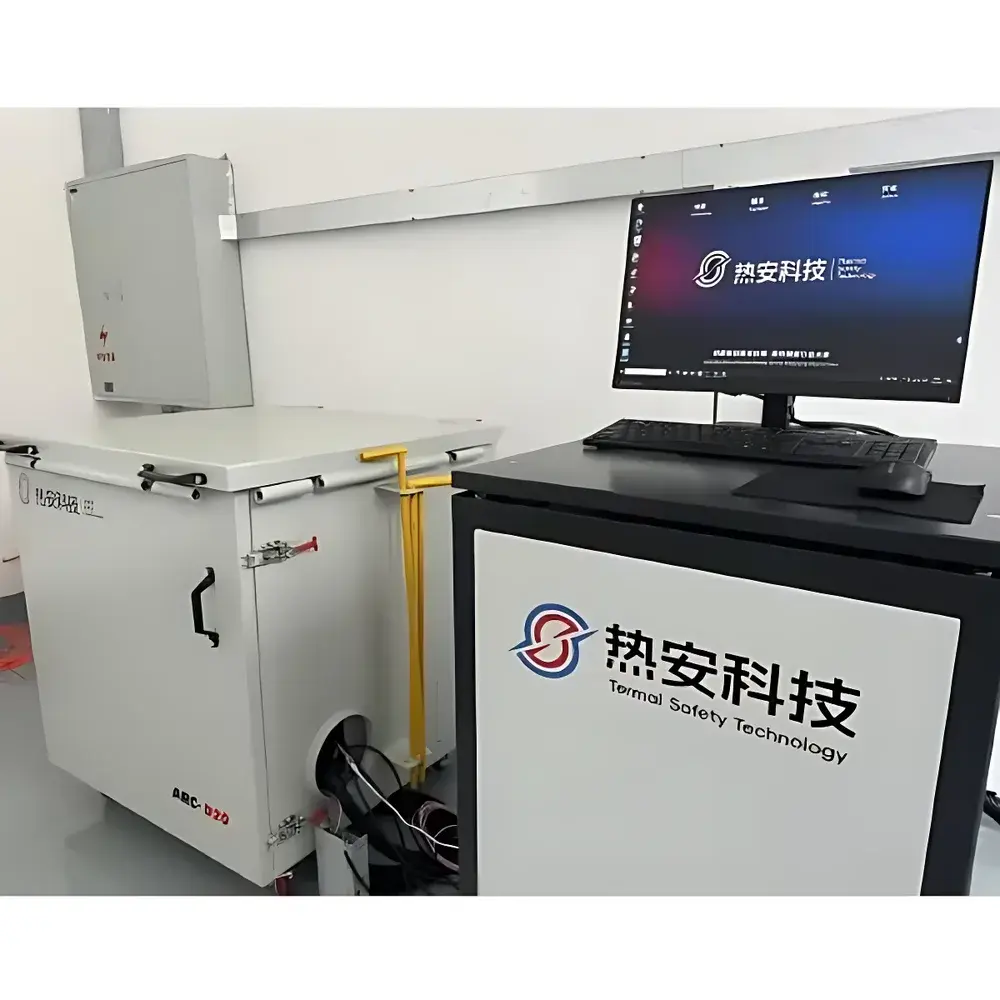
Foshan TST ARC Series Accelerating Rate Calorimeter
| Brand | FoShan TST |
|---|---|
| Origin | Guangdong, China |
| Manufacturer Type | Authorized Distributor |
| Country of Origin | China |
| Model | ARC Series |
| Pricing | Available Upon Request |
Overview
The Foshan TST ARC Series Accelerating Rate Calorimeter is a high-precision adiabatic calorimetric instrument engineered for the quantitative assessment of thermal runaway behavior in reactive chemical systems. It operates on the fundamental principle of adiabatic temperature tracking—continuously adjusting the furnace temperature to match the sample’s instantaneous temperature, thereby maintaining ΔT ≈ 0 between sample and surroundings. This dynamic thermal nulling eliminates heat loss pathways, effectively simulating worst-case industrial scenarios such as loss of cooling, insulation failure, or bulk storage under confined conditions. Unlike differential scanning or heat-flux calorimeters, the ARC directly measures self-heating rate (dT/dt), time-to-maximum-rate (TMR), pressure rise rate (dP/dt), and onset temperature under near-perfect adiabatic conditions—enabling rigorous derivation of kinetic parameters including activation energy (Ea), pre-exponential factor (A), and reaction order via isoconversional or model-fitting methods per ASTM E698 and ISO 8231 standards.
Key Features
- True adiabatic operation with real-time temperature feedback control (±0.02 °C tracking accuracy) ensuring minimal heat exchange during exothermic events
- Integrated high-sensitivity pressure transducer (range: 0–200 bar, resolution: 0.01 bar) synchronized with thermal data acquisition
- Robust stainless-steel reaction cell (standard volume: 5–10 mL) compatible with corrosive, volatile, and high-viscosity samples
- Automated search-and-locate mode for precise detection of exothermic onset, eliminating operator bias in threshold selection
- Compliant heating/cooling system capable of ramp rates from 0.01 to 5 °C/min, supporting both slow-scan and fast-response protocols
- Explosion-resistant containment housing rated to 300 bar burst pressure, certified to CE Machinery Directive 2006/42/EC
Sample Compatibility & Compliance
The ARC Series accommodates a broad spectrum of process-relevant materials: organic peroxides, nitro compounds, polymerization initiators, lithium-ion battery electrolytes, pharmaceutical intermediates, and agrochemical formulations. Sample containment options include standard Hastelloy C-276 cells for halogenated or acidic systems, and quartz-lined variants for alkali-sensitive reactions. All test methodologies align with internationally recognized safety evaluation frameworks—including CCPS Guidelines (Center for Chemical Process Safety), NFPA 495, UN Test Series H (UN Manual of Tests and Criteria), and EU REACH Annex VII/XI requirements for thermal stability data submission. Data integrity meets GLP audit criteria with full traceability of calibration records, environmental logs, and user actions.
Software & Data Management
The proprietary TST-Calorimetry Suite v4.x provides intuitive workflow management—from method setup and real-time monitoring to automated kinetic analysis and report generation. Raw data streams (temperature, pressure, time, heater power) are captured at ≥10 Hz with timestamped binary logging. The software supports ASTM E2070-compliant kinetic modeling (e.g., Friedman, Ozawa-Flynn-Wall, ASTM E698), TMRad extrapolation to ambient storage conditions, and adiabatic time-to-explosion (Texp) prediction. Audit trails comply with FDA 21 CFR Part 11 requirements, featuring electronic signatures, role-based access control, and immutable data archiving. Export formats include CSV, PDF (with embedded metadata), and XML for LIMS integration.
Applications
- Process safety screening of batch and continuous manufacturing steps in fine chemicals and specialty polymers
- Determination of safe operating limits (e.g., MTSR, SADT, TD24) for transportation and storage per IMDG Code and IATA Dangerous Goods Regulations
- Supporting Design Basis Accident (DBA) analysis in PHA (Process Hazard Analysis) and Layer of Protection Analysis (LOPA)
- Validation of thermal stabilization strategies, including inhibitor efficacy and quenching agent performance
- Regulatory dossier preparation for EPA TSCA, ECHA REACH registration, and FDA IND/NDA submissions requiring thermal hazard characterization
FAQ
What distinguishes ARC from DSC or RC1-type reaction calorimeters?
ARC provides true adiabatic conditions essential for runaway prediction; DSC measures relative heat flow under non-adiabatic constraints, while RC1 quantifies heat flow under controlled jacket temperature—not applicable for low-phi-factor or high-energy systems.
Can the ARC Series be used for gas-generating reactions?
Yes—the integrated pressure sensor and vent-capable cell design allow simultaneous thermal and pressure profiling for decomposition or nitration reactions involving significant gas evolution.
Is calibration traceable to national standards?
All temperature and pressure sensors are calibrated annually against NIST-traceable references, with certificates included in the system validation package.
Does the system support remote operation and monitoring?
Yes—via secure HTTPS interface with TLS 1.2 encryption; full control and live data streaming available through authenticated enterprise networks.
What training and technical support does Foshan TST provide?
On-site installation qualification (IQ), operational qualification (OQ), and user training are delivered by certified process safety engineers; extended warranty and 24/7 remote diagnostics are available under service agreement.



