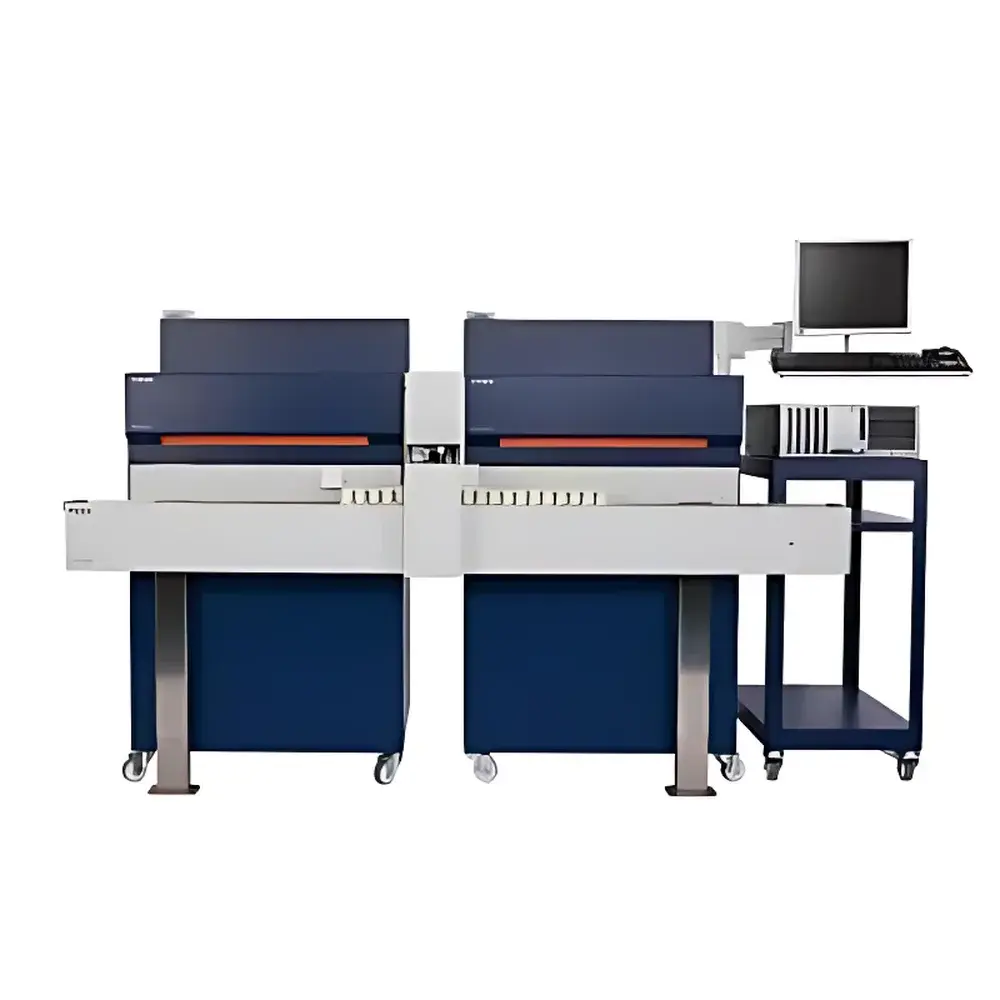
FOSS CombiFoss 7 Dairy Analyzer with Integrated Milk Composition and Somatic Cell Counting
| Brand | FOSS |
|---|---|
| Origin | Denmark |
| Model | CombiFoss 7 |
| Automation Level | Fully Automatic |
| Analysis Throughput | 600 samples/hour |
| Somatic Cell Count (SCC) Range | 0–10 × 10⁶ cells/mL |
| Repeatability | < 2% CV |
| Accuracy | ±0.1–1.5 × 10⁶ cells/mL |
| Sample Temperature Range | 30–42 °C |
| Regulatory Compliance | Designed for ISO 8570, IDF 141, AOAC 991.19, and EU Regulation (EC) No 853/2004 compliance |
| Detection Capabilities | Fat, Protein, True Protein, Lactose, Total Solids, Non-Fat Solids, Urea, Citric Acid, Freezing Point, Casein, Free Fatty Acids, pH, Monounsaturated Fatty Acids (MUFA), Polyunsaturated Fatty Acids (PUFA), Total Unsaturated Fatty Acids, Total Saturated Fatty Acids, Sample Inlet Temperature, Somatic Cell Count (with FM FC module) |
Overview
The FOSS CombiFoss 7 Dairy Analyzer is a fully integrated, dual-function instrument engineered for high-throughput, regulatory-grade analysis of raw milk at collection centers, dairy processing facilities, and third-party testing laboratories. It combines two validated analytical platforms—Milkoscan near-infrared (NIR) spectroscopy for compositional analysis and Fossomatic flow cytometry-based somatic cell counting—into a single, synchronized system. This architecture enables simultaneous, single-aspiration measurement of both milk composition and somatic cell count (SCC), eliminating sequential handling and reducing total turnaround time per sample. The system operates on the principle of calibrated multivariate NIR regression models (for compositional parameters) and fluorescent dye-stained cell enumeration under hydrodynamic focusing (for SCC), ensuring traceable, metrologically sound results aligned with international dairy standards.
Key Features
- Fully automated sample handling with integrated barcode reader support, enabling unattended batch processing and full sample traceability.
- Pre-formulated, sealed reagent cartridges for somatic cell staining—eliminating manual reagent preparation and minimizing operator exposure to dyes.
- Automatic sample degassing and temperature equilibration (30–42 °C) prior to analysis, ensuring stable optical path conditions and consistent spectral response.
- Robust mechanical architecture with self-diagnostic routines, automatic air bubble detection, and empty-vial sensing to prevent measurement errors and cross-contamination.
- Modular expandability: Optional FM FC (Flow Cytometry Filter Cartridge) module enables SCC quantification in preserved or preservative-treated milk samples, complying with EU and USDA requirements for transport-stabilized samples.
- Calibration stability maintained via daily internal reference checks and optional external standard verification protocols per ISO/IEC 17025 laboratory practices.
Sample Compatibility & Compliance
The CombiFoss 7 accepts raw bovine milk directly from farm collection tanks or bulk tankers, including samples treated with approved preservatives (e.g., bronopol or azidiol). Its optical and fluidic design accommodates variable fat globule size distributions and minor particulate content without clogging. All reported parameters—including fat, protein, lactose, freezing point, urea, citric acid, and SCC—are traceable to primary reference methods (e.g., Gerber for fat, Kjeldahl for protein, Coulter counter for SCC) and validated against ISO 9622 (milk composition) and ISO 13366-1 (somatic cell counting). The system supports audit-ready documentation required under EU Regulation (EC) No 853/2004, FDA Grade A Pasteurized Milk Ordinance (PMO), and national quality payment schemes based on component and SCC grading.
Software & Data Management
FOSS WinDairy software provides centralized control, method configuration, calibration management, and GLP-compliant data archiving. Each analysis generates a timestamped, digitally signed result file containing raw spectra, processed values, QC flags, and instrument status logs. Audit trail functionality complies with FDA 21 CFR Part 11 requirements, including user authentication, electronic signatures, and immutable record retention. Data export formats include CSV, XML, and LIS-compatible HL7 messaging for seamless integration into enterprise LIMS or ERP systems. Remote diagnostics and firmware updates are supported via secure HTTPS connections, minimizing onsite service interventions.
Applications
- Raw milk pricing and quality-based payment at dairy cooperatives and collection hubs.
- In-process monitoring during pasteurization and standardization to ensure compositional consistency.
- Regulatory surveillance testing by national food safety authorities and accredited reference labs.
- Research applications requiring high-fidelity correlation between composition, SCC, and functional properties (e.g., cheese yield prediction, heat stability assessment).
- Supplier qualification and contract compliance verification in private-label and export-oriented dairy supply chains.
FAQ
Does the CombiFoss 7 require daily recalibration?
No—calibration stability is maintained through built-in reference checks and scheduled verification using certified control samples; full recalibration is typically performed quarterly or after major maintenance.
Can it analyze goat or sheep milk?
Yes, with dedicated calibration models validated per IDF Standard 193A; species-specific calibrations must be commissioned separately.
Is SCC measurement affected by bacterial contamination?
The FM FC module includes proprietary gating algorithms that distinguish nucleated somatic cells from bacterial debris, ensuring specificity even in samples with elevated microbial loads.
What connectivity options are available for data transfer?
Standard Ethernet (TCP/IP), optional RS-232, and secure cloud API access for real-time data streaming to central dashboards.
How is compliance with GMP/GLP environments ensured?
Through configurable user roles, electronic audit trails, instrument qualification templates (IQ/OQ/PQ), and validation support documentation aligned with ISO/IEC 17025 and Annex 11 requirements.
Related Products