
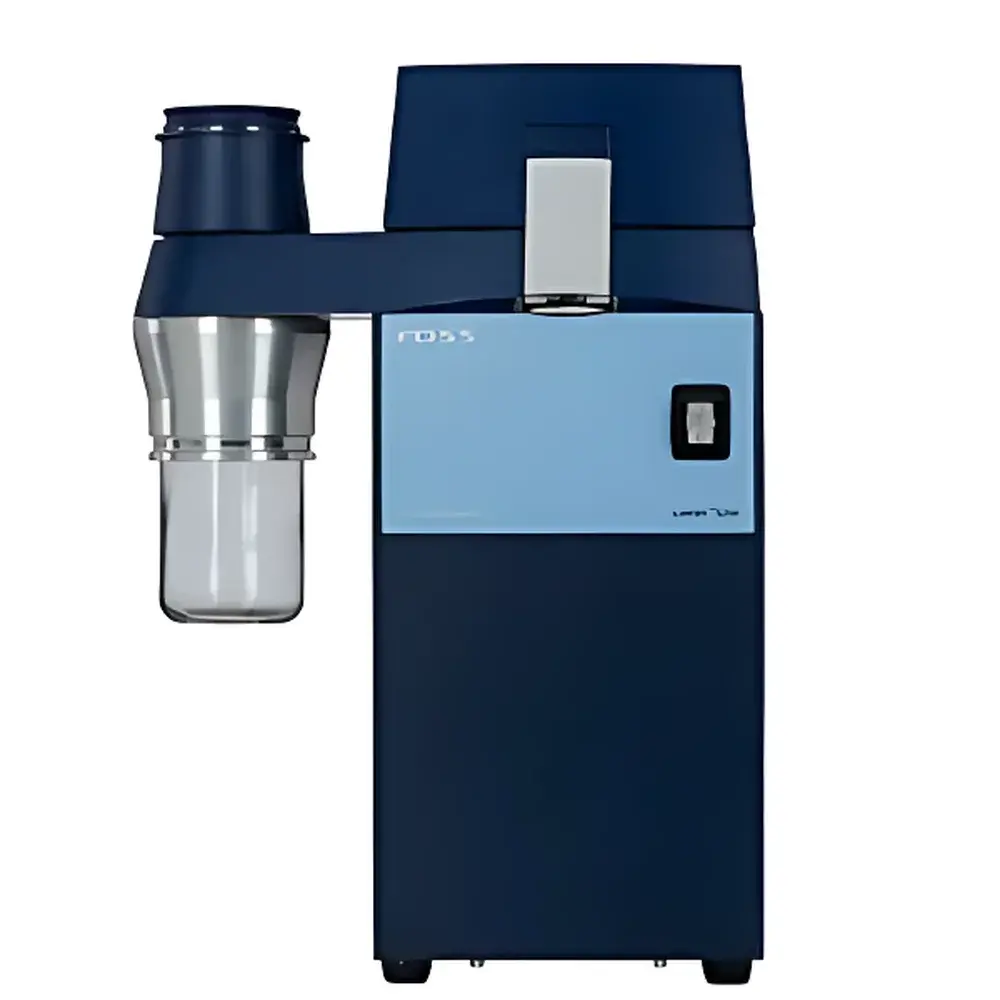
FOSS Cyclotec CT 293 Cyclonic Sample Mill
| Brand | FOSS |
|---|---|
| Origin | Denmark |
| Model | CT 293 |
| Instrument Type | Cyclonic Grinder |
| Sample Applicability | Hard, brittle, and fibrous materials (e.g., cereals, seeds, feed, leaves, tablets, tobacco, limestone, coal) |
| Feed Size | ≤10 mm (standard inlet), up to 40 mm (optional large inlet) |
| Output Particle Size | 0.01–0.5 mm |
| Particle Distribution | ≥95% retained on 1 mm sieve |
| Rotational Speed | 10,000 rpm |
| Grinding Rate | ~4 g/s |
| Noise Level | <75 dB(A) |
| Compliance | AOAC Official Method 995.13 |
Overview
The FOSS Cyclotec CT 293 Cyclonic Sample Mill is an engineered solution for rapid, reproducible, and thermally neutral size reduction of heterogeneous solid samples in analytical laboratories. Based on cyclonic grinding principles—where high-velocity airflow entrains particles against a fixed abrasive ring—the CT 293 achieves mechanical comminution without significant frictional heating. This principle ensures minimal thermal degradation of heat-sensitive analytes (e.g., proteins, vitamins, volatile compounds), making it especially suitable for quantitative methods requiring intact molecular integrity, such as Kjeldahl nitrogen analysis, near-infrared (NIR) spectroscopy, Soxhlet extraction, and fiber determination. Unlike conventional blade or jaw mills, the CT 293 employs a rotating impeller that accelerates material tangentially into a hardened steel grinding chamber, where centrifugal force drives particles against a wear-resistant annular surface. Finely ground material passes through user-selectable stainless-steel mesh screens (ranging from 0.1 mm to 1.0 mm), while continuous air flow simultaneously cools the chamber and clears residual fines—eliminating carryover between runs and reducing manual cleaning requirements.
Key Features
- Thermally stable operation: Air-assisted cyclonic action limits temperature rise to <5 °C above ambient during standard grinding cycles, preserving analyte stability.
- Precision particle size control: Interchangeable stainless-steel sieves (0.1, 0.25, 0.5, and 1.0 mm) enable method-specific particle distribution targeting; ≥95% of output passes through a 1 mm sieve, with median particle size typically ≤0.2 mm using the 0.5 mm screen.
- High throughput & repeatability: 10,000 rpm impeller speed supports consistent grinding rates of ~4 g/s for cereal grains and similar matrices, delivering batch-to-batch reproducibility essential for ISO/IEC 17025-compliant testing.
- Low-noise design: Acoustically damped housing maintains operational noise below 75 dB(A), meeting occupational health standards for routine lab use.
- Integrated safety architecture: Dual interlock system—mechanical lid switch and electronic motor cutoff—prevents operation unless the grinding chamber is fully sealed and locked.
- Minimal maintenance footprint: Sealed bearings, tool-free sieve replacement, and absence of lubrication points reduce scheduled downtime and service dependency.
Sample Compatibility & Compliance
The CT 293 accommodates a broad spectrum of hard, semi-brittle, and fibrous materials—including whole grains, oilseeds, pelleted feed, dried botanicals, pharmaceutical tablets, lignocellulosic biomass, and mineral powders—provided initial particle dimensions do not exceed 10 mm (standard inlet) or 40 mm (with optional large-port adapter). Its design conforms to AOAC Official Method 995.13 for sample homogenization prior to NIR calibration and validation. It is formally endorsed by the Canadian Grain Commission for routine grain quality assessment and recognized under ASTM D7432–22 for standardized feed particle size preparation. The mill’s closed-loop air path and full-sample recovery capability support GLP-aligned workflows, minimizing cross-contamination risk and enabling traceability in regulated environments (e.g., FDA-regulated food testing labs operating under 21 CFR Part 11 data integrity requirements).
Software & Data Management
While the CT 293 operates as a standalone electromechanical instrument without embedded firmware or touchscreen interface, its performance parameters are fully integratable into laboratory information management systems (LIMS) via analog signal outputs (0–10 V DC) for runtime monitoring and digital I/O triggers for automated start/stop synchronization. FOSS provides documented SOP templates aligned with ISO 17025 clause 7.2.2 (method validation) and USP Analytical Instrument Qualification protocols, including IQ/OQ documentation packages, preventive maintenance logs, and calibration verification procedures for rotational speed and sieve integrity. All operational records—including sieve lot numbers, grinding duration, and sample identification—are manually logged per GLP Annex 11 guidance or exported via connected barcode scanners and LIMS interfaces.
Applications
- Kjeldahl nitrogen analysis: Produces homogeneous, low-temperature-ground samples ensuring complete digestion and accurate N quantification.
- Near-infrared (NIR) spectroscopy: Delivers narrow particle size distribution critical for spectral reproducibility and PLS model robustness.
- Crude fiber and detergent fiber analysis (AOAC 978.10, AACC 32-10): Achieves uniform particle geometry required for consistent solvent penetration and residue recovery.
- Soxhlet and accelerated solvent extraction: Generates optimal surface-area-to-volume ratios for efficient lipid and metabolite recovery.
- Pharmaceutical content uniformity testing: Processes tablets and granules without polymorphic alteration or API degradation.
- Feed formulation QA/QC: Supports rapid batch homogenization for proximate analysis (moisture, ash, protein, fat) per AOAC and FAMI-QS standards.
FAQ
What particle size distributions can be achieved with different sieve options?
Standard configurations include 0.1 mm, 0.25 mm, 0.5 mm, and 1.0 mm stainless-steel meshes. With the 0.5 mm sieve, ≥95% of ground material passes a 1 mm test sieve, and the D50 typically falls between 0.15–0.22 mm for cereal-based samples.
Is the CT 293 compliant with FDA 21 CFR Part 11 for electronic records?
As a non-computerized device, the CT 293 itself does not generate electronic records. However, its analog/digital I/O ports enable integration with Part 11–compliant LIMS platforms for audit-trail-enabled run logging and parameter tracking.
How frequently must the grinding ring and impeller be replaced?
Under normal use with cereal and feed samples, the hardened steel grinding ring exceeds 5,000 operating hours; the impeller requires inspection every 2,000 hours and replacement only upon visible wear or imbalance-induced vibration.
Can the CT 293 process moisture-sensitive or hygroscopic samples?
Yes—its closed-air circuit minimizes ambient humidity ingress, and optional desiccant air-drying modules (FOSS accessory kit A-CT293-D) further suppress moisture adsorption during grinding.
Does FOSS provide validation support for GMP environments?
Yes—FOSS supplies IQ/OQ documentation templates, metrological traceability certificates for speed calibration, and sieve certification reports compliant with ISO/IEC 17025 and EU GMP Annex 15 requirements.



