
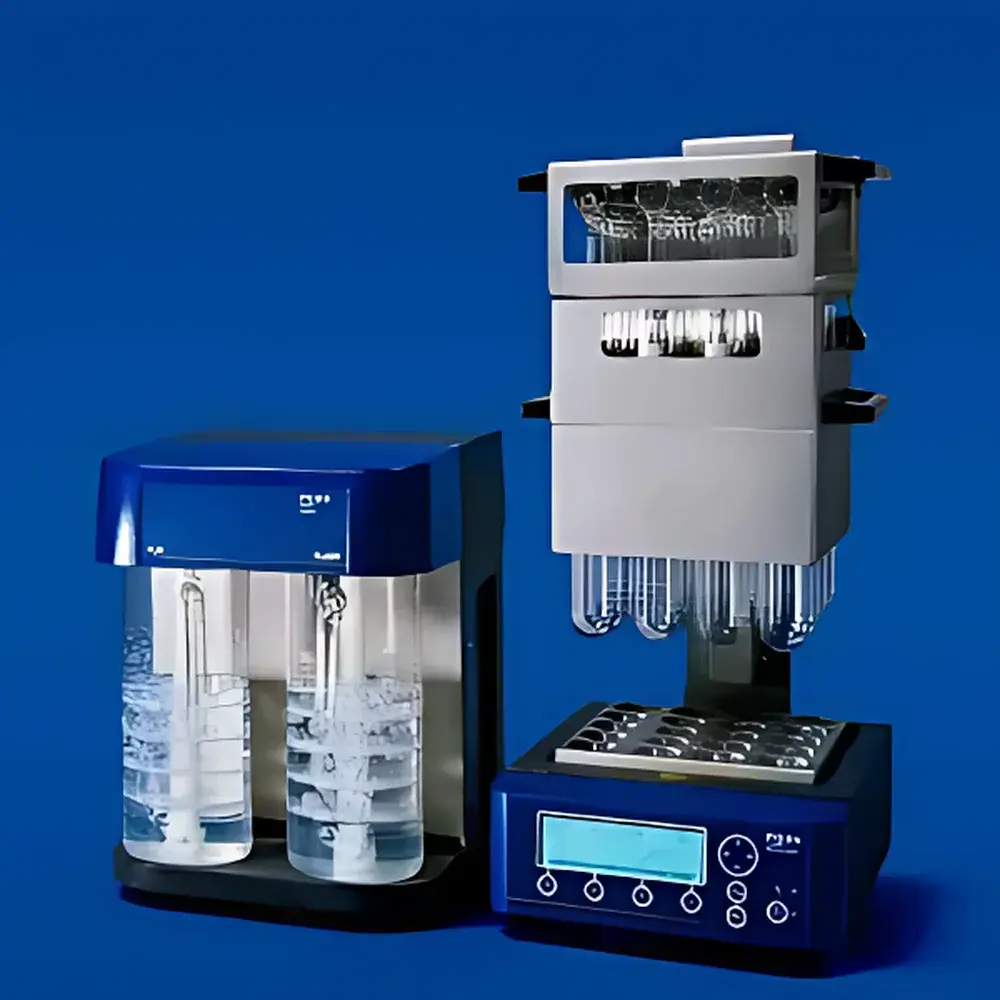
FOSS Digestor™ 2508 and Digestor™ 2520 Electric Heating Digestion Systems
| Brand | FOSS |
|---|---|
| Origin | Denmark |
| Model | Digestor™ 2508 and Digestor™ 2520 |
| Instrument Type | Electric Heating Digestion System |
| Automation Level | Fully Automatic |
| Temperature Range | Ambient to 440 °C |
| Temperature Stability | ±1 °C at 400 °C |
| Temperature Accuracy | ±1 °C across full range |
| Max. Tube Capacity | 8 (Digestor™ 2508) / 20 (Digestor™ 2520) tubes per batch |
| Tube Volumes Supported | 100 mL, 250 mL, 400 mL |
| Heating Time (20 °C → 400 °C) | ~35 min (2508), ~40 min (2520) |
| Power Supply | 200–240 V, 50–60 Hz |
| Power Consumption | 1100 W (2508), 2300 W (2520) |
| Dimensions (W×D×H) | 300×440×140 mm (2508), 300×600×140 mm (2520) |
| Net Weight | 10 kg (2508), 18 kg (2520) |
| Exhaust Flow Rate | 3–5 L/min (initial 5 min), then 1 L/min (2508) |
| Application Memory | Up to 254 methods (127 FOSS-standard + 127 user-defined) |
| Max. Steps per Method | 23 (including ramp, hold, cool-down, wash cycles) |
| Communication Interface | Bidirectional PC interface compliant with GLP traceability requirements |
| Optional Accessories | Integrated fume extraction duct, external scrubber unit, programmable peristaltic wash system |
Overview
The FOSS Digestor™ 2508 and Digestor™ 2520 are fully automated electric heating digestion systems engineered for precision, safety, and regulatory compliance in Kjeldahl nitrogen analysis workflows. Based on controlled conductive heating of digestion tubes within a thermally optimized metal block, these instruments execute reproducible thermal programs—including precise ramping, isothermal holds, controlled cooling, and post-digestion washing—under programmable logic control. Designed for integration into routine analytical laboratories performing AOAC, ISO 8968, and ASTM D5133-compliant nitrogen determination, the Digestor™ series ensures consistent decomposition of organic matrices (e.g., food, feed, environmental, and agricultural samples) using sulfuric acid and catalysts. Its robust architecture eliminates manual intervention during digestion, minimizes operator exposure to corrosive fumes and high temperatures, and supports audit-ready documentation through bidirectional RS-232/USB communication with LIMS or laboratory data management software.
Key Features
- Fully automatic operation with integrated programmable controller managing up to 254 stored digestion methods—127 preconfigured in FOSS standard format and 127 user-definable.
- High-precision temperature control: ±1 °C stability at 400 °C and ±1 °C accuracy across the full ambient-to-440 °C operating range, validated per IEC 61000-4-30 harmonic immunity and thermal uniformity testing.
- Scalable throughput: Digestor™ 2508 accommodates 8 tubes per batch; Digestor™ 2520 handles 20 tubes—both compatible with 100 mL, 250 mL, and 400 mL borosilicate digestion tubes.
- Multi-step method programming: Each application supports up to 23 discrete steps—including temperature ramps, dwell periods, active cooling, and automated tube rinsing—with independent time, slope, and setpoint parameters.
- Dedicated fume management: Integrated exhaust ducting with dynamic flow control (3–5 L/min initial, tapering to 1 L/min for 2508; 10–12 L/min initial, tapering to 3–5 L/min for 2520) ensures continuous removal of SO2, NOx, and acid vapors.
- Optional scrubber compatibility: External alkaline scrubbers can be connected to neutralize acidic exhaust gases prior to venting, meeting local occupational health and environmental discharge regulations (e.g., OSHA 29 CFR 1910.1200, EPA 40 CFR Part 63).
Sample Compatibility & Compliance
The Digestor™ 2508 and 2520 support a broad spectrum of solid and semi-solid matrices requiring complete mineralization prior to distillation or colorimetric detection. Validated applications include cereal grains, dairy powders, meat products, soil extracts, wastewater sludge, and botanical materials. All digestion protocols adhere to internationally recognized standards including ISO 5983-1 (Animal feeding stuffs), AOAC Official Method 981.10 (Crude protein in foods), and USP (Nitrogen content in pharmaceutical excipients). The system’s firmware and method storage architecture comply with GLP principles: electronic records include timestamped method execution logs, operator ID, tube position mapping, and real-time thermal profile capture—enabling full traceability required under FDA 21 CFR Part 11 when paired with validated software environments.
Software & Data Management
Bidirectional communication via RS-232 or USB enables seamless synchronization with FOSS’ KjelMaster™ software or third-party LIMS platforms. Digestion methods can be uploaded from centralized databases, edited locally, and exported for cross-laboratory protocol harmonization. The instrument maintains an internal audit trail documenting every method run—including start/stop times, actual vs. target temperatures at 10-second intervals, power fluctuations, and fault codes. All data fields are immutable post-execution unless authorized via multi-level password access (administrator, supervisor, operator roles). Export formats include CSV and XML, supporting integration with statistical process control (SPC) tools and automated report generation for ISO/IEC 17025 accreditation submissions.
Applications
These systems serve as the primary digestion stage in end-to-end Kjeldahl workflows, particularly where throughput, repeatability, and regulatory defensibility are critical. Typical use cases include QC laboratories in food manufacturing (protein quantification per Codex Alimentarius), contract testing labs serving EU REACH compliance, agricultural extension services performing soil fertility assessments, and academic research groups studying nitrogen cycling in ecological systems. The ability to store and recall complex multi-ramp methods makes them suitable for challenging matrices requiring staged oxidation—such as high-fat samples prone to foaming or fiber-rich plant tissues demanding extended hold times at elevated temperatures.
FAQ
What safety certifications do the Digestor™ 2508 and 2520 carry?
Both models are CE-marked per Directive 2014/30/EU (EMC) and 2014/35/EU (LVD), and conform to IEC 61010-1:2010 for laboratory electrical equipment safety.
Can the Digestor™ systems be integrated with FOSS Kjeltec™ distillation units?
Yes—native interoperability is supported via hardware-triggered start/stop signals and synchronized method transfer through KjelMaster™ software.
Is remote monitoring or cloud-based method management available?
While the base unit does not include Ethernet/Wi-Fi, optional gateway modules enable MQTT or OPC UA connectivity for integration into Industry 4.0 laboratory infrastructure.
What maintenance is required for long-term thermal accuracy?
Annual calibration verification using NIST-traceable RTD probes is recommended; FOSS-certified service technicians perform thermocouple validation and block uniformity mapping.
Are replacement digestion blocks or tube holders available as spare parts?
Yes—FOSS supplies certified replacement heating blocks, ceramic tube supports, and exhaust gasket kits with documented lot traceability and material compliance (RoHS, REACH).



