
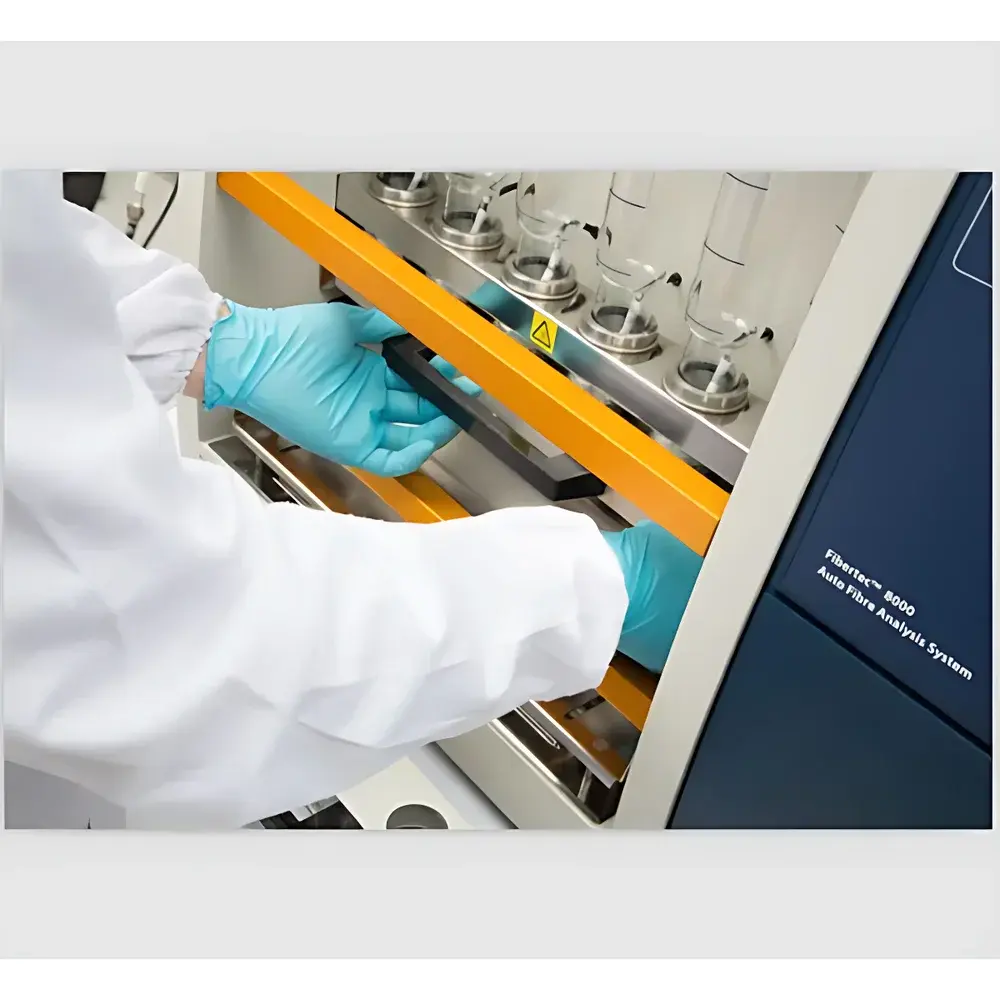
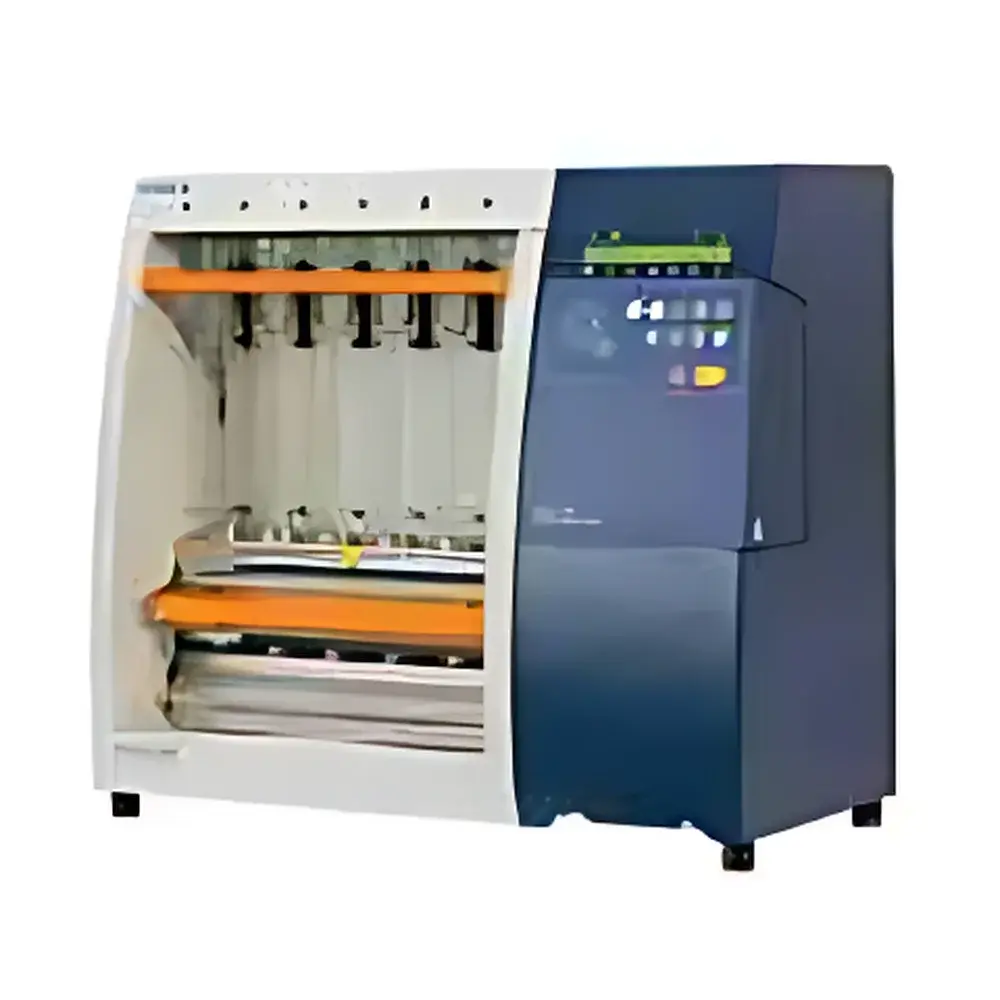
FOSS Fibertec 8000 Automated Dietary Fiber Analyzer
| Brand | FOSS |
|---|---|
| Origin | Denmark |
| Model | Fibertec 8000 |
| Principle | Gravimetric Crude Fiber and Detergent Fiber Analysis (Weende & van Soest Methods) |
| Sample Throughput | Up to 6 samples per run |
| Digestion Vessels | Ceramic crucibles (standardized, pre-weighed) |
| Reagent Handling | Fully automated acid/alkali/enzyme dosing and temperature-controlled digestion |
| Compliance | AOAC 978.10, AOAC 985.29, AACC 32-05, ISO 6865, EN ISO 13906 |
Overview
The FOSS Fibertec 8000 is a fully automated, benchtop dietary fiber analyzer engineered for precise, reproducible determination of crude fiber (CF), neutral detergent fiber (NDF), amylase-treated NDF (aNDF), acid detergent fiber (ADF), and acid detergent lignin (ADL) in feedstuffs, cereals, legumes, forages, and processed food matrices. It implements standardized gravimetric methodologies rooted in classical proximate analysis—specifically the Weende system for crude fiber and the sequential detergent fiber approach developed by van Soest. Unlike semi-automated or manual systems, the Fibertec 8000 executes all critical steps—including reagent dispensing, timed heating cycles (boiling reflux), vacuum filtration, solvent rinsing, drying, and ashing—under programmable, closed-loop control. Each sample is processed independently in its own ceramic crucible, eliminating cross-contamination and ensuring traceability at the individual sample level. The system operates without operator intervention post-loading, delivering robust data integrity essential for regulatory reporting and quality assurance in animal nutrition, agricultural research, and food regulatory compliance laboratories.
Key Features
- Fully automated digestion, filtration, washing, drying, and ashing sequences—no manual transfers or timing interventions required
- Ceramic crucible-based architecture compliant with AOAC and ISO specifications for weight stability and chemical resistance
- Integrated reagent management system with precision peristaltic pumps for controlled delivery of neutral detergent solution (NDS), acid detergent solution (ADS), sulfuric acid, and α-amylase
- Programmable thermal profiles: independent temperature control for NDF (100 °C reflux), ADF (100 °C reflux), and ADL (525 °C muffle furnace cycle)
- Onboard vacuum filtration unit with pressure-regulated suction and automatic solvent recovery
- Embedded balance interface supporting ASTM E1132-compliant tare/weight logging during crucible pre- and post-processing stages
- Robust stainless-steel housing rated IP42 for laboratory environments; CE-marked and compliant with IEC 61010-1 safety standards
Sample Compatibility & Compliance
The Fibertec 8000 accommodates solid, ground, or pelleted samples ranging from coarse forage materials (e.g., alfalfa hay, corn silage) to finely milled grains, bakery by-products, and formulated pet foods. Sample mass is typically 0.5–2.0 g, adjusted per matrix density and expected fiber content. All analytical protocols adhere strictly to internationally recognized reference methods: AOAC Official Method 978.10 (crude fiber), AOAC 985.29 (NDF and ADF), AACC 32-05 (aNDF with heat-stable α-amylase), ISO 6865 (determination of crude fiber in animal feeding stuffs), and EN ISO 13906 (detergent fiber analysis). The system supports GLP-compliant operation through audit-trail-enabled method storage, user access levels, and electronic signature-capable workflow logs—fully aligned with FDA 21 CFR Part 11 requirements when integrated with FOSS’s optional FossLink LIMS interface.
Software & Data Management
Controlled via the intuitive FOSS WinFibertec software, the Fibertec 8000 provides method-driven workflow execution with real-time status monitoring, event logging, and deviation alerts. Each analysis generates a timestamped report containing raw weights (tare, residue post-drying, residue post-ashing), calculated moisture-, ash-, and protein-corrected values, and uncertainty estimates derived from balance calibration records and repeatability studies. Data export is supported in CSV, PDF, and XML formats compatible with enterprise LIMS platforms. Software validation documentation (IQ/OQ/PQ protocols) and 21 CFR Part 11 configuration packages are available upon request to support regulated environments.
Applications
- Nutritional profiling of ruminant and monogastric feed formulations for digestibility modeling and ration balancing
- Quality control of cereal bran, oat fractions, and resistant starch ingredients in functional food development
- Regulatory submission support for health claims related to dietary fiber content under EFSA, FDA, and Health Canada guidelines
- Research into fiber solubility, fermentability, and physicochemical behavior across processing conditions (extrusion, baking, fermentation)
- Method transfer and verification between contract testing labs and in-house QA departments operating under ISO/IEC 17025
FAQ
What digestion chemistry does the Fibertec 8000 use for NDF determination?
It applies neutral detergent solution (NDS) containing sodium lauryl sulfate, EDTA, sodium borate, and triethanolamine at pH 6.9–7.1, heated under reflux at 100 °C for 60 minutes—per AOAC 985.29.
Can the system perform aNDF analysis with thermostable α-amylase?
Yes—WinFibertec software includes dedicated aNDF method templates that integrate pre-treatment with heat-stable bacterial α-amylase prior to NDS digestion, in accordance with AACC 32-05.
Is crucible handling fully automated?
Crucibles are manually loaded and unloaded, but all thermal, fluidic, and filtration steps—including crucible transfer between digestion, filtration, drying, and ashing modules—are executed robotically without operator contact.
Does the system meet FDA 21 CFR Part 11 requirements?
When configured with FOSS’s validated software package and electronic signature module, it supports audit trails, role-based access control, and secure electronic records—enabling compliance in GxP environments.
What maintenance is required for long-term operational reliability?
Scheduled tasks include quarterly calibration of reagent pumps and temperature sensors, annual verification of furnace uniformity and balance linearity, and routine cleaning of filtration manifolds and solvent lines per FOSS Maintenance Manual Rev. 4.2.





