
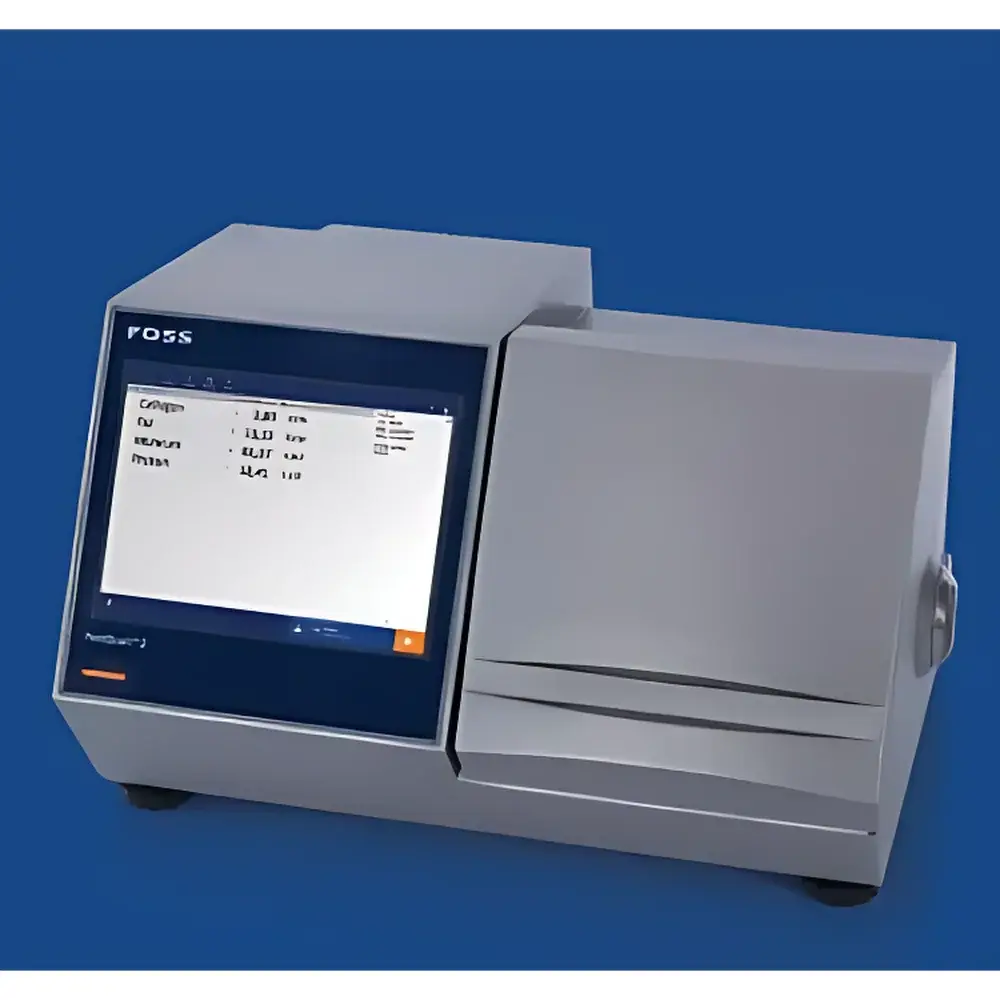
FOSS FoodScan 2 Near Infrared Spectrometer
| Brand | FOSS |
|---|---|
| Origin | Denmark |
| Model | FoodScan 2 |
| Instrument Type | Laboratory NIR Spectrometer |
| Optical Design | Grating Scanning System |
| Wavelength Range | 400–1100 nm |
| Sample Throughput | 15–25 seconds per sample |
| Data Sampling Interval | 1 nm |
| Measurement Mode | Transmission and Reflectance |
| Chemometric Software Engine | Artificial Neural Network (ANN) Calibration |
| Regulatory Certification | AOAC Official Method of Analysis™ 983.18 |
| Application Scope | Raw and processed meat, poultry, and aquatic products (porcine, bovine, avian, etc.) |
| Key Analytes | Fat, Protein, Moisture, Collagen, Salt (Cl⁻ basis), Lean Meat Content |
| Optional Extensions | Saturated Fatty Acids, Ash, Sodium-based Salt, Water Activity, Color Parameters |
Overview
The FOSS FoodScan 2 is a laboratory-grade near-infrared (NIR) spectrometer engineered for rapid, non-destructive compositional analysis of meat and meat products. Operating on the principle of grating-scanned reflectance and transmission spectroscopy in the visible–NIR region (400–1100 nm), the instrument captures high-fidelity spectral data that are interpreted via a proprietary artificial neural network (ANN) chemometric calibration framework. Unlike conventional regression-based models, ANN calibration enables superior handling of complex, non-linear relationships between spectral signatures and multi-component composition—particularly critical in heterogeneous biological matrices such as minced, emulsified, or cooked meat. Designed as the successor to the globally deployed FoodScan 1 platform—with over 1,500 units installed at facilities including Danish Crown, Tyson Foods, and Shuanghui Group—the FoodScan 2 delivers enhanced throughput (15–25 s/sample), expanded analyte coverage, and improved robustness for routine QC in regulated environments.
Key Features
- Grating-scanning optical architecture ensures stable wavelength registration and long-term photometric reproducibility across daily operation cycles.
- Simultaneous transmission and reflectance measurement modes accommodate diverse physical forms—from raw boneless cuts and ground meat to sausages, patties, and restructured products—without requiring homogenization or chemical digestion.
- AOAC Official Method of Analysis™ 983.18 certified for fat, protein, moisture, collagen, chloride-based salt, and lean content in fresh and processed meats—providing auditable compliance for food safety and labeling verification.
- No consumables, solvents, or hazardous reagents required; minimal sample preparation reduces operator variability and eliminates analytical waste streams.
- Integrated thermal stabilization and automatic reference validation minimize drift and support unattended batch analysis under GLP-compliant workflows.
Sample Compatibility & Compliance
The FoodScan 2 is validated for use with raw and cooked muscle tissues from porcine, bovine, ovine, avian, and aquatic species. Its optical interface supports both intact samples (e.g., 10–20 mm thick slices) and particulate forms (e.g., ground meat, mince, or emulsions), provided minimum particle size remains above 100 µm to ensure representative light interaction. The system complies with ISO 17025 requirements for method validation when operated within defined calibration maintenance intervals. All ANN calibrations are traceable to primary reference methods (e.g., AOAC 992.15 for fat, AOAC 984.13 for protein), and full audit trails—including calibration history, user logins, and spectral acquisition metadata—are retained per FDA 21 CFR Part 11 and EU Annex 11 guidelines.
Software & Data Management
Control and analysis are performed using FOSS WinISI III software, which embeds the ANN engine and provides tools for calibration development, outlier detection, and statistical process control (SPC) charting. Raw spectra (1 nm resolution) are stored in HDF5 format with embedded metadata (sample ID, operator, timestamp, instrument conditions). The software supports automated report generation compliant with ISO/IEC 17025 documentation standards and exports structured data (CSV, XML) for integration into LIMS or ERP systems. Remote diagnostics, firmware updates, and calibration transfer between instruments are managed via secure FOSS Connect cloud services—subject to customer-configured data residency policies.
Applications
- Raw material valuation: Real-time fat/protein ratios inform purchasing decisions and contract pricing for carcass grading and trim selection.
- Formulation optimization: Precise quantification of lean-to-fat ratio enables dynamic adjustment of batter formulations in sausage, pâté, and restructured product lines—reducing over-formulation and raw material cost variance.
- Finished product release testing: Verification of nutritional label claims (e.g., % fat, % protein) and regulatory limits (e.g., sodium, moisture) prior to distribution.
- Supply chain surveillance: Rapid screening at receiving docks or retail distribution centers to detect adulteration, mislabeling, or specification drift.
- Research & development: High-throughput screening of novel processing parameters (e.g., marination, thermal treatment, enzymatic modification) on compositional outcomes.
FAQ
Is the FoodScan 2 suitable for analyzing cooked or smoked meat products?
Yes—its dual-mode (transmission + reflectance) optical design and ANN calibration are explicitly validated for thermally processed, cured, and smoked matrices, including frankfurters, bacon, jerky, and canned meats.
Can I develop my own calibrations for proprietary products or regional species?
Yes—WinISI III supports custom ANN model development using user-collected reference data; FOSS offers technical support for calibration validation and transfer according to ISO 12099:2017.
Does the system require annual recalibration by FOSS service engineers?
No—routine performance verification is conducted internally using built-in ceramic reference standards; full calibration validation is recommended every 6–12 months depending on usage intensity and regulatory context.
How is data integrity ensured during multi-shift operations?
Each analysis session is cryptographically timestamped and linked to authenticated user accounts; all spectral acquisitions and result exports are logged with immutable hash signatures for forensic traceability.





